

According to Experts.news, the European Commission has proposed new rules for the recognition of professional qualifications, which are expected to significantly simplify the process of finding employment in the EU for professionals with degrees obtained outside the European Union, particularly in Ukraine.
The changes are part of the Fair Labor Mobility Package, presented on September 15, 2026, which aims to increase worker mobility and reduce the shortage of skilled workers in EU countries.
One of the key innovations is the introduction of uniform rules for third-country nationals and EU citizens who have obtained professional qualifications outside the European Union. Currently, such professionals must go through procedures in accordance with the national rules of a specific EU country.
The European Commission proposes setting clear deadlines for processing documents, digitizing procedures, and creating a single European access point available in all EU languages. New and recently obtained qualifications are planned to be issued in a standardized digital format with the option to store them in the European Digital Identity Wallet.
A separate, free Europass tool will allow employers to compare qualifications obtained in different countries.
The proposed directive on the recognition of third-country nationals’ qualifications may be of particular importance to Ukrainians. It is intended to make procedures for such professionals faster and more transparent, regardless of where the qualification was obtained.
For seven regulated professions for which common minimum training standards already exist in the EU, the proposal provides for the automatic recognition of diplomas issued by educational institutions outside the EU, provided these institutions are accredited by European quality assurance bodies.
These professions include doctors, nurses, dentists, midwives, pharmacists, veterinarians, and architects.
However, automatic recognition will not apply to just any foreign diploma: the curriculum and the institution must meet established European requirements.
The European Commission also plans to shorten the timeframes for professional recognition. Under the new system, the procedure should take no more than 11 weeks, and for the automatic recognition of regulated professions, up to five weeks.
At the same time, simplified diploma recognition will not, in and of itself, grant the right to enter or reside in the EU. Member states will retain control over immigration rules and requirements for admitting foreigners to professional practice.
The package also provides for the creation of a European Social Security Pass, the strengthening of the European Labor Authority, and the wider use of digital documents when workers move between EU countries.
According to the European Commission’s estimates, once fully implemented, the reform could generate an economic impact of approximately €5 billion by 2040 by streamlining procedures, reducing administrative costs, and combating fraud.
The proposals still need to go through the EU legislative process. Simplified recognition of qualifications obtained outside the European Union is planned to be introduced within two years after the adoption of the relevant legislation, while digital qualifications and simplified procedures for regulated professions are to be implemented within three years.
For Ukraine, these changes are potentially of particular significance due to the large number of Ukrainian citizens currently living and working in EU countries. The difficulty of verifying education and professional qualifications remains one of the barriers to migrants finding employment in their field of expertise.
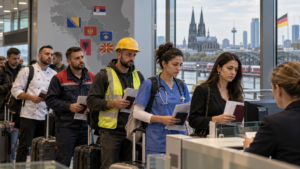
Germany will reduce the annual limit for admitting workers under the Westbalkanregelung programme from 50,000 to 25,000 people, which will affect citizens of six Western Balkan countries at once — Albania, Bosnia and Herzegovina, Kosovo, Montenegro, North Macedonia and Serbia, the Experts Club analytical center reports, citing data from the German government and the Federal Employment Agency.
The new limit is to take effect from 2027 and effectively means a return to the level that existed before June 2024, when Germany doubled the annual quota from 25,000 to 50,000 people.
Westbalkanregelung has been in force since 2016 and is a special mechanism providing citizens of the Western Balkans with access to the German labor market.
The main difference between the programme and many other channels of labor migration is that it applies not only to qualified specialists. A citizen of one of the six countries can obtain permission to work in Germany if they have a specific job offer from a German employer, while recognition of professional qualifications in Germany is generally not a mandatory requirement.
Regulated professions, such as doctors, remain an exception, as separate qualification recognition requirements apply to them.
It is precisely because of this that Westbalkanregelung has become one of the most accessible channels of legal labor migration from the region to Germany.
At the same time, there are no separate national quotas for Serbia, Albania, Bosnia and Herzegovina, Kosovo, Montenegro or North Macedonia. The limit is common to all six countries, so reducing it to 25,000 people will mean increased competition among applicants from across the region.
Demand for the programme already significantly exceeds supply.
According to Germany’s Federal Employment Agency, demand continued to grow after the quota was increased to 50,000 places. In December 2025 alone, the agency had to reject around 18,000 applications because the annual limit had already been exhausted.
At the same time, the scale of labor migration from the Western Balkans significantly exceeds the figures directly related to this programme.
The Federal Employment Agency notes that, among the relevant category of foreign workers, citizens of Albania, Bosnia and Herzegovina, Kosovo, Montenegro, North Macedonia and Serbia account for around a quarter of all employees in Germany covered by social insurance who have a residence permit or permanent residence based on employment.
Thus, over the past decade, the Western Balkans have become one of the important external sources of labor for the German economy.
“The German decision is interesting because it comes against the backdrop of two opposing trends. On the one hand, the German economy is experiencing a structural shortage of workers and is interested in attracting foreign labor. On the other hand, the state is tightening migration controls and reducing one of the most accessible employment channels for citizens of the Western Balkans,” said Maksym Urakin, founder of the Experts Club analytical center.
According to Experts Club, the most immediate consequence of the quota reduction may be increased competition for permits among citizens of the six countries.
If demand already exceeded supply with a limit of 50,000 places, halving the quota could potentially increase waiting times and the share of applicants who will not be able to use the programme in a particular calendar year.
At the same time, the Westbalkanregelung mechanism itself is not being closed. Citizens of the region will still be able to work in Germany through other labor migration channels provided for by law if they meet the established requirements.
Germany’s decision is also of particular interest from the demographic perspective of the Western Balkans themselves. Serbia, Bosnia and Herzegovina, North Macedonia, Albania, Montenegro and Kosovo have for many years been sources of labor migration to EU countries, primarily Germany, Austria and other Western European economies.
For the countries of the region, the mass outflow of the working-age population has a dual effect. Remittances from citizens working abroad support household incomes and domestic consumption, but at the same time emigration increases labor shortages within the Balkan economies themselves.
The outflow of medical personnel, construction workers, drivers, technical specialists, service-sector employees and other categories that are in demand both in Germany and in the domestic labor markets of the countries of the region remains particularly sensitive.
“For the Western Balkans, Germany’s decision may somewhat reduce one of the channels of labor outflow, but it is unlikely by itself to substantially change migration processes. The difference in wages and employment opportunities between Germany and most of the region remains the main economic driver of migration,” Urakin believes.
The reduction of Westbalkanregelung is part of a broader adjustment of the German government’s migration policy. Among its objectives, the cabinet lists reducing irregular migration, expanding the list of safe countries of origin, increasing the number of returns and introducing stricter regulation of migration flows.
At the same time, Berlin continues to emphasize the need for legal migration for the German labor market.
This creates a certain paradox: Germany is restricting one of the most in-demand regional channels of labor migration at precisely the moment when population ageing and staff shortages are forcing the German economy to search more actively for workers outside the country.
For the Western Balkans, the consequences are also ambiguous. The quota reduction potentially reduces opportunities for new labor emigration, but at the same time may somewhat reduce pressure on national labor markets, which themselves face worker shortages.
The key indicator of the effectiveness of the decision will be how quickly the new quota of 25,000 permits is exhausted after its introduction. If demand remains at its current level, Westbalkanregelung will effectively become a significantly more competitive channel of access to the German labor market.
The Westbalkanregelung programme has been in force in Germany since 2016 and applies to citizens of Albania, Bosnia and Herzegovina, Kosovo, Montenegro, North Macedonia and Serbia. In mid-2024, the annual limit was increased from 25,000 to 50,000 people. The German government has decided to limit it again to 25,000 permits per year.
Sources: Federal Government of Germany, Federal Employment Agency of Germany.
EMPLOYMENT, GERMANY, Labor market, MIGRATION, Western Balkans

In 2024, nearly 31.6 million jobs in European Union countries were supported by final demand for European goods and services from non-EU countries, Eurostat reported on July 20, 2026.
This figure represents 14.4% of total employment in the European Union. In 2010, external demand supported 22.6 million jobs, or 11.5% of employment. Thus, over the course of 14 years, the number of jobs linked to foreign consumers increased by approximately 9 million.
Gross value added generated in the EU as a result of final consumption and investment outside its borders rose from EUR1.3 trillion in 2010 to EUR2.788 trillion in 2024. Its share of the EU economy’s total value added rose from 13.3% to 17.2%.
The United States remains the largest external market for the European economy. U.S. demand supported approximately 6 million jobs in the EU, or 19.1% of all employment linked to final demand outside the bloc. The United States also accounted for EUR585.8 billion in value added—21% of the total.
The United Kingdom generated demand that supported 3.4 million jobs in the European Union, or 10.6% of the corresponding employment. China ranked third with 3.1 million jobs and a 9.8% share. However, in terms of value added generated, China, at EUR289.8 billion, outpaced the United Kingdom, which stood at EUR276 billion.
Swiss demand supported approximately 1.5 million jobs in the EU and generated EUR126.6 billion in value added.
Eurostat’s calculations are based on the FIGARO cross-country tables and take into account not only employees of companies that directly export products but also employment across the entire production chain—including suppliers of raw materials, components, and services. External final demand refers to goods and services purchased outside the EU for consumption or investment.
Eurostat also provides a broader measure of the impact of exports, which includes intermediate goods and services: in 2024, exports to countries outside the EU supported 32.9 million jobs, or 15% of total employment, and generated EUR2.905 trillion in value added.
The growing dependence of European employment on external markets highlights the importance of the EU’s trade relations with the United States, the United Kingdom, and China. Potential tariffs, trade restrictions, or a decline in demand in these countries could affect not only European exporters but also companies operating within their associated supply chains.
EMPLOYMENT, EUROPEAN UNION, Eurostat, EXPORTS, UNITED STATES

Employers offered jobs to 1,554 Ukrainians aged 50 and older as part of the government’s “Experience Matters” program; as of June 22, 2026, 841 participants had successfully found employment, and another 713 are currently undergoing internships.
According to a statement on the website of the Ministry of Economy, Environment, and Agriculture of Ukraine, more than 2,300 candidates have joined the initiative overall, while employers have posted nearly 2,600 job openings.
Kyiv, as well as the Lviv, Kharkiv, Mykolaiv, and Zaporizhzhia regions, have shown the highest activity in terms of the number of candidates. The regions with the highest number of job openings are Kyiv, Lviv, Kharkiv, Zaporizhzhia, and Rivne. The greatest demand is for salespeople of food and non-food items, accountants, drivers, unskilled laborers, cooks, office cleaners, security guards, seamstresses, janitors, and administrators.
The ministry notes that, given the labor shortage, workers aged 50 and older are an important group for the labor market; however, some of them face age-based stereotypes, the need to update their skills, or difficulties after a long break from work. To overcome these barriers, the program combines career counseling, assistance from the employment service, internships, and direct contact with employers.
Training, which began in the second half of June, is a separate component of the program. Specifically, the course on collaboration in intergenerational teams attracted 1,350 registrations, the course on digital tools and artificial intelligence (AI) received 1,100 applications, and the course on career strategy drew 883 applications.
The ministry added that the Ministry of Economy, the State Employment Service (SES), the Astarta agro-industrial holding, the Zhiznelub Charitable Foundation, the Federation of Employers of Ukraine (FEU), as well as the multi-donor initiative Skills4Recovery, Skills Alliance, and other partners are involved in implementing and funding the program.
As previously reported, the Ministry of Economy, Environment, and Agriculture, together with its partners, launched the “Experience Matters” internship project for adults on May 11, 2026. The initiative is being implemented as part of the National Accessibility Strategy for 2026 and aims to address the labor shortage that, according to the EBA, affects 75% of companies in Ukraine. The project model is based on three components: a training program to update resumes and prepare for job interviews; face-to-face meetings with business representatives to discuss collaboration opportunities; and a hands-on internship lasting up to 10 days to assess mutual compatibility before making a hiring decision.

Germany is losing industrial jobs at an accelerated rate – and this is no longer a localized slump, but a steady trend. According to a fresh study by EY, the industry cut employment by 2.1% over the year, with the auto industry losing about 51,500 jobs (-6.7% year-on-year). Weak demand, expensive energy, competition from Asia, US duties and the expensive transition to electric vehicles are squeezing margins and forcing concerns to optimize staffing levels. In Q2 2025, industry revenue fell 2.1% YoY to €533bn, continuing a series of quarterly declines.
Structurally, the auto sector was the hardest hit, but contractions are also evident in mechanical engineering and metals, while chemicals and pharma are showing relative stability, as evidenced by both public excerpts from the EY barometer and industry commentary in the German business press. In aggregate, German industry has shed around a quarter of a million jobs since 2019, reflecting the cumulative effect of several consecutive shocks.
Operational metrics point to a sluggish cycle, with new orders in manufacturing falling in June and annualized turnover declining; this combination usually signifies weakness over the horizon of the coming quarters, even if individual months produce technical bounces in production. At the macro level, this is combined with a fall in GDP in Q2 and a downward revision of the dynamics of the beginning of the year.
The political backdrop has become tougher, with Chancellor Friedrich Merz openly stating that the current welfare state model is “unfundable” without reforms, signaling a possible shift in budget priorities in favor of incentives for employment and industrial competitiveness. For business, this means less room for “inertia” subsidies and more pressure on productivity, R&D and export adaptation.
What this means for companies and the labor market. Automakers and their supply chain will likely face a second wave of restructuring to accommodate the EV economy and US tariff geopolitics; engineering will continue to lose low-margin positions to Asian competitors, and growth will shift to high-engineering value-added niches. For chemicals and pharma, the window of resilience is preserved through contractual models and pricing power, but energy-intensive segments remain vulnerable to spot gas and electricity disruptions. The labor market will be “two-speed”: release on the assembly line and in basic metalworking in parallel with a shortage of specialists in automation, electronics, software, battery technologies and chemical technologies – this is already evident in the structure of vacancies and industry surveys.
Conclusion. The job cuts are not the “end of industry” but a painful realignment: Germany is losing mass jobs where it is losing out on costs and is trying to retain and grow employment in capital- and knowledge-intensive segments. The key to a turnaround is cheaper energy, faster permitting procedures, prioritization of industrial investments and retraining for the electric and digital agenda. In the meantime, order and turnover statistics signal that the bottom of the cycle has not yet been passed.
https://t.me/relocationrs/1332

52% of employers believe that psychological problems and behavioral peculiarities hinder the employment of veterans with disabilities, according to the research of the charitable foundation “You are with us”.
In particular, when asked what peculiarities of veterans with disabilities hinder their employment, 24% of employers answered that there are no peculiarities, 52% noted psychological problems and behavioral peculiarities, 19% – alcoholism and drug use, and 5% believe that veterans with disabilities should receive assistance from the state so that there is no need to work.
Also, when asked what incentives the employer needs from the state to employ a veteran with a disability, respondents most often named: compensation for the cost of equipping workplaces for the needs of an employee with a disability; benefits for the payment of unified social tax; and subsidies for each such employed employee.
The survey was conducted in April-July 2023. In the course of the research 468 managers and owners of small, medium and large enterprises in all regions of the country and different sectors of the economy were interviewed. Surveys were conducted under conditions of anonymity by telephone questionnaire. It is noted that 18% of surveyed enterprises have more than 100 employees, 28% – up to 100 employees and 54% – up to 20 employees.
disability, employer, EMPLOYMENT, psychological problems, ветеран



