

Ukraine’s first municipal specialized driving school for veterans with musculoskeletal disorders has opened in Kyiv; the first class currently has 17 students, according to the capital’s mayor, Vitali Klitschko.
“We’ve opened Ukraine’s first municipal specialized driving school in the capital for veterans with disabilities who have musculoskeletal disorders, particularly as a result of limb amputations. This is another important element of the city’s support system for defenders,” he wrote on Telegram on Tuesday.
The mayor noted that the driving school has already passed an inspection of its training facility, and specially equipped vehicles have been provided for practical lessons toward a Category B license.
“They were provided at my request by the Dzhurinsky Family Charitable Foundation. Thank you for your support! I would also like to thank the Ministry of Internal Affairs Service Center for its guidance and assistance in implementing this project,” Klitschko said.
According to him, the first class of 17 veterans has now been formed. Here, participants can learn to drive from scratch, obtain a driver’s license, or—if they had driving experience prior to their injury—undergo retraining to master driving a vehicle with adaptive equipment, including hand controls. Training is conducted by certified instructors. An important principle is “peer-to-peer.” The instructors include veterans who have completed the necessary training, passed the exams, and earned the right to teach others. For those who have difficulty getting to the training location on their own, the Kyiv Military Hub provides a transportation service.
“We will continue to expand the range of training programs. In the future, the courses will be open to all people with disabilities who require specialized training,” Klitschko said.
Klitschko also noted that a comprehensive approach to veterans’ automotive mobility is currently being developed. Specifically, upon completion of the training, the city may help partially subsidize the purchase of a car, partially subsidize its retrofitting to meet the individual’s needs, and assist with retraining and employment.
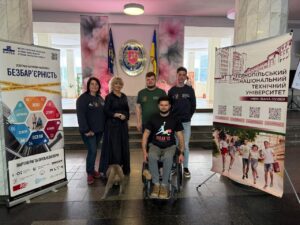
In Ukraine, accessibility is increasingly viewed not as a formal requirement for infrastructure, but as a systemic prerequisite for veterans and people with disabilities to return to active life, work, education, and participation in community development.
This is discussed in an article on the Events.org.ua platform dedicated to the All-Ukrainian Accessibility Week, which took place in May 2026.
The initiative arose from the personal experience of veteran Vadym Honcharenko, call sign “Kinolog,” who uses a wheelchair after being wounded. His son, Artem Goncharenko, and the project team emphasize that for people with disabilities, barriers include not only obvious obstacles but also dozens of small design choices in urban spaces: stairs with no alternative, dangerous ramps, curbs, narrow doors, a lack of elevators, or improperly designed tactile paving.
According to the organizers, it is precisely this experience that shows accessibility cannot be achieved through a “trial-and-error” approach by people with disabilities themselves. Every flawed architectural or service-related decision can pose a risk of falls, injuries, additional pain, or complications for them.
As part of the All-Ukrainian Accessibility Week, the focus was not on declarations but on practical actions. The initiative was joined by Kyiv National University of Construction and Architecture, Igor Sikorsky Kyiv Polytechnic Institute, Ivan Pul’uj Ternopil National Technical University, National University of Life and Environmental Sciences of Ukraine, the National University of Physical Education and Sports of Ukraine, the Drohobych National Pedagogical University, the Kyiv City Employment Service, the KNUBA Institute for Veterans, the Veterans Cluster of Ukraine, the Agency for the Reconstruction of Ukraine, business partners, and civil society organizations.
In May and June, a training course titled “Rights of People with Disabilities” also began; the organizers stated that its goal was not only to raise awareness but also to change approaches to decision-making. The program emphasized non-discriminatory procedures, appropriate communication, and a practical understanding of the needs of people with disabilities.
A separate module was dedicated to assessing the accessibility of urban spaces. On May 26, in the Teremky-2 neighborhood, participants, together with people in wheelchairs, followed actual routes to identify where formal accessibility measures were failing and which solutions required immediate change. Based on the results of this work, preliminary design solutions for KNUBA and NUFVSU were developed in collaboration with the Mlyn group of companies and the Shaw architectural firm.
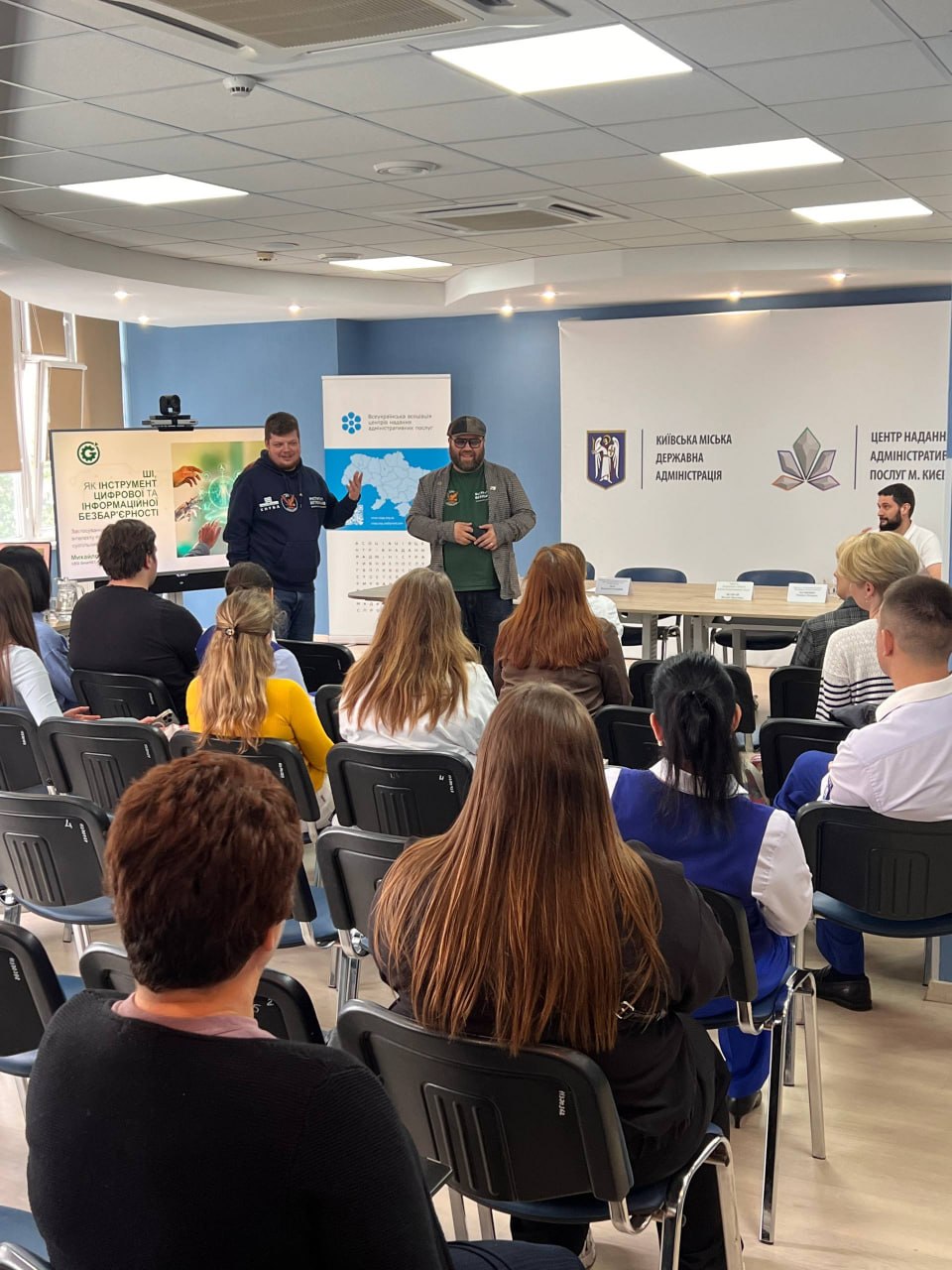
Another area of focus was the topic of Smart City. The organizers emphasize that a smart city without accessibility becomes a service available only to a portion of its residents. Therefore, digital solutions, navigation, transportation, and urban services must be designed with the needs of veterans, people with disabilities, older adults, parents with children, and other population groups in mind.
A separate training session was held for employees of Kyiv’s Administrative Service Centers (ASC) on working with veterans and people with disabilities, crisis communication, and the use of AI tools in service delivery. The organizers also identified the following training areas: safety and first aid.
Neurologist Denys Boichuk led practical training sessions on first aid and how to respond to epileptic seizures. Participants in the initiative emphasize that accessibility applies not only to physical spaces but also to people’s readiness to act appropriately in critical situations.
According to the organizers, Ukraine already possesses the expertise, partnerships, and practical experience needed to develop an accessible environment; however, such efforts cannot be limited to isolated events. They must become an integral part of daily decision-making in the areas of management, education, architecture, and services.
The article also notes that the “Architecture of Resilience” Veterans Institute at KNUBA and the Veterans Cluster of Ukraine continue to develop educational opportunities for veterans, defenders, and their family members. These include training, retraining, courses, second higher education, master’s programs, doctoral studies, psychological support, rehabilitation, and participation in projects aimed at Ukraine’s recovery.
Partner universities in the initiative include KNUBA, the National University of Physical Education and Sports of Ukraine, the Western Ukrainian National University, Poltava Polytechnic, the Precarpathian National University, NUBiP, the Drohobych Pedagogical University, Igor Sikorsky Kyiv Polytechnic Institute, Ivan Pul’uj Ternopil National Technical University, and the University of Educational Management.
The organizers emphasize that “tuition-free education” refers to participation in state compensation programs, grants, scholarships, and support from employers. Admissions take place during the standard dates of the main admissions campaign.
The All-Ukrainian Accessibility Week demonstrated that, for post-war Ukraine, accessibility should not be a separate social initiative, but rather an integral part of economic recovery, the labor market, education, urban planning, and service policy. Given the number of veterans and people returning to civilian life after injuries, such decisions will have a direct impact on employment, quality of life, and communities’ capacity for recovery.
accessibility, BARRIER-FREE, disability, GONCHARENKO, RECOVERY, ветеран
52% of employers believe that psychological problems and behavioral peculiarities hinder the employment of veterans with disabilities, according to the research of the charitable foundation “You are with us”.
In particular, when asked what peculiarities of veterans with disabilities hinder their employment, 24% of employers answered that there are no peculiarities, 52% noted psychological problems and behavioral peculiarities, 19% – alcoholism and drug use, and 5% believe that veterans with disabilities should receive assistance from the state so that there is no need to work.
Also, when asked what incentives the employer needs from the state to employ a veteran with a disability, respondents most often named: compensation for the cost of equipping workplaces for the needs of an employee with a disability; benefits for the payment of unified social tax; and subsidies for each such employed employee.
The survey was conducted in April-July 2023. In the course of the research 468 managers and owners of small, medium and large enterprises in all regions of the country and different sectors of the economy were interviewed. Surveys were conducted under conditions of anonymity by telephone questionnaire. It is noted that 18% of surveyed enterprises have more than 100 employees, 28% – up to 100 employees and 54% – up to 20 employees.
disability, employer, EMPLOYMENT, psychological problems, ветеран
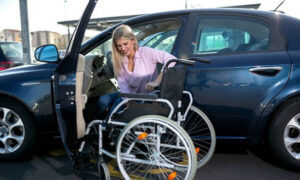
An inclusive driving school has started operating in the village of Vita-Poshtova on the basis of the National Academy of Internal Affairs (Educational and Research Institute No. 1), the Kyiv City State Administration reports.
According to a statement on the KCSA website, “at the driving school, people with disabilities can receive services to study theory and gain practical driving skills; pass theoretical and practical exams, and then get a driver’s license.”
If necessary, people can also retrain or acquire the skills to drive a manual car.
In addition, both individual and mixed group training is possible, and it is also possible to learn theory online. The driving school’s curricula are adapted to the needs of people with disabilities, and training and exams will be held in inclusive facilities.
In total, 11 weeks are allocated for training, including 4 weeks of theory and 7 weeks of practice. Up to 30 people study in one group.
To enroll in a driving school, you must pass a medical and social commission and receive a certificate of the cause and group of disability, as well as undergo a medical examination and receive a certificate of fitness to drive.
Next, you need to choose a driving school and submit the required package of documents to the educational institution. This includes an application addressed to the director of the driving school, a copy of the passport of a citizen of Ukraine or an identity document confirming his or her citizenship or special status, a copy of one of the documents provided for by the Tax Code of Ukraine with data on the registration number of the taxpayer’s account card or a notice of refusal to accept it, a medical certificate and a 3.5 x 4.5 cm color photograph.
Driving schools for people with disabilities operate in Kyiv, Khmelnytskyi, Kirovohrad, Lviv and Dnipro regions.

Only 16% of persons with disabilities are officially employed in Ukraine, Social Policy Minister Oksana Zholnovych has said.
“The existing system of employment of persons with disabilities, based on the quota principle and the system of penalties, is ineffective. As a result, only 16% of persons with disabilities are officially employed in Ukraine, while in Europe this figure reaches more than 55%”, – the press service of the ministry said with reference to Zholnovych.
According to her, the draft law No. 5344 developed by the Ministry of Social Policy, which is already being considered in the Verkhovna Rada, is intended to create new opportunities for employment of persons with disabilities.
“First of all, the bill No. 5344 is intended to increase inclusion in society, to make the conditions equal for everyone. Because today the situation is that – mainly in private business – there is a quota for the employment of people with disabilities. And if it is not met, the private sector pays a so-called “administrative economic sanction” once a year. And there are already many cases of bypassing and non-payment, employers are afraid to hire people with disabilities because they do not know how to do it, there is no systematic support and assistance to adapt such a person in the team,” said the minister.
According to her, abolishing such practices, the bill proposes three options for employers: pay an unconditional earmarked contribution to support the employment of people with disabilities; hire people with disabilities themselves and get support; buy the product from social enterprises that have already employed 50 percent or more of people with disabilities.
“Thus, the emphasis is on ensuring decent working conditions for people with disabilities, accumulating a resource and expanding support for social enterprises,” the report says.
Another problem that the bill solves, Zholnovich said, is the impossibility of state support for entrepreneurs who hire people with disabilities but whose founders are not public organizations.
“Today under the law, support from the state is only possible if the founder is a public organization. So we remove this restriction and say: any employer who hires 50 or more people with disabilities can count on support and benefits. Socially oriented business will create new, socially protected jobs,” the Minister stressed.



