
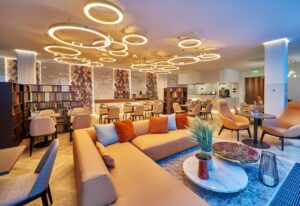
The international hotel management company Ribas Hotels Group (RHG) has joined the nationwide project to promote hotel accessibility, “Space with Opportunities.” WOL.GREEN Polyana has undergone an independent audit, the group’s press service reported.
“Today, accessibility is no longer a competitive advantage that sets a hotel apart from others, but rather a basic requirement for all market players. Amid the war, the number of people with amputations and disabilities is growing, and businesses must ensure equal opportunities for all,” notes Anastasia Ocheretnyuk, PR Lead at Ribas Hotels Group, whose remarks are quoted in the press release.
Inclusivity requirements under Ukraine’s State Building Codes (DBN) are constantly being raised (the latest changes took effect on August 1, 2025; work is currently underway on a new edition—IF-U), and it is not always possible to fully implement these innovations in existing projects. In particular, in the existing hotels of the RHG chain, accessibility has so far been implemented mainly in part—through individual elements such as adapted rooms, ramps, or elevators, the press service explains. Accessibility is being incorporated more comprehensively into new projects that the group is building from the ground up, particularly at “WOL Vinnytsia” and AMA Family Resort, where relevant solutions are planned as early as the design phase.
To assess how truly accessible these solutions are in practice, the Ribas Hotels Group participated in Metro Ukraine’s special project “Space with Opportunities,” carried out in collaboration with the nonprofit organization “Dostupno.UA,” during which 10 free audits of hospitality establishments across Ukraine were conducted. The project’s goal is to help HoReCa businesses create accessible spaces for guests and staff amid the growing number of people with disabilities in Ukraine as a result of the war—a number that, according to rough estimates, could reach 300,000–400,000 people in the post-war period.
The RHG network selected the WOL.GREEN Polyana Hotel for the audit; the company had renovated this unfinished building while the full-scale war was still underway, which allowed it to incorporate some accessibility standards right from the construction phase. The audit confirmed a number of implemented solutions: barrier-free common areas, a reception desk with two service areas, a universal restroom with standard handrails, and an elevator that complies with regulations. At the same time, the experts provided the hotel with recommendations on how to design a guest room adapted for guests with disabilities.
According to Tetyana Morozova, head of the architecture division at TEMO Design, incorporating barrier-free solutions into a project from the very beginning is always less expensive than retrofitting a completed facility. At the same time, inclusivity is not limited to the width of passageways or ramps, but encompasses the guest’s entire journey through the hotel: navigation, lighting, acoustics, and psychological comfort.
Ribas Hotels Group was founded in 2014 in Odesa as an international full-cycle management company and a hotel business ecosystem. It manages the entire process: from site selection, design, and construction to management, franchising, and investment. It is the only hotel group in Ukraine that independently handles all stages of creating and developing hotel projects.
The company’s portfolio includes 56 projects currently in the construction phase, launch phase, or under management, including locations in Ukraine, Poland, Turkey, and Bali. It develops 3-, 4-, and 5-star city and resort hotels under the brands Ribas Hotels, Ribas Rooms, WOL home + hotel, and Mandra Moments. The operator’s total room inventory exceeds 1,000 rooms.
accessibility, AUDIT, HOTEL, inclusivity, RIBAS HOTELS GROUP
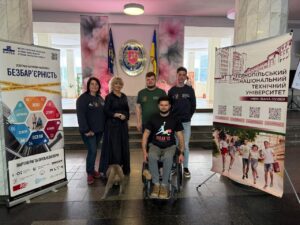
In Ukraine, accessibility is increasingly viewed not as a formal requirement for infrastructure, but as a systemic prerequisite for veterans and people with disabilities to return to active life, work, education, and participation in community development.
This is discussed in an article on the Events.org.ua platform dedicated to the All-Ukrainian Accessibility Week, which took place in May 2026.
The initiative arose from the personal experience of veteran Vadym Honcharenko, call sign “Kinolog,” who uses a wheelchair after being wounded. His son, Artem Goncharenko, and the project team emphasize that for people with disabilities, barriers include not only obvious obstacles but also dozens of small design choices in urban spaces: stairs with no alternative, dangerous ramps, curbs, narrow doors, a lack of elevators, or improperly designed tactile paving.
According to the organizers, it is precisely this experience that shows accessibility cannot be achieved through a “trial-and-error” approach by people with disabilities themselves. Every flawed architectural or service-related decision can pose a risk of falls, injuries, additional pain, or complications for them.
As part of the All-Ukrainian Accessibility Week, the focus was not on declarations but on practical actions. The initiative was joined by Kyiv National University of Construction and Architecture, Igor Sikorsky Kyiv Polytechnic Institute, Ivan Pul’uj Ternopil National Technical University, National University of Life and Environmental Sciences of Ukraine, the National University of Physical Education and Sports of Ukraine, the Drohobych National Pedagogical University, the Kyiv City Employment Service, the KNUBA Institute for Veterans, the Veterans Cluster of Ukraine, the Agency for the Reconstruction of Ukraine, business partners, and civil society organizations.
In May and June, a training course titled “Rights of People with Disabilities” also began; the organizers stated that its goal was not only to raise awareness but also to change approaches to decision-making. The program emphasized non-discriminatory procedures, appropriate communication, and a practical understanding of the needs of people with disabilities.
A separate module was dedicated to assessing the accessibility of urban spaces. On May 26, in the Teremky-2 neighborhood, participants, together with people in wheelchairs, followed actual routes to identify where formal accessibility measures were failing and which solutions required immediate change. Based on the results of this work, preliminary design solutions for KNUBA and NUFVSU were developed in collaboration with the Mlyn group of companies and the Shaw architectural firm.
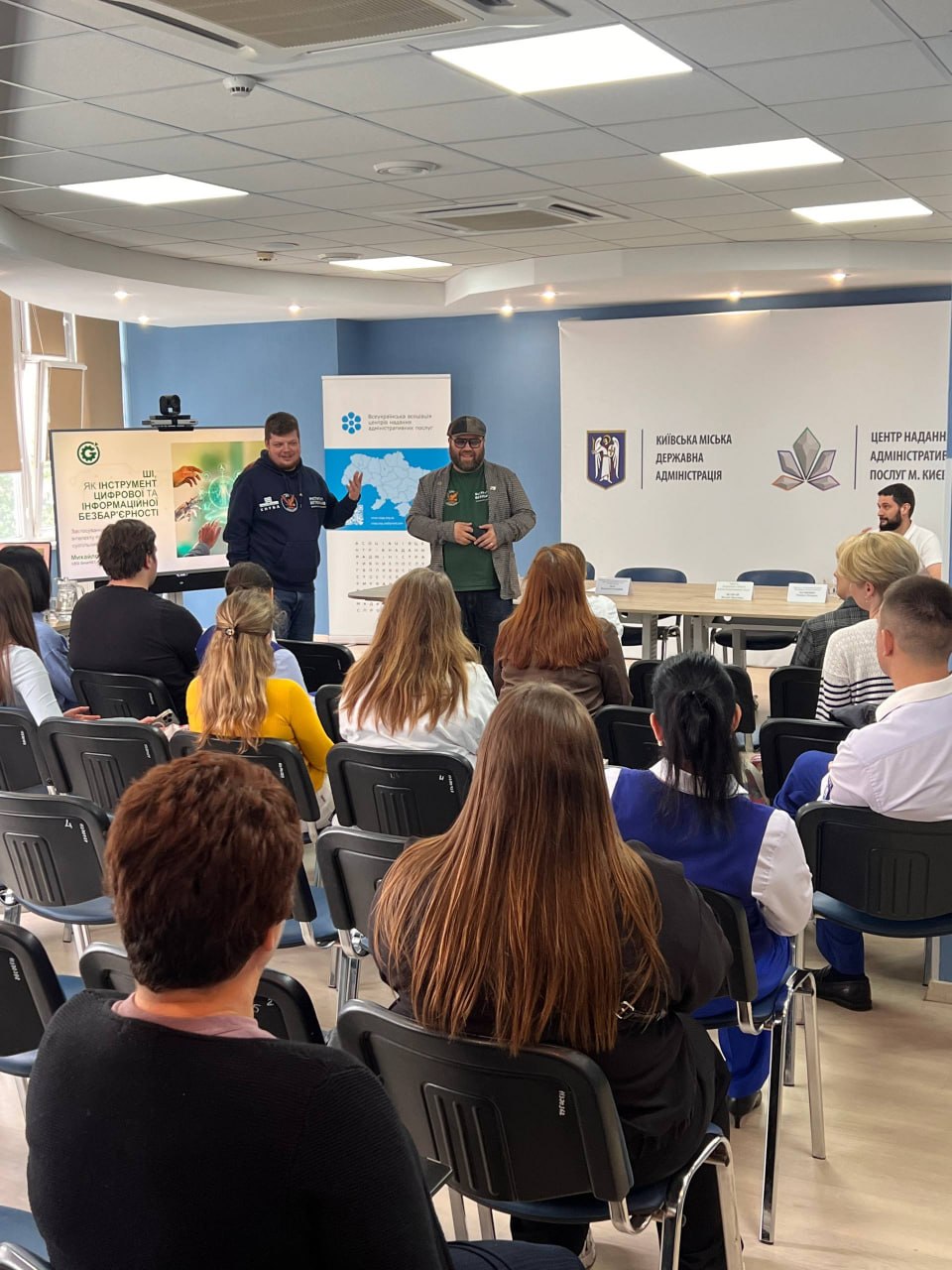
Another area of focus was the topic of Smart City. The organizers emphasize that a smart city without accessibility becomes a service available only to a portion of its residents. Therefore, digital solutions, navigation, transportation, and urban services must be designed with the needs of veterans, people with disabilities, older adults, parents with children, and other population groups in mind.
A separate training session was held for employees of Kyiv’s Administrative Service Centers (ASC) on working with veterans and people with disabilities, crisis communication, and the use of AI tools in service delivery. The organizers also identified the following training areas: safety and first aid.
Neurologist Denys Boichuk led practical training sessions on first aid and how to respond to epileptic seizures. Participants in the initiative emphasize that accessibility applies not only to physical spaces but also to people’s readiness to act appropriately in critical situations.
According to the organizers, Ukraine already possesses the expertise, partnerships, and practical experience needed to develop an accessible environment; however, such efforts cannot be limited to isolated events. They must become an integral part of daily decision-making in the areas of management, education, architecture, and services.
The article also notes that the “Architecture of Resilience” Veterans Institute at KNUBA and the Veterans Cluster of Ukraine continue to develop educational opportunities for veterans, defenders, and their family members. These include training, retraining, courses, second higher education, master’s programs, doctoral studies, psychological support, rehabilitation, and participation in projects aimed at Ukraine’s recovery.
Partner universities in the initiative include KNUBA, the National University of Physical Education and Sports of Ukraine, the Western Ukrainian National University, Poltava Polytechnic, the Precarpathian National University, NUBiP, the Drohobych Pedagogical University, Igor Sikorsky Kyiv Polytechnic Institute, Ivan Pul’uj Ternopil National Technical University, and the University of Educational Management.
The organizers emphasize that “tuition-free education” refers to participation in state compensation programs, grants, scholarships, and support from employers. Admissions take place during the standard dates of the main admissions campaign.
The All-Ukrainian Accessibility Week demonstrated that, for post-war Ukraine, accessibility should not be a separate social initiative, but rather an integral part of economic recovery, the labor market, education, urban planning, and service policy. Given the number of veterans and people returning to civilian life after injuries, such decisions will have a direct impact on employment, quality of life, and communities’ capacity for recovery.
accessibility, BARRIER-FREE, disability, GONCHARENKO, RECOVERY, ветеран

Under a memorandum between the Ministry of Community and Territorial Development of Ukraine and the Kyiv National University of Construction and Architecture, and with the support of the flagship project “Movement Without Barriers,” a team of researchers has developed a pilot AI accessibility consultant in ChatGPT.
The tool helps users quickly obtain basic answers with references to DBN standards, which, in particular, regulate issues of inclusivity and accessibility, as well as advice for specific spaces or situations.
The AI consultant does not replace architects and accessibility experts, but it can serve as a convenient first step to get oriented, verify solutions, or prepare for working with specialists.
“For me, the topic of accessibility isn’t an abstract policy, but a personal story. My dad is a veteran with a disability who uses a wheelchair, and every day I see the barriers he faces. That is why the launch of the AI accessibility consultant is an important step toward making spaces in Ukraine truly accessible, not just ‘on paper.’” — Artem Goncharenko, Accessibility Ambassador at the Ministry of Education and Science
This approach is intended to make the process of creating an accessible environment more systematic, consistent, and understandable for communities, businesses, and everyone who works with public spaces.
The AI consultant is constantly updated with materials and technical data. The project is coordinated by the KNUBA Veterans Institute and the KNUBA Expert Working Group on Accessibility. If you have any questions while using the tool, please contact us at: veterano@knuba.edu.ua.
The materials generated by the AI Consultant are for informational purposes only. It is recommended to verify the information in accordance with current regulations and consult with specialists if necessary.



