
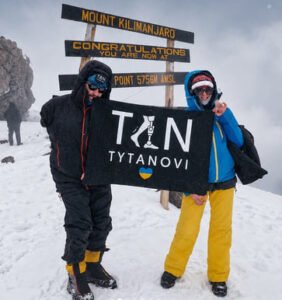
The Ukrainian documentary project “The Summit of Freedom,” which focuses on rehabilitation and the return to a full life after severe war-related injuries, has received a number of awards and has been selected to participate in international film festivals.
According to the project team, the film has already been named an Award Winner, Official Selection, and Semi-Finalist at festivals in various countries and cities around the world.
“Every festival award means a new independent jury, a new audience, and yet another confirmation that this story resonates across borders,” the project’s creators noted.
The film’s team emphasizes that its main themes are freedom, resilience, courage, and human dignity.
The documentary film “The Summit of Freedom” was released in 2026. The film was directed and produced by Maria Springis, founder of the London-based production company Dreams Into Reality Production. In her filmography, the project is listed as a 2026 documentary.
One of the film’s confirmed international selections was the Los Angeles Film and Documentary Awards, where “The Summit of Freedom” was included in the Official Selection.
The project tells the story of Ukrainian veteran Stepan Korobkin, who lost his arm as a result of a war injury and underwent 32 surgeries, after which he climbed Kilimanjaro alongside Ukrainian mountaineer Tetiana Yalovchak. The expedition became part of a documentary exploring physical and psychological recovery from a severe injury.
According to the filmmakers, the film tells not only the story of climbing Africa’s highest peak but also of a person’s return to an active life, overcoming the consequences of an injury, and finding a new purpose.
Tetyana Yalovchak previously reported that the film “The Summit of Freedom” has already received more than two dozen international nominations.
The film’s team notes that its festival tour is ongoing, and new screenings and results will be announced later.
Tetyana Yalovchak is a Ukrainian mountaineer, volunteer, and Ukrainian record-holder—the first Ukrainian woman to complete the “Seven Summits” program, which involves climbing the highest peaks on every continent, including Everest.
DOCUMENTARY FILM, film festival, The Summit of Freedom, UKRAINE, ветеран
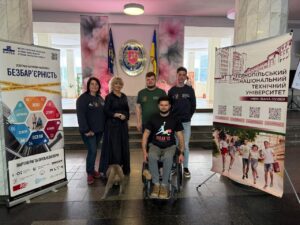
In Ukraine, accessibility is increasingly viewed not as a formal requirement for infrastructure, but as a systemic prerequisite for veterans and people with disabilities to return to active life, work, education, and participation in community development.
This is discussed in an article on the Events.org.ua platform dedicated to the All-Ukrainian Accessibility Week, which took place in May 2026.
The initiative arose from the personal experience of veteran Vadym Honcharenko, call sign “Kinolog,” who uses a wheelchair after being wounded. His son, Artem Goncharenko, and the project team emphasize that for people with disabilities, barriers include not only obvious obstacles but also dozens of small design choices in urban spaces: stairs with no alternative, dangerous ramps, curbs, narrow doors, a lack of elevators, or improperly designed tactile paving.
According to the organizers, it is precisely this experience that shows accessibility cannot be achieved through a “trial-and-error” approach by people with disabilities themselves. Every flawed architectural or service-related decision can pose a risk of falls, injuries, additional pain, or complications for them.
As part of the All-Ukrainian Accessibility Week, the focus was not on declarations but on practical actions. The initiative was joined by Kyiv National University of Construction and Architecture, Igor Sikorsky Kyiv Polytechnic Institute, Ivan Pul’uj Ternopil National Technical University, National University of Life and Environmental Sciences of Ukraine, the National University of Physical Education and Sports of Ukraine, the Drohobych National Pedagogical University, the Kyiv City Employment Service, the KNUBA Institute for Veterans, the Veterans Cluster of Ukraine, the Agency for the Reconstruction of Ukraine, business partners, and civil society organizations.
In May and June, a training course titled “Rights of People with Disabilities” also began; the organizers stated that its goal was not only to raise awareness but also to change approaches to decision-making. The program emphasized non-discriminatory procedures, appropriate communication, and a practical understanding of the needs of people with disabilities.
A separate module was dedicated to assessing the accessibility of urban spaces. On May 26, in the Teremky-2 neighborhood, participants, together with people in wheelchairs, followed actual routes to identify where formal accessibility measures were failing and which solutions required immediate change. Based on the results of this work, preliminary design solutions for KNUBA and NUFVSU were developed in collaboration with the Mlyn group of companies and the Shaw architectural firm.
Another area of focus was the topic of Smart City. The organizers emphasize that a smart city without accessibility becomes a service available only to a portion of its residents. Therefore, digital solutions, navigation, transportation, and urban services must be designed with the needs of veterans, people with disabilities, older adults, parents with children, and other population groups in mind.
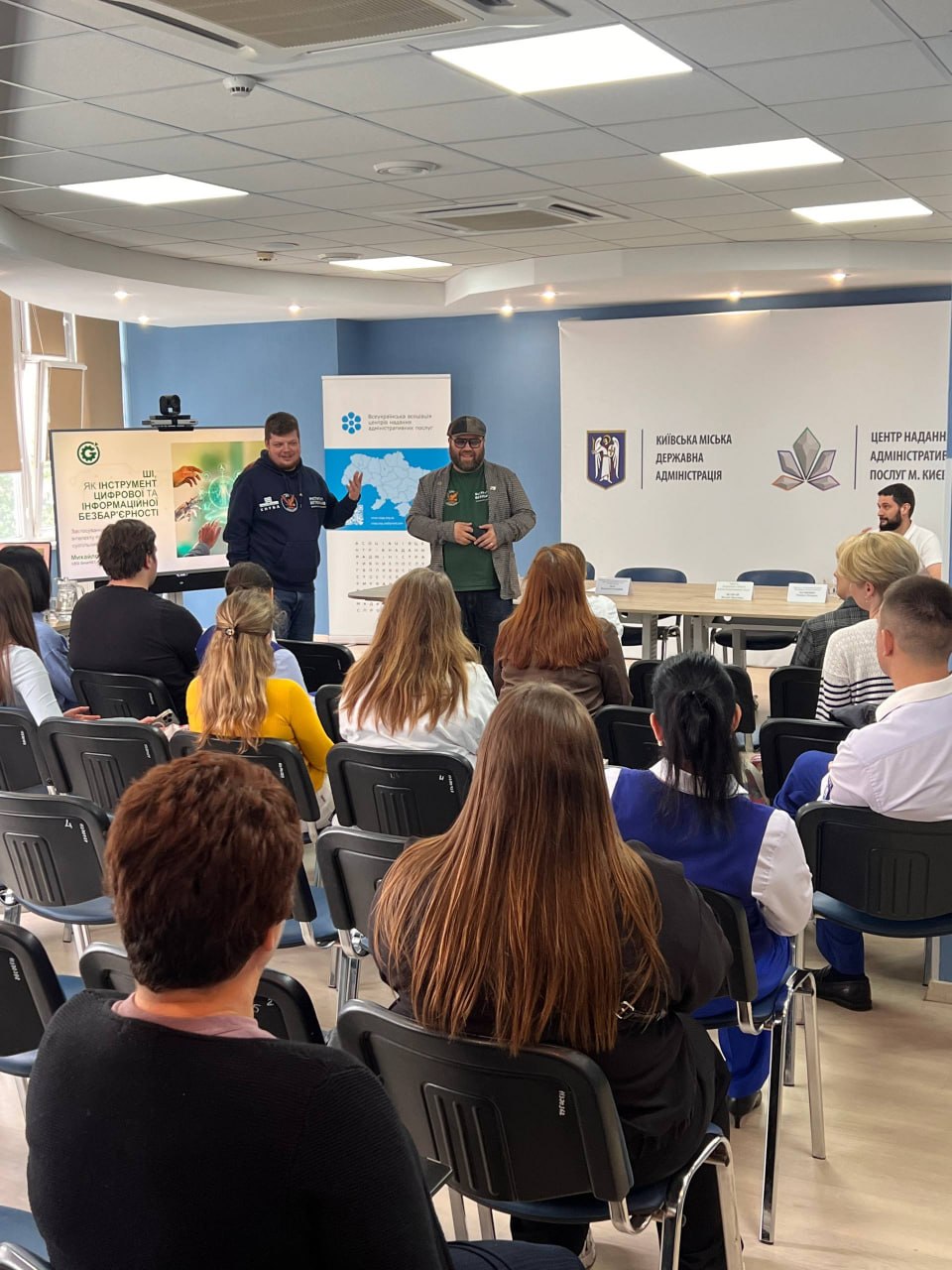
A separate training session was held for employees of Kyiv’s Administrative Service Centers (ASC) on working with veterans and people with disabilities, crisis communication, and the use of AI tools in service delivery. The organizers also identified the following training areas: safety and first aid.
Neurologist Denys Boichuk led practical training sessions on first aid and how to respond to epileptic seizures. Participants in the initiative emphasize that accessibility applies not only to physical spaces but also to people’s readiness to act appropriately in critical situations.
According to the organizers, Ukraine already possesses the expertise, partnerships, and practical experience needed to develop an accessible environment; however, such efforts cannot be limited to isolated events. They must become an integral part of daily decision-making in the areas of management, education, architecture, and services.
The article also notes that the “Architecture of Resilience” Veterans Institute at KNUBA and the Veterans Cluster of Ukraine continue to develop educational opportunities for veterans, defenders, and their family members. These include training, retraining, courses, second higher education, master’s programs, doctoral studies, psychological support, rehabilitation, and participation in projects aimed at Ukraine’s recovery.
Partner universities in the initiative include KNUBA, the National University of Physical Education and Sports of Ukraine, the Western Ukrainian National University, Poltava Polytechnic, the Precarpathian National University, NUBiP, the Drohobych Pedagogical University, Igor Sikorsky Kyiv Polytechnic Institute, Ivan Pul’uj Ternopil National Technical University, and the University of Educational Management.
The organizers emphasize that “tuition-free education” refers to participation in state compensation programs, grants, scholarships, and support from employers. Admissions take place during the standard dates of the main admissions campaign.
The All-Ukrainian Accessibility Week demonstrated that, for post-war Ukraine, accessibility should not be a separate social initiative, but rather an integral part of economic recovery, the labor market, education, urban planning, and service policy. Given the number of veterans and people returning to civilian life after injuries, such decisions will have a direct impact on employment, quality of life, and communities’ capacity for recovery.
accessibility, BARRIER-FREE, disability, GONCHARENKO, RECOVERY, ветеран



