Ukrainian defense startup Swarmer, which went public on the Nasdaq in March of this year (ticker SWMR), reported in its financial statement that in the second quarter of 2026, its net loss increased from $1.6 million in the same period of 2025 to $7.3 million, while revenue rose from $138,200 to $216,000.
“The second quarter of 2026 was our first full quarter as a public company and a period of significant progress across all areas of our business. We successfully attracted new customers and made progress in implementing projects to deploy our solutions on various unmanned platforms, while continuing to invest in the team and technologies necessary to ensure future growth,” the press release quotes company co-founder Alex Fink as saying.
According to the report, the company’s gross profit for the second quarter of 2026 was $183,600, compared to $82,000 in April–June 2025. This growth was primarily driven by licensing revenue recognized under the SkyKnight program.
It is noted that Swarmer’s operating expenses for this reporting period totaled $7.5 million, compared to $854,800 a year ago.
“This increase is primarily due to investments in personnel, engineering development, product creation, and platform integration capabilities, as well as higher expenses for consulting, legal, and professional services related to the company’s operations as a public entity,” the company noted.
Operating expenses for the second quarter of 2026 also included, among other things, approximately $1.2 million in non-cash stock-based compensation expenses and certain one-time expenses for equipment purchases, which are not expected to recur on a regular basis.
The report added that during the second quarter of this year, the company billed drone manufacturer SkyKnight $1.5 million. Specifically, $0.2 million was recognized as revenue, $0.1 million was recorded as deferred revenue, and the remaining amount was recorded as an advance payment on the balance sheet.
The company noted that as of the end of June 2026, cash and cash equivalents had increased to $25.3 million from $9.3 million as of December 31, 2025.
Swarmer explains that this growth was driven by approximately $16 million raised from its initial public offering (IPO), $8.8 million raised under a share-for-equity financing facility, and $3.5 million from the sale of Series A-1 convertible preferred shares.
In April–June of this year, Swarmer also signed a memorandum of understanding (MOU) with the technology company Autonomous Power Corporation (Powerus) to explore the potential integration of Swarmer’s battle-proven software with Powerus’s autonomous aerial and maritime platforms.
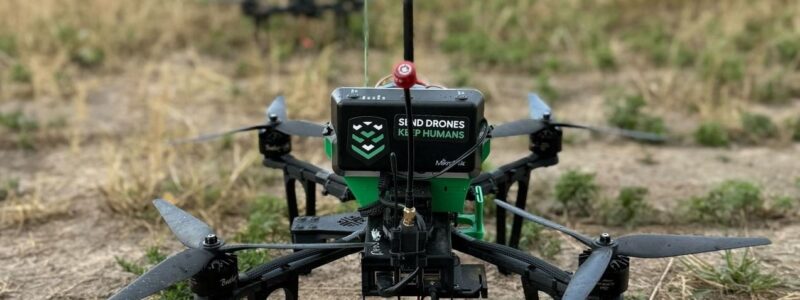
The company’s core areas of activity include autonomous swarm coordination, integration of multi-domain unmanned systems, AI-based collaborative autonomy, and software for commanding and controlling distributed robotic operations, according to the press release. In addition, the company’s clients include drone manufacturers that license Swarmer’s software for integration with their hardware platforms.
As previously reported, Swarmer posted a net loss of $4.5 million for January–March 2026, compared to $0.7 million for the same period in 2025. Revenue fell to $20,300 from $110,700, while operating expenses rose to $4.5 million from $0.8 million.
The company was founded by Serhiy Kuprienko and Alex Fink in May 2023. Its registered headquarters and marketing and sales office are in Austin, Texas, USA, while its engineering divisions are split between offices in Kyiv, Ukraine, and Warsaw, Poland. The company’s holding structure includes “subsidiary” companies in Ukraine, Poland, and Estonia.
Prior to the IPO, Kuprienko held a 27.4% stake and Fink held 15.1%, while other shareholders included Theseus Capital Partners—where Philip Wagenheim, a member of the board of directors, serves as managing partner—with 22%, D3 Fund (Evelyn Buchacki) with 10.1%, RG.AI Technologies, led by Charles Eberle von Sexi, held 14%, Green Flag Fund I held 5.3%, and Radius Fund I held 6.9%
Swarmer’s revenue in 2025 fell to $0.31 million from $0.33 million a year earlier, while its net loss increased to $8.53 million from $2.07 million.