
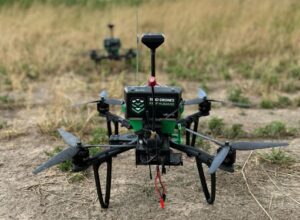
Ukrainian defense startup Swarmer, which went public on the Nasdaq in March of this year (ticker SWMR), reported in its financial statement that in the second quarter of 2026, its net loss increased from $1.6 million in the same period of 2025 to $7.3 million, while revenue rose from $138,200 to $216,000.
“The second quarter of 2026 was our first full quarter as a public company and a period of significant progress across all areas of our business. We successfully attracted new customers and made progress in implementing projects to deploy our solutions on various unmanned platforms, while continuing to invest in the team and technologies necessary to ensure future growth,” the press release quotes company co-founder Alex Fink as saying.
According to the report, the company’s gross profit for the second quarter of 2026 was $183,600, compared to $82,000 in April–June 2025. This growth was primarily driven by licensing revenue recognized under the SkyKnight program.
It is noted that Swarmer’s operating expenses for this reporting period totaled $7.5 million, compared to $854,800 a year ago.
“This increase is primarily due to investments in personnel, engineering development, product creation, and platform integration capabilities, as well as higher expenses for consulting, legal, and professional services related to the company’s operations as a public entity,” the company noted.
Operating expenses for the second quarter of 2026 also included, among other things, approximately $1.2 million in non-cash stock-based compensation expenses and certain one-time expenses for equipment purchases, which are not expected to recur on a regular basis.
The report added that during the second quarter of this year, the company billed drone manufacturer SkyKnight $1.5 million. Specifically, $0.2 million was recognized as revenue, $0.1 million was recorded as deferred revenue, and the remaining amount was recorded as an advance payment on the balance sheet.
The company noted that as of the end of June 2026, cash and cash equivalents had increased to $25.3 million from $9.3 million as of December 31, 2025.
Swarmer explains that this growth was driven by approximately $16 million raised from its initial public offering (IPO), $8.8 million raised under a share-for-equity financing facility, and $3.5 million from the sale of Series A-1 convertible preferred shares.
In April–June of this year, Swarmer also signed a memorandum of understanding (MOU) with the technology company Autonomous Power Corporation (Powerus) to explore the potential integration of Swarmer’s battle-proven software with Powerus’s autonomous aerial and maritime platforms.
The company’s core areas of activity include autonomous swarm coordination, integration of multi-domain unmanned systems, AI-based collaborative autonomy, and software for commanding and controlling distributed robotic operations, according to the press release. In addition, the company’s clients include drone manufacturers that license Swarmer’s software for integration with their hardware platforms.
As previously reported, Swarmer posted a net loss of $4.5 million for January–March 2026, compared to $0.7 million for the same period in 2025. Revenue fell to $20,300 from $110,700, while operating expenses rose to $4.5 million from $0.8 million.
The company was founded by Serhiy Kuprienko and Alex Fink in May 2023. Its registered headquarters and marketing and sales office are in Austin, Texas, USA, while its engineering divisions are split between offices in Kyiv, Ukraine, and Warsaw, Poland. The company’s holding structure includes “subsidiary” companies in Ukraine, Poland, and Estonia.
Prior to the IPO, Kuprienko held a 27.4% stake and Fink held 15.1%, while other shareholders included Theseus Capital Partners—where Philip Wagenheim, a member of the board of directors, serves as managing partner—with 22%, D3 Fund (Evelyn Buchacki) with 10.1%, RG.AI Technologies, led by Charles Eberle von Sexi, held 14%, Green Flag Fund I held 5.3%, and Radius Fund I held 6.9%
Swarmer’s revenue in 2025 fell to $0.31 million from $0.33 million a year earlier, while its net loss increased to $8.53 million from $2.07 million.

OpenAI is considering postponing its initial public offering until 2027, Reuters reports, citing The New York Times.
According to the NYT, the company’s advisors have presented management with two possible scenarios: go public earlier but accept a lower valuation, or wait until 2027 to try to maintain a target valuation of up to $1 trillion.
Sources familiar with the matter told the publication that OpenAI has already hired financial advisors and lawyers to prepare for the IPO and had previously been targeting a listing in the third or fourth quarter of 2026. However, the advisors warned management that, given the volatility of the tech market, investors may be less willing to support a listing at the highest possible valuation.
According to the NYT, OpenAI CEO Sam Altman opposed lowering the target valuation and insisted that the consultants explore the possibility of taking the company public at a valuation of around $1 trillion. OpenAI’s most recent private valuation, according to media reports, was approximately $730 billion.
Reuters also notes that OpenAI had previously considered filing with regulators in the second half of 2026. Initial discussions centered on raising at least $60 billion, though the timing, size of the offering, and valuation could change depending on market conditions and the company’s growth rate.
OpenAI’s potential IPO could become one of the largest offerings in the history of the tech sector and a major test for the entire artificial intelligence market. Investors will evaluate not only revenue growth rates but also spending on computing infrastructure, dependence on major partners, competition with Google, Anthropic, Meta, and other players, as well as the company’s ability to monetize demand for AI services.
The delayed IPO may also send a signal to the broader market: despite high interest in artificial intelligence, investors are becoming more cautious about the valuations of fast-growing AI companies. Following strong growth in the tech sector, the market increasingly demands not only user scale and technological leadership but also a clear financial model.
OpenAI was founded in 2015 and became one of the key players in the global artificial intelligence market following the launch of ChatGPT. The company develops the GPT family of models, enterprise AI products, developer tools, and infrastructure partnerships to scale computing power.
OpenAI, the U.S.-based developer of ChatGPT, has privately filed for an initial public offering in the United States, Reuters reports, citing sources.
According to the agency, the company may be targeting a valuation of up to $1 trillion, and the offering could take place as early as September 2026. However, the specific terms of the IPO, the size of the offering, and the timing of the listing have not yet been officially disclosed.
A potential OpenAI IPO could become one of the largest offerings in the history of the tech sector and a significant test for the artificial intelligence market. Investor interest in AI companies remains high amid growing demand for generative AI, cloud infrastructure, data centers, and computing power.
OpenAI became one of the most prominent companies in the field of artificial intelligence following the launch of ChatGPT in 2022. The service quickly became a mass-market product and intensified competition among the largest tech companies for leadership in generative AI.
OpenAI’s IPO could provide the company with additional capital to develop infrastructure, train new models, and compete with other market players. At the same time, its public status will require the company to demonstrate greater financial transparency and regularly disclose performance metrics to investors.
OpenAI was founded in 2015 as a research organization in the field of artificial intelligence. The company is known for its ChatGPT products, developer APIs, the GPT family of models, image and video generation tools, and corporate AI solutions. Among OpenAI’s key investors and partners is Microsoft, which actively integrates the company’s technologies into its own products and the Azure cloud platform.
OpenAI’s main competitors in the artificial intelligence market include Anthropic, the developer of Claude; Google DeepMind with its Gemini models; Meta with the Llama family; Elon Musk’s xAI with Grok; the French company Mistral AI; as well as Perplexity, Cohere, and a number of other companies developing generative AI, enterprise language models, and AI search.
Competition in the sector is intensifying not only due to the quality of models but also due to access to chips, data centers, corporate clients, and distribution. In this context, OpenAI’s IPO could become not just a financial event but a new phase in the battle for leadership in the global artificial intelligence market.

The global IPO market is showing signs of recovery amid intensified initial public offerings in Asia, analysts believe.
According to calculations of Bloomberg agency, in March and April IPO in the world were carried out to the amount of about $ 25 billion, which almost doubles the figure for the first two months of this year.
Issuers from Hong Kong to Milan saw a window of opportunity as volatility in the markets declined. Activity over the past two months has been particularly buoyant in Asia, with local exchanges accounting for nearly 80% of April’s IPOs. The number of listings in Europe has also increased. Meanwhile, fears of a U.S. recession are scaring away U.S. issuers, slowing the full recovery of the global market.
On average, transaction sizes remain smaller than before. The amount of money raised in IPOs this year is about half what it was during the same period last year.
“We’re starting to see sprouts of activity, companies are resuming processes that were suspended, but there’s still a significant degree of uncertainty in the market,” says Jason Manketo, one of the heads of Linklaters law firm.
“The IPO market is coming back gradually and slowly,” notes Goldman Sachs Asia analyst James Wang. – It’s not back 100% yet, but there are signs of life and energy recovery.”

The draft ownership policy of JSC Ukrzaliznytsia does not envisage a possibility of holding an initial public offering (IPO) for the company, Ukrzaliznytsia Director for Strategic Development and Investment Policy Anton Sabolevsky told reporters on the sidelines of the third International Conference “Railways of Ukraine: Developments & Investments” held in Kyiv. “The draft ownership policy, which is now being considered, does not mention the possibility of an IPO. This is not a question of a year or three, it is more distant. It will definitely not be held in the next five years,” he said.
According to Sabolevsky, in Europe the only successful transaction for holding an IPO for a part of a cargo carrier was in Poland. “Also, there is an example of Doicebahn, which was bought freight operators in the Netherlands, Denmark and partly in Sweden,” he said.
At the same time, according to Sabolevsky, for the next five years, Ukrzaliznytsia needs an additional investment of $6 billion to maintain its assets at current levels.
“If we look at the ratio of capital investment and company revenues, then, to a large extent, we will come to the conclusion that Ukrzaliznytsia must spend about $ 1billion on its capital investment a year. These are the sums which the company announces in its financial plan every year. For example, in 2018, we had a little more than UAH 26 billion of capital investment,” he said.



