
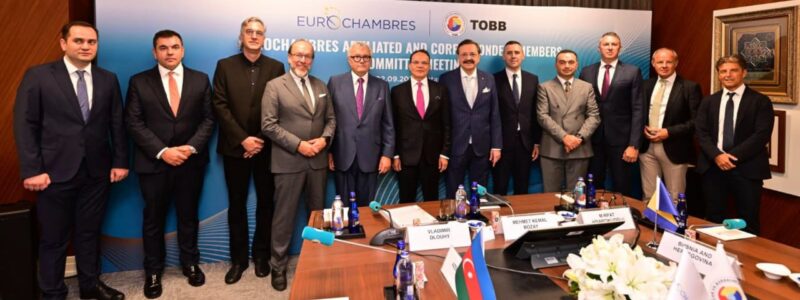
Gennadiy Chizhikov, President of the Ukrainian Chamber of Commerce and Industry, called on European chambers of commerce and industry, companies, and investors to become more actively involved in Ukraine’s economic recovery even before the war ends. This was discussed during a meeting of EUROCHAMBRES’ affiliated and associate members, which took place on September 1–2, 2026, in Istanbul, with the participation of representatives from European business communities.
The meeting was hosted by the Union of Chambers and Commodity Exchanges of Turkey (TOBB). Participants included EUROCHAMBRES President Vladimir Dlouhy, EUROCHAMBRES Vice President and TOBB President Rifat Hisarcıklıoğlu, Turkish Deputy Minister of Foreign Affairs for EU Affairs Mehmet Kemal Bozay, EUROCHAMBRES Director General Ben Batters, as well as the heads of chambers of commerce from Ukraine, Serbia, Georgia, Montenegro, Bosnia and Herzegovina, and other countries.
Key topics of discussion included future EU enlargement, economic relations with candidate countries, the impact of the war in Ukraine on European security, trade, and transport links, as well as the growing role of the Black Sea region in trade, energy, and the supply of critical raw materials.
Participants paid special attention to the development of transport and economic corridors between the EU and Central Asia via Turkey and the South Caucasus. Meeting participants also discussed updating the mechanisms for interaction among EUROCHAMBRES members and strengthening practical cooperation between chambers of commerce.
“For Ukrainian business, European integration is a strategic and irreversible course. EUROCHAMBRES plays a special role as a bridge between Ukrainian and European business, as well as a practical tool for promoting Ukraine’s economic integration into the EU,” Chizhikov noted.
According to him, Ukraine’s progress toward EU membership must be accompanied by a parallel convergence of Ukrainian and European business, the formation of new supply chains, the expansion of trade, and the attraction of European capital to reconstruction projects.
The president of the Ukrainian Chamber of Commerce and Industry emphasized that the country’s economic recovery cannot be postponed until the war ends. Ukrainian enterprises continue to operate amid attacks on production facilities, logistics centers, and commercial infrastructure, so practical support from European partners is needed right now.
“I spoke frankly: how is business holding up in these difficult times, when attacks on business facilities, logistics centers, and retail spaces are not stopping but, on the contrary, are intensifying? It’s not easy to say this out loud in front of colleagues from other countries, but it’s important that they hear it not from the news, but from us directly,” Chizhikov said.
Ukraine is an affiliated member of EUROCHAMBRES. According to the organization’s latest data, EUROCHAMBRES brings together, through its members, a network of approximately 1,700 regional and local chambers of commerce and industry, representing more than 20 million businesses in Europe. More than 93% of the companies represented by this network are small and medium-sized businesses, and together they provide over 120 million jobs. EUROCHAMBRES was founded in 1958 and represents the interests of the business community before EU institutions.
The Ukrainian Chamber of Commerce and Industry is a non-governmental, non-profit, self-governing organization. The Ukrainian Chamber of Commerce and Industry system includes the central chamber and 25 regional chambers of commerce and industry and brings together approximately 8,000 enterprises and entrepreneurs. The Chamber promotes export development and the search for international partners; conducts expert reviews and assessments; issues certificates of origin for goods; and certifies force majeure circumstances. According to the Ukrainian Chamber of Commerce and Industry, it has 70 representatives in 56 countries, has concluded 174 international cooperation agreements, and coordinates 45 bilateral business councils.
#Ukraine #Eurochambres #CCI #business #Europeanintegration




