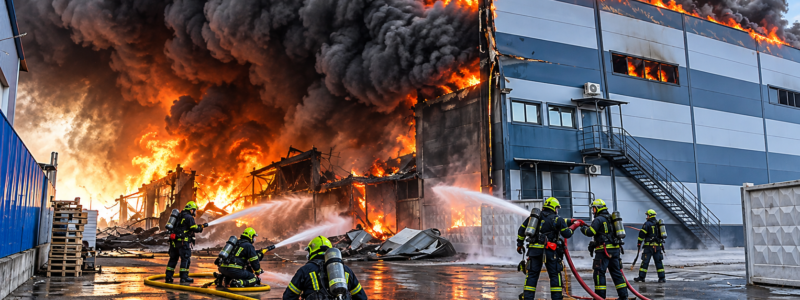
The intensification of Russian attacks on Ukraine’s production, logistics, retail and digital facilities is increasingly affecting not only individual companies, but also the growth potential of the economy as a whole. The destruction of enterprises and critical business infrastructure leads to downtime, disruptions in supply chains, higher logistics costs and the need to direct investment resources toward recovery instead of development, reports the Experts Club information and analytical center.
According to the UN Human Rights Monitoring Mission in Ukraine, in August 2026 alone, at least 32 attacks on facilities belonging to Fozzy Group, Epicentr, Nova Poshta, Rozetka, Aurora and Varus were recorded, compared with 11 in July. This figure concerns only the specified group of companies and does not reflect the total number of attacks on Ukrainian businesses.
Warehousing and transport logistics remain among the most vulnerable segments. In August, large distribution and logistics complexes belonging to Rozetka, NOVUS, MTI Group and EVA were destroyed or seriously damaged as a result of attacks. On August 31, a strike on a Nova Poshta terminal in Odesa destroyed a key sorting line. In September, production, warehouse and digital facilities of a number of companies were also damaged.
Experts Club founder and Candidate of Economic Sciences Maksym Urakin notes that the economic effect of such attacks significantly exceeds the book value of the destroyed property.
“When a distribution center, factory or data center is destroyed, economic losses cannot be calculated solely on the basis of the value of the facility itself. Along with it, part of production output temporarily disappears, supplies to dozens or hundreds of other companies are disrupted, inventories are lost, logistics and insurance costs increase, and businesses are forced to create backup capacity,” Urakin noted.
According to the joint RDNA5 assessment by the Government of Ukraine, the World Bank, the European Commission and the UN, as of the end of 2025, direct damage to Ukraine from the war amounted to $195.1 billion, while recovery needs over the next decade were estimated at $587.7 billion. Direct damage to trade and industry amounted to $19.2 billion, about 85% of which was attributable to industry. At the same time, these estimates do not yet take into account the new destruction of 2026.
The deterioration of the situation has already affected macroeconomic forecasts. In September, the European Bank for Reconstruction and Development lowered its forecast for Ukraine’s real GDP growth in 2026 from 2.2% to 1.5%. Among the factors, the EBRD cited intensified attacks on enterprises, energy infrastructure and Black Sea ports, as well as labor shortages, weak business confidence and logistical constraints. The IMF had previously forecast growth of the Ukrainian economy in 2026 at 1–1.6%.
Experts Club emphasizes that the downgrade of forecasts cannot be explained solely by the physical destruction of enterprises. GDP is affected by the duration of downtime, the volume of lost production, the possibility of relocating production to other sites, the state of the energy sector and the speed of restoring logistics links.
Of particular concern is the displacement of investment in development by recovery expenditures. Enterprises have to simultaneously finance repairs, generators and electricity storage systems, backup warehouses, servers and the relocation of production facilities. This supports business continuity but limits the ability to invest in modernization, capacity expansion and the creation of new jobs.