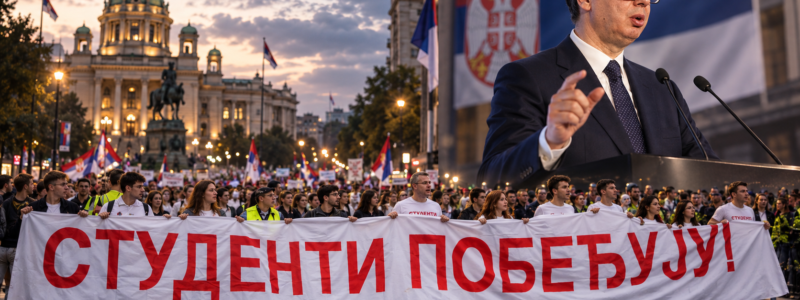
As the Serbian portal Parametar reports in its article, two weeks before the snap parliamentary elections on October 25 in Serbia, published opinion polls continue to show sharply differing pictures of support for the two largest forces — the “Aleksandar Vučić – United Serbia” list and “Students Win”.
The most recent Faktor Plus poll, conducted on September 16–20 with a sample of 986 people, gives Vučić’s list 48.6% and the student list 37.1%. The gap amounts to 11.5 percentage points. In the same survey, Ivica Dačić’s Socialists receive 4.9%, while “European Serbia” receives 3.6%.
However, the NSPM poll published on September 30 shows almost the opposite situation: “Students Win” – 44.4%, “United Serbia” – 41.7%. Moreover, in the previous measurement by the same organization, the figures were 39.6% and 37.5%, respectively.
Thus, the difference between the two latest publicly available surveys is fundamental: one gives the authorities a lead of more than 11 points, while the other gives the students a lead of almost 3 points.
At the same time, the dynamics within the polls themselves are also interesting. At the beginning of September, Faktor Plus estimated Vučić’s list at 47.2% and the students at 31.5%. Just a few weeks later, the students’ figure rose to 37.1%, that is, by 5.6 percentage points, while Vučić’s list gained only 1.4 percentage points.
A separate June survey by CRTA and the Stanford Democracy Action Lab also showed a high degree of political polarization. It recorded significant differences in the views of supporters of the student list and the SNS and confirmed that Serbian society is increasingly dividing into two large political camps.
It is noteworthy that sociologists themselves are now cautious about attempts to determine the exact balance of support. Faktor Plus representative Vladimir Pajić stated on October 1 that the only thing that can be considered sufficiently probable based on the survey data is high voter turnout.
Turnout itself may become one of the key factors on October 25. In the September Faktor Plus survey, 64% of respondents said they would definitely vote, while another 11% were undecided. Among those intending to participate in the elections, 69% already knew exactly whom they would vote for.
Against this background, the campaign is increasingly resembling a referendum between the two largest blocs. Even NSPM researcher Đorđe Vukadinović explicitly spoke of the approaching “referendum atmosphere,” in which the space for third forces is noticeably narrowing.
There will be 18 parties on the ballot on October 25, but the actual struggle for the majority of votes is increasingly concentrated around the two largest political projects.
Source: Parametar, NSPM, CRTA.