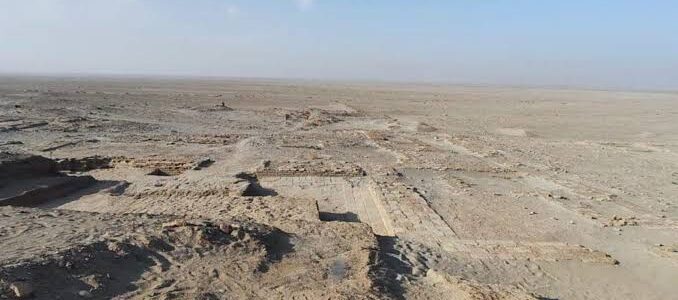
French and Iraqi archaeologists are examining the remains of a bridge dating back approximately 3,800 years, discovered on the site of the ancient city of Larsa in southern Iraq. The structure was built across a large water canal during the Old Babylonian period and attests to the high level of engineering technology in ancient Mesopotamia, according to Arkeonews, citing Iraq’s State Board of Antiquities and Cultural Heritage.
The research is being conducted by a joint French-Iraqi archaeological expedition led by Régis Vallée. The site is located in the Dhi Qar province within the ancient city of Larsa, also known by its modern name, Tell es-Senkere.
The bridge spanned the Great Canal, which was about 22 meters wide and ran through the central part of the city. The structure connected the two banks of the waterway and provided a transportation link between the city’s districts.
During the excavations, archaeologists discovered massive supports made of fired brick, as well as a brick bearing an inscription containing the name of the ruler of Larsa, Sin-iddinam, who reigned approximately from 1849 to 1843 BCE.
The discovery links one of the phases of the bridge’s construction or reconstruction to the reign of Sin-iddinam. This ruler is known for large-scale projects involving the construction and restoration of temples, city walls, and irrigation canals.
Researchers have determined that the bridge was built and rebuilt in several phases. This indicates the structure’s long-term use and changes in the city’s infrastructure in response to the economic needs of the population.
French archaeologists initially identified the remains of the bridge in 2019, and direct excavations of its piers began in 2021. Thus, this report concerns new findings from ongoing research, rather than the discovery of a previously unknown site.
According to Iraqi authorities, archaeologists have so far uncovered approximately half of the structure. Further work should help clarify its design, dimensions, and operational characteristics.
Ancient Larsa was one of the largest economic centers of Mesopotamia
At the beginning of the 2nd millennium BCE, Larsa was an important political, commercial, and religious center of Southern Mesopotamia. The city covered an area of approximately 200 hectares, and its defensive walls stretched for about 5.4 kilometers.
A well-developed system of water canals provided irrigation for agricultural land, facilitated the transport of goods, and ensured communication with neighboring settlements.
Since 2019, archaeologists have identified hundreds of canals, several water basins, and the remains of port infrastructure in and around the city. The bridge across the Great Canal is considered one of the key elements of this transportation system.
In addition to the bridge, an international expedition is studying the city gates, monumental buildings, and residential complexes of the local elite.
In particular, near the Ebabbar Temple, dedicated to the sun god Shamash, researchers are studying an architectural complex covering an area of approximately 7,250 square meters. It is believed that this complex may have served as a temple residence for priestesses, though the final identification of the structure has not yet been completed.
In another area, archaeologists discovered the remains of a large residence containing archival clay tablets linked to a high-ranking official named Etellum.
According to researchers, further study of the finds will provide new insights into the organization of trade, urban administration, religious life, and water management in ancient Mesopotamia.
Mesopotamia is considered one of the oldest centers of world civilization. The first major cities emerged in what is now Iraq, where writing, state institutions, irrigation systems, and organized international trade developed.
Source: Arkeonews, published on November 12, 2026, citing the Iraqi State Board of Antiquities and Cultural Heritage.