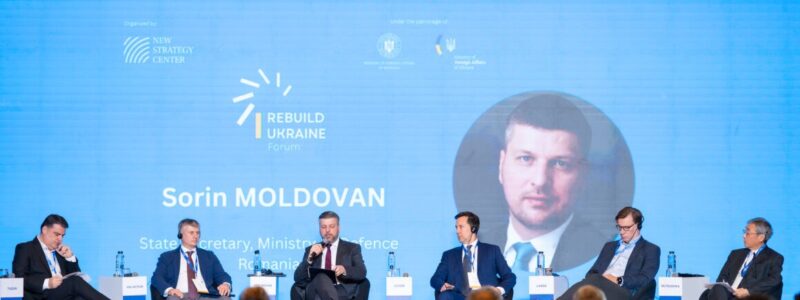
Participants in the panel discussion “Security Perspectives for 2026: Possible Developments” at the Ukraine Recovery Forum in Bucharest concluded that 2026 is shaping up to be a potential strategic turning point for Euro-Atlantic security against the backdrop of the ongoing war in Ukraine, the vulnerability of transatlantic ties, and growing pressure on the EU to strengthen its defense capabilities and strategic autonomy.
The discussion was moderated by Antena 3 CNN journalist Radu Tudor. The panel included Sorin Moldovan, State Secretary of the Romanian Ministry of National Defense; Vadym Halaychuk, First Deputy Chairman of the Verkhovna Rada Committee on EU Integration; Paul Coyer, Professor at the Institute of World Politics (USA), Nico Lange, Senior Research Fellow at the Munich Security Conference, and Shigeo Mutsushika, Executive Director of the Kazankai Foundation and Honorary Professor at Shizuoka University (Japan).
According to the speakers, Europe’s security environment in 2026 will be determined by a combination of several factors: the Russian Federation’s ongoing full-scale invasion of Ukraine, the fragmentation of transatlantic unity, and growing competition between major powers, including the use of hybrid instruments. Against this backdrop, Europe, in their opinion, should play a “more mature strategic role” – not only in the defense sphere, but also in industrial and energy policy.
“European states can no longer take security for granted – they need their own capabilities that will complement, not replace, the transatlantic partnership,” Lange said.
The participants paid particular attention to the stability of the Black Sea region and the resilience of NATO’s eastern flank, which were identified as key pillars of the European security architecture. It was emphasized that maintaining and strengthening support for Ukraine—military, economic, and political—will remain a decisive factor in deterring Russia and preventing further destabilization of neighboring regions. In this context, particular attention was paid to the risks associated with hybrid threats – cyberattacks, sabotage against critical infrastructure, and information operations.
Following the discussion, the panel concluded that structural changes in the security environment require deeper coordination between European states, accelerated investment in critical capabilities, and the adaptation of defense doctrines to new operational realities. Continued support for Ukraine, active use of Western economic and legal instruments—including the possible use of frozen Russian assets—and strengthening of the transatlantic partnership were identified as necessary prerequisites for maintaining regional stability and establishing a sustainable European security order.