

According to Interfax-Ukraine, the National Bank of Ukraine (NBU) increased its interventions in the interbank market last week by $307.0 million, or 29.6%, to $1.3444 billion, marking the largest weekly volume of interventions since the end of 2024, according to statistics on the regulator’s website.
According to data from the National Bank, over the first four days of last week, the average daily negative balance of currency purchases and sales by legal entities increased to $170.9 million from $97.1 million during the same period a week earlier, totaling $683.4 million.
At the same time, in the retail foreign exchange market from Saturday to Thursday, the negative balance rose to $57.9 million from $38.5 million the week before last.
The official hryvnia-to-dollar exchange rate strengthened from 44.1381 UAH/$1 at the start of last week to 43.9617 UAH/$1 by the end of the week.
The same trend was observed in the cash market, where the hryvnia exchange rate strengthened over the past week: the buying rate by 17 kopecks to 43.86 UAH/$1, and the selling rate by 19 kopecks to 44.24 UAH/$1.
Analysts at KYT Group, a major player in the cash currency exchange market (Liberty-Finance LLC), note that in the first half of March, the hryvnia continued to depreciate, and turbulence in the currency market intensified under the influence of both external and internal factors.
Among these factors, they cite hostilities in the Middle East, rising demand for the dollar and euro in Ukraine, as well as the cautious actions of the National Bank, which is balancing between currency demand and the need to maintain sufficient international reserves.
In their view, the strengthening of the dollar is creating additional pressure on the hryvnia in the global market: the DXY index has gained 3.33% over the past month, while the euro is weakening amid rising energy prices and Europe’s high dependence on fuel imports.
Analysts note that in mid-March, the EUR/USD pair fell to 1.1445, and the price of Brent exceeded $101.4 per barrel, which boosted demand for foreign currency in the Ukrainian market as well.
In the domestic context, they note an increase in demand for the currency in both the non-cash and cash segments, particularly due to purchases by importers of energy equipment and fuel.
At the same time, Ukraine’s international reserves, according to preliminary data cited in the review, decreased by 5% as of March 1, 2026, to $54.75 billion, and the NBU conducted several operations in March to exchange banks’ non-cash currency for cash to replenish cash reserves and prevent a cash currency shortage.
Regarding the dollar, KYT Group notes that in mid-March, the cash dollar buying rate reached 43.80–44.10 UAH/$1, and the selling rate—44.35–44.60 UAH/$1, while the spread between buying and selling widened to 0.45–0.60 UAH/$1.
According to their forecast, in the medium term (2–3 months), the rate is expected to be 44.30–44.90 UAH/$1, and in the long term (6+ months), the baseline scenario calls for a devaluation of the hryvnia to 44.4–45.5 UAH/$1.
https://interfax.com.ua/news/economic/1153678.html

According to the Relocation.com.ua project, Italy is tightening controls on vacation rentals and short-term leases following the launch of a municipal monitoring tool within the national BDSR accommodation database and the mandatory national identification code (CIN). Back in June 2025, the Italian Ministry of Tourism provided municipalities with a special digital dashboard that allows them to identify properties without a CIN, track non-compliance, and strengthen oversight at the local level.
As the ministry explains, the BDSR and the CIN system operate under Article 13-ter of Decree-Law No. 145/2023. The new municipal interface includes four main functions, including viewing properties without a CIN, verifying mapping data, and tools for reporting violations. The Ministry explicitly calls this system a step toward greater digitization and transparency in the short-term rental market.
Practical results of this policy have already emerged in some cities. In Bologna, following the first inspections conducted in collaboration with the Guardia di Finanza and the municipality, 80 illegal accommodation properties were fined, while authorities stated that the analysis also revealed other irregularities in the tourist rental market.
Thus, reports that Italy is moving toward mass inspections of tourist apartments are generally confirmed. This initiative is based on the national BDSR database, the mandatory CIN code, and the provision of digital tools to municipalities that enable the systematic identification of illegal or improperly registered short-term rental properties.

According to Serbian Economist, low-cost carrier Wizz Air will open its first hub in Montenegro at Podgorica Airport on March 30, 2026, and begin a phased rollout of 17 new routes to European cities. This was announced by Montenegro’s airport operator, Aerodromi Crne Gore.
According to the published information, the new flights will be introduced gradually from late March through mid-June. Among the announced destinations are Malmö, Paris-Beauvais, Hamburg, Maastricht, Catania, Bratislava, Barcelona, Basel, Rzeszów, Rome, Baden-Baden, Cologne, Ljubljana, Poznań, Vilnius, Gdańsk, and Wrocław.
As previously reported, Wizz Air will station two Airbus A321neo aircraft in Podgorica. According to the company’s estimates, the new base will create about 80 direct jobs and generate approximately 700 indirect ones, as well as increase tourist and business traffic through the capital of Montenegro. Back in October 2025, the carrier stated that the launch of the base and new routes is expected to add about 1 million seats per year.
For Podgorica Airport, the project also has infrastructure significance. Aerodromi Crne Gore previously announced plans to invest €21 million in equipment and modernization in 2026, with the main focus on Podgorica, where traffic is expected to grow by approximately 50%, in part thanks to the Wizz Air hub.
https://t.me/relocationrs/2483
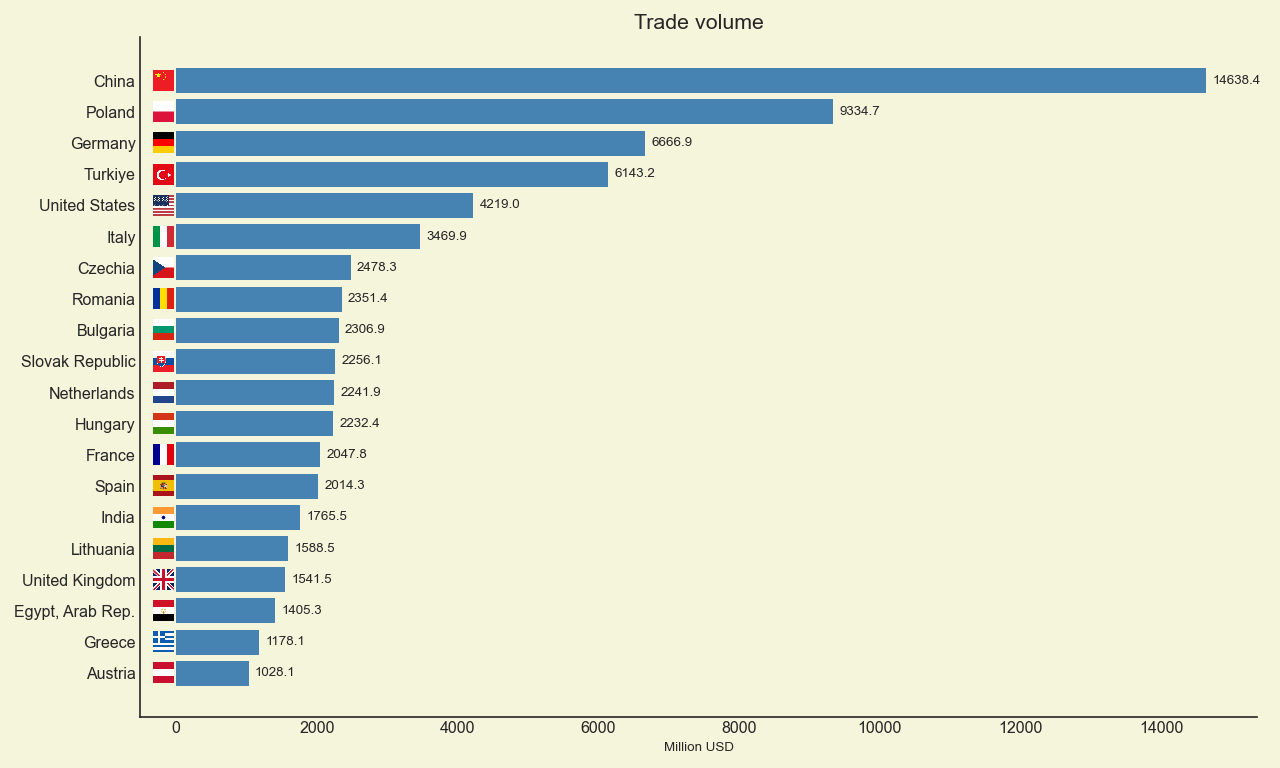
Geographic structure of Ukraine’s foreign trade (trade volume) in January-September 2025, mln. USD

From March 23 to 25, traffic will be partially restricted on several bridges and overpasses in Kyiv. During this period, specialists from the Kyivavtoshlyakhmist municipal enterprise will be repairing sections of the road surface.
According to Kyivavtodor, on March 23, repair work will be carried out on: the Northern Bridge; the overpass on Mykoly Vasilenko Street near the “Beresteiska” metro station; the Vozduhoflootsky overpass across the railroad tracks on Vozdushnykh Sil Avenue; the bridge across the Lybid River on Vozdushnykh Sil Avenue; the flyover on Zhilyanska Street; the overpass across Beresteisky Avenue on Vozdushnykh Sil Avenue.
On March 24, work will be carried out on: the North Bridge; the Vozduhoflootsky overpass across the railroad tracks on Vozdukhnykh Sil Avenue; the bridge across the Lybid River on Vozdukhnykh Sil Avenue; the overpass across Berezestsky Avenue on Vozdukhnykh Sil Avenue.
March 25 – on: the E.O. Paton Bridge; the overpass on Kyoto Street; the Northern Bridge.
During the work, traffic will be partially and gradually restricted. In the event of deteriorating weather conditions, the schedule of the work may be changed.
The municipal corporation apologizes for the temporary inconvenience and asks that you take the restrictions into account when planning your route.

According to Serbian Economist, Romania has prepared a strategic study on the creation of a 781.9-km railway corridor from Constanța to the Hungarian border, which will combine modernized sections with speeds of 160–200 km/h and new double-track sections designed for speeds of up to 250 km/h. This is reported by Romanian business publications.
According to the study, the most suitable route is the Constanta–Bucharest–Brasov–Sighisoara–Târgu Mureș–Cluj-Napoca–Zaleu–Oradea–Hungarian border corridor. The project is estimated at €14.93 billion, with an average investment cost of approximately €19 million per kilometer.
The first phase involves the construction of a new double-track line between Bucharest and Cimpina with a design speed of 250 km/h, while the Cimpina–Brasov section is proposed to be upgraded to 200 km/h. The second phase covers the new Brasov–Cluj-Napoca line via Targu Mures, the third—Cluj-Napoca–Oradea via Zalau, and both of these new lines are also designed for 250 km/h. The fourth phase includes upgrading the Bucharest–Fetești section to 200 km/h and constructing a new double-track section between Fetești and Constanța for speeds of 250 km/h.
The document examines the technical, investment, operational, and institutional parameters of the project and recommends phased financing after 2027 through European funds, the state budget, and, potentially, public-private partnership mechanisms.
https://t.me/relocationrs/2476



