
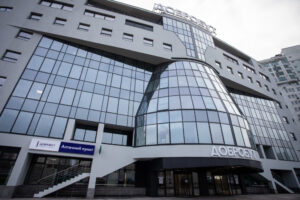
Dobrobut Medical Network has opened an ophthalmology clinic at its multidisciplinary hospital on Bazhana Avenue in Kyiv. According to a press release from the healthcare chain, the clinic provides a full range of ophthalmology services – from outpatient appointments and diagnostics to surgical interventions of any complexity.
The team of ophthalmic surgeons at Dobrobut Clinic is headed by a married couple – Professor Andrii Sergienko, MD, and Victoria Sergienko, PhD. Professor Sergienko has been developing the field of treatment of retinal diseases and rare eye pathologies for 35 years. He has performed more than 30 thousand surgeries in Europe, Asia and Africa.
The clinic’s team consists of eight doctors who consult and operate. They will involve colleagues from other medical areas of Dobrobut: neurosurgeons, endocrinologists, cardiologists, and oncodermatologists.
The medical network clarifies that the clinic, in particular, provides medical care to the military with eye injuries caused by small metal fragments or blast waves.
“The war has led to an increase not only in the demand for ophthalmic services, but also in the complexity of the problems patients come with. Collaboration with other Dobrobut doctors will allow us to develop new areas, such as ophthalmogenetics and neuro-ophthalmology to treat complex diseases,” Professor Sergienko said in a press release.
“Dobrobut is one of the largest private medical networks in Ukraine. The company’s portfolio includes 17 medical centers in Kyiv and Kyiv region, an emergency service, dentistry and pharmacies. The medical centers of the network provide services for children and adults in more than 75 medical areas. Every year, Dobrobut specialists perform more than 7,000 surgeries. The network employs more than 2,800 people.
Thanks to cooperation with international charitable organizations such as Direct Relief International, Children of War Foundation, International Medical Corps and University of Miami Global Institute, as well as the work of the Dobrobut Foundation charitable foundation, the clinics of the network continued to operate even during the hostilities and provided a significant part of medical services free of charge. Since the first days of the war, the Dobrobut Medical and Diagnostic Center in Kyiv has been providing emergency medical care to Ukraine’s defenders and wounded civilians free of charge 24/7.
Clinic managers from 20 regions of Ukraine have completed a series of anti-crisis training modules “Leadership in times of crisis” by the humanitarian agency Zdorovi.
According to a Zdorovi press release, 63 hospital managers from 20 regions of Ukraine took part in the three-month training program, and more than 200 participants watched the training videos.
In addition, the humanitarian organization is conducting a study of the state of the medical sector during the war as part of the Barometer project.
“The Zdorovi team cooperates with a large database of hospitals, whose managers and medical staff are given the opportunity to share real problems in their medical institutions and the industry as a whole during the survey. Based on these answers, an analysis and report is created, which is the basis for creating an effective strategy for assistance from foreign donors for the next period,” the humanitarian agency said.
At the end of the survey, analysts of the National Humanitarian Aid Agency ZDOROVI will prepare and publish a report on the project results.
The National Humanitarian Aid Agency Zdorovi is recognized as a critical enterprise for the functioning of Ukrainian medicine. Zdorovi’s large-scale humanitarian work is carried out in cooperation with international partners, including ISAR Ednannia, RAZOM for UKRAINE, NOVA Ukraine, Americares, Philips, the Netherlands Refugee Council, GIZ, Projecten Vastenactie, and other charitable foundations and organizations.

Commercial banks in Ukraine in 2024 will focus on the implementation of their programs of car loans, mortgages and lending to small and medium-sized businesses.
This opinion was expressed by Elena Dmitrieva, First Deputy Chairman of the Board of Globus Bank, in her comments to Interfax-Ukraine.
“Significant reduction of the discount rate in 2023 from 25% to 15% allowed banks to attract cheaper resources, restore credit programs frozen by the war and introduce fundamentally new areas of lending. Under the most favorable economic conditions in 2024, we should expect further reduction of the discount rate to 14-12%. As a consequence, in 2024 (at banks) the reduction of rates depending on the type of loan, the term of its payment and down payment may be from 2% to 4%,” – said Dmitrieva.
She recalled that since the second half of the year, the average reduction in interest rates on bank loans depending on the term of repayment and the size of the down payment has already amounted to 4%. In particular, rates on mortgage loans have fallen by an average of 3% (mainly we are talking about loans under partnership programs of developers and banks in the primary housing market), rates on car loans for new cars have fallen by 3-5%, and rates on consumer loans for the purchase of consumer goods have fallen by an average of 4%.
“The request of citizens for one or another type of credit on acceptable terms is almost inexhaustible. In 2024, any positive changes in credit conditions will be predetermined solely by economic factors,” emphasized Elena Dmitrieva.
In 2024, an important component of credit development will remain the participation of commercial banks in the implementation of a number of government credit programs, such as lending to small and medium-sized enterprises “5-7-9”, “Affordable factoring” (collateral-free financing for micro, small and medium-sized businesses with deferred payment at a compensatory rate of 13% per annum for up to 360 days), programs for energy modernization of houses “Energodom”, preferential mortgage “eOsel”, as well as the development of special compensatory programs with local authorities to reimburse a part of the loan amount.
In particular, the Globus Bank under the Energodom program expects to issue loans for more than UAH 200 million, of which more than 70% will be for partnership programs for reimbursement of condominiums’ expenses.
Dmitrieva predicts a gradual transformation of the state preferential programs “5-7-9” and “eOsel”. In particular, the “5-7-9” program will be gradually extended to regions with high military risks and will concern those industries that have not yet recovered from the very beginning of the full-scale invasion.
“The state budget for 2024 envisages more than UAH 18 billion for compensation of interest rates of the “5-7-9” program. However, most of these funds may go to repay the debt of the program manager – the Entrepreneurship Development Fund, because the debt to banks participating in the program is already up to UAH 5 billion. We expect that “5-7-9″ will be significantly narrowed, and loans under the program will be more point”, – said Dmitrieva.
At the same time, according to her assessment, the share of investment loans will gradually increase – for the purchase of fixed business assets (special technical means, motor vehicles, medical transport, production equipment, etc.). “It is expected that the share of such loans will make up to 30% of all loans issued,” Dmitrieva said.
The effectiveness of the eOsela soft mortgage program next year will depend on the volume of financing and popularization of the program among housing developers (activation of the program in residential projects at the construction stage).
Dmitrieva noted that compared to June 2023, when more than 490 mortgages were issued, the program’s activity has almost doubled (currently, about 800-900 loans are issued monthly), but it is extremely important to increase the program’s activity by at least 1.5 times, to 1.4-1.5 thousand loans per month, in 2024.
It is important to increase the number of financial institutions that are partners of the program, which will allow a wider range of citizens to take advantage of the preferential mortgage, as well as increase the “weight” of lending in the portfolio of commercial banks (currently, 7 commercial banks participate in the program), as well as intensify lending to facilities under construction, as well as expanding to townhouses and private houses.
According to her estimates, it is possible to increase from the current 1% to 25% the share of loans issued under the aHouse program for the purchase of housing under construction, but for the preferential mortgage to work in the primary market, the will of the developers themselves is needed, as well as the reformatting of their sales systems to meet legislative innovations to protect the rights of investors-buyers of housing.
“18 developers have already been accredited to participate in the eHouse program, which builds only 3-5% of the number of objects whose construction began before the full-scale invasion and continues in a slow mode, but without signs of “frozen” construction. We expect that in 2024 the number of residential complexes under construction accredited to participate in the program will increase by at least 2-2.5 times. After all, this is a direct investment in further construction, in the development of the industry in general, which is very important during the war,” summarized Dmitrieva.
Globus Bank was registered in 2007. According to the NBU, as of April 11, 2023, the bank’s shareholders were Elena Silnyagina (100%), Dmitry Polkovsky (16.198866%), Yevgeny Varyagin (9.899307%), Sergey Mamedov (9.899307%), Andrey Pinchuk (9.899307%) and Taras Lisovoy (3.599748%), who indirectly own the authorized capital.
According to the National Bank of Ukraine, as of September 1, 2023, Globus was ranked 24th (UAH 9.07 billion) among 60 banks operating in the country in terms of total assets.

In 2022, PrJSC Marhanets Mining and Processing Plant (MGOK, Dnipro region) increased its net loss by 1.9 times year-on-year to UAH 47.062 million.
According to the company’s annual report in the information disclosure system of the National Securities and Stock Market Commission (NSSMC), net income for the period decreased by 63.8% to UAH 1 billion 434.670 million.
Retained earnings by the end of 2022 amounted to UAH 563.731 million.
In 2022, MMPP produced 271,825 thousand tons of manganese ore, 51,284 thousand tons of concentrate, 219,937 thousand tons of sludge, and sold 237,539 thousand tons of ore, 59,539 thousand tons of concentrate, and 219,937 thousand tons of sludge.
As reported, in the first half of 2022, MMPP increased its net loss by 4.3 times compared to the same period last year – up to UAH 42.164 million, net income decreased by 23.6% to UAH 1 billion 138.683 million.
In January-March 2022, MMPP increased its net loss by 16.6 times compared to the same period in 2021 to UAH 159.870 million, while net income increased by 2.4 times to UAH 865.275 million.
MMPP ended 2021 with a net loss of UAH 24.541 million, while in 2020 it made a net profit of UAH 239.284 million.
MMPP is developing the eastern part of the Nikopol manganese ore deposit (Hrushevsko-Basansky area). The plant comprises four operating mines, including one under construction, one open pit mine – Hrushevsky – and a processing plant.
According to the third quarter of 2023, the largest shareholders of the company are Couttenmax Holdings Limited, Mosfilia Investments Limited and Humax Enterprises Limited, which own 23.8933% of the company’s shares each, as well as Fianex Holdings Limited (all of Cyprus), which owns 24% of the company’s shares.
The authorized capital of MMPP is UAH 366.625 million, with a share price of UAH 0.25.
Commissioning of housing in Ukraine, mln sq m
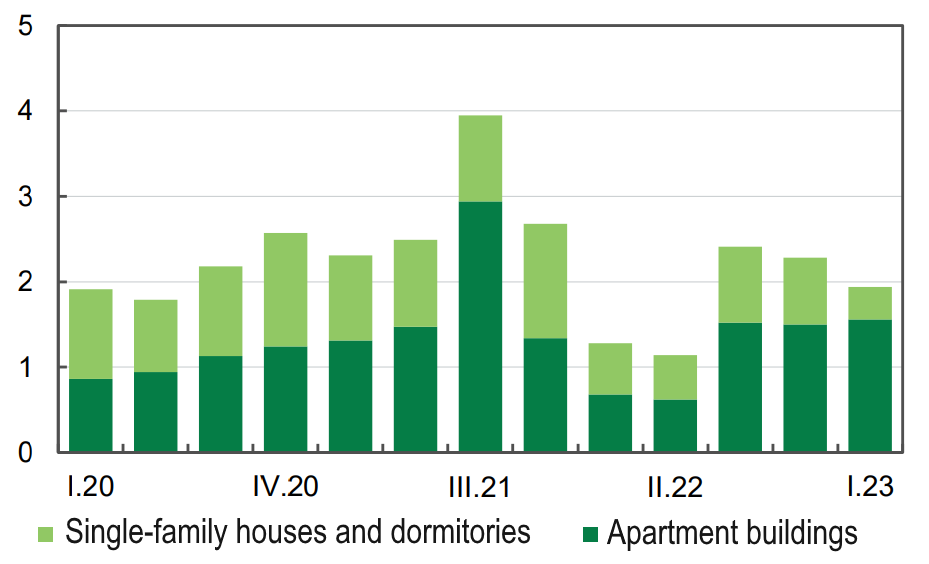
Source: Open4Business.com.ua and experts.news
In 2023, NNEGC Energoatom increased its revenue from electricity sales by 30% (by UAH 44 billion) compared to last year – up to UAH 190.7 billion, the company reported on its Telegram channel.
“Of these funds, more than UAH 124.4 billion was paid as part of the PSO, or in other words, to maintain low tariffs for the population,” the company said in a statement.
The company’s revenue quadrupled from 2020 (UAH 48.1 billion) to 2023. At the same time, over the same period, the growth in the cost of electricity production amounted to 26.6%.
In 2024, NNEGC plans to increase its revenue by one third compared to the current year – up to UAH 253.3 billion.
“Despite wartime, a significant reduction in electricity consumption and the loss of capacity at the temporarily occupied Zaporizhzhya NPP, we managed to implement a set of measures to improve the economic efficiency of Energoatom’s operations. This is what allows the state to maintain low electricity tariffs for the population,” NNEGC President Petro Kotin said in a statement.



