
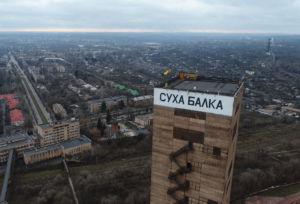
Sukhaya Balka mine (Krivoy Rog, Dnepropetrovsk region), which is part of DCH Group of Oleksandr Iaroslavskyi, produced almost 931 thousand tons of commercial ore by the end of 2023, said Vitaly Bash, General Director of DCH Steel of DCH Group, in his address to employees on the eve of the New Year, published in the corporate newspaper of DCH Steel on Thursday.
According to him, for the second year in a row there is a full-scale war in the country, and the company has to overcome wartime difficulties. For example, almost 1,000 employees of the group’s companies are now at the front, so the workforce is under constant strain.
“But despite the numerous crises – energy crisis, water shortage, lack of qualified personnel – DMZ and the Sukhaya Balka mine continue to work. At the mine, 2023 can be called the year of the most frugal use of resources: at the industrial sites we restored the equipment, continued the implementation of the program to modernize the equipment,” – stated the General Director.
At the same time, he reminded that in April the fleet of technological transport was replenished with four new loading and delivery machines with bucket size of 1 cubic meter and 0.6 cubic meter. Renewal of mine skips of the Yubileynaya mine is next in line.
“In September we resumed mining at the mine named after Frunze. Frunze, which was suspended due to constant shelling of the energy infrastructure in November 2022. The coordinated work of employees of all mine divisions contributed to the production of almost 931 thousand tons of commercial ore in 2023,” the CEO said.
The head of the company also said that production activities at DMZ have intensified: starting from spring, production at the coke and chemical site has increased. Rolling shops have been conducting campaigns for the whole year for the production of mine stand, mine rails, channels and angles from toll billets. Much attention was paid to repairs, which were mainly performed by our own forces. Also, the repair departments have successfully mastered the manufacture of parts and some spare parts for the DMZ and colleagues.
“I look forward to an improvement in the situation in the country and the mining and metallurgical industry so that the enterprises can work at full (utilization – IF-U),” Bash said.
In the company to the agency “Interfax-Ukraine” specified the volume of ore production by the mine “Sukhaya Balka” in 2022, as earlier this figure was not made public – 1.469 million tons.
DMZ specializes in the production of steel, pig iron, rolled steel and products from them. On March 1, 2018, DCH Group signed an agreement to purchase Dniprovsky Steel Works from Evraz.
Sukhaya Balka mine is one of the leading mining companies in Ukraine. It extracts iron ore by underground mining. The mine includes the Yubileynaya and Frunze mines. Frunze.
DCH Group acquired the mine from Evraz Group in May 2017.

Oil prices are moderately rising on Friday morning after a sharp decline in the previous session.
The price of March futures for Brent on the London ICE Futures exchange by 7:09 a.m. is $77.59 per barrel, which is $0.44 (0.57%) higher than at the close of the previous session. On Thursday, these contracts fell by $2.39 (3%) to $77.15 per barrel.
Quotes for February futures for WTI in electronic trading on the New York Mercantile Exchange (NYMEX) by this time increased by $0.31 (0.43%) to $72.08 per barrel. At the end of the previous session, they fell by $2.34 (3.2%) to $71.77 per barrel.
Analysts say the main reason for the drop in oil prices on the eve of the previous day is the reduction of fears about attacks by Yemeni Houthis on transport vessels. In particular, on Wednesday, the Danish transport and logistics company A.P. Moeller-Maersk AS announced the resumption of transportation through the Red Sea after the implementation of an international mission to ensure security in the region.
“Oil prices have fallen as global transportation giants prepare to resume navigation in the Red Sea despite attacks by Houthi rebels,” wrote Stephen Innes, managing partner of SPI Asset Management. – “It’s a calculated risk and a bet on the success of the international security mission.
The quotes could not be supported by the data on oil and oil products stocks in the United States published the day before.
Commercial oil reserves in the United States last week fell by 6.911 million barrels, while analysts on average had forecast a decline of 2.7 million barrels, according to Trading Economics. The decline in stocks was a record for four months.
Stocks at the Cushing terminal, where NYMEX-traded crude is stored, increased by 1.508 million barrels. This is the tenth consecutive week that Cushing stockpiles have increased, which has not been seen since 2016.
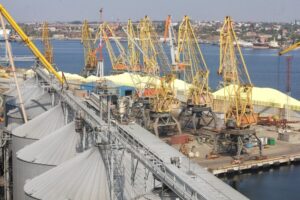
“Kernel, one of Ukraine’s largest agricultural holdings, has been using its Aeneid and Mavka vessels to export agricultural products for the second year in a row and intends to further expand its fleet, the agricultural holding reported on Facebook.
“For the second year, we have been operating our own vessels and transporting Ukrainian products in the difficult conditions of the termination of the grain deal. (…) Two Kernel vessels, Aeneid and Mavka, are currently exporting Ukrainian products. The deadweight (maximum loading) of the bulk carrier Aeneid is 47,335 tons, and the Mavka tanker is 13,500 tons. We have no plans to stop and are already working on expanding the fleet,” the statement said.
The agricultural holding noted that the use of its own fleet is economically beneficial, especially during the period of inflated freight rates during martial law. The development of its own shipping gives impetus to the entire market and strengthens the country’s export capabilities, Kernel believes.
“The Black Sea remains the only alternative for Ukrainian exports. The deep-water ports are able to accumulate and ship large-tonnage consignments of more than 60 thousand tons. This makes it possible to optimize logistics processes and significantly reduce costs. All alternative routes have extremely high logistics costs,” the agricultural holding explained and promised to continue to strengthen Ukraine’s exports and contribute to food stability in Europe and the world.
As reported, before the war, Kernel was the world’s largest producer of sunflower oil (about 7% of global production) and its exports (about 12%). It is one of the largest producers and sellers of bottled oil in Ukraine. In addition, it is engaged in the cultivation and sale of agricultural products.
In the first quarter of FY2024, the company posted a net loss of $30.9 million, while the previous year ended with a net profit of $162 million, with a 17% decrease in revenue to $564 million.
According to the report, the book value per share for the year decreased from $20.7 to $6 (or PLN26.22), in particular due to an increase in the number of shares from 77.429 million to 147.864 million.
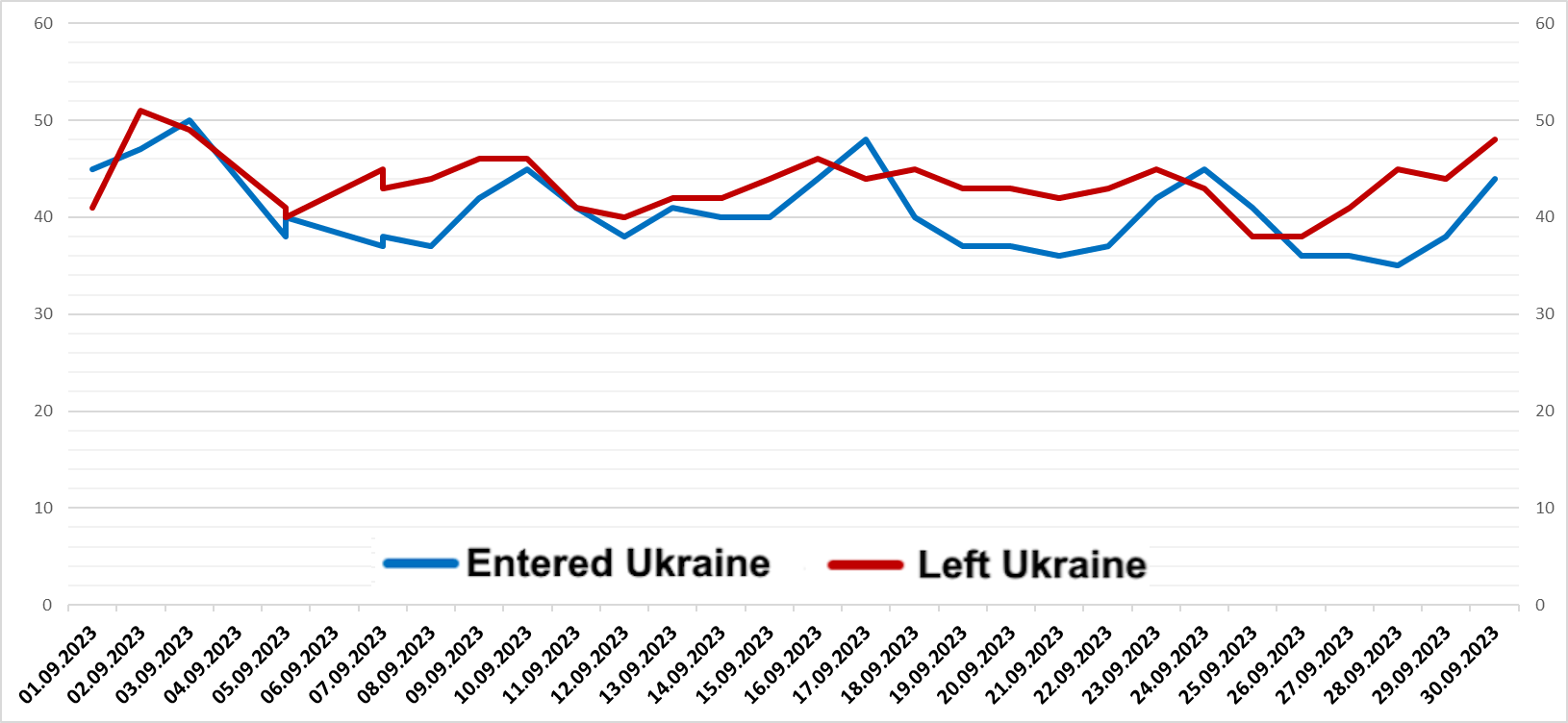
Passenger flow through western border of Ukraine in September 2023, thousand
Source: Open4Business.com.ua and experts.news
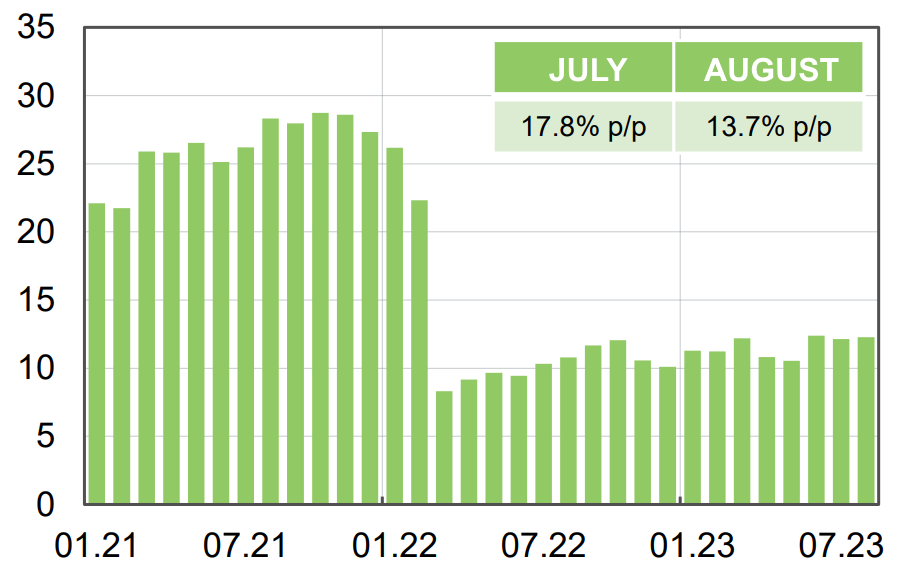
Freight transportation by rail, mln tons
Source: Open4Business.com.ua and experts.news
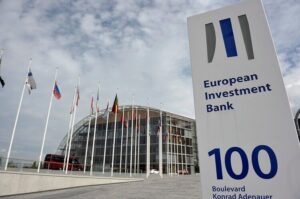
The European Investment Bank (EIB) has allocated EUR 3 million to improve the energy efficiency of 18 public buildings in Zaporizhzhia, Kamianske and Lutsk.
“The allocated funds will be used to modernize five kindergartens and three schools in Zaporizhzhia, four kindergartens and three schools in Kamianske, and in Lutsk to modernize three hospitals intended for the treatment of civilians and rehabilitation of military personnel injured during the war,” the EU Delegation to Ukraine reported on its website on Thursday.
It is noted that these funds will help the Ukrainian authorities to continue implementing the EIB’s Municipal Infrastructure Development Program (MIP), which aims to improve public infrastructure in various municipalities.
“After today’s tranche of EUR 3 million, the total amount of funds allocated for the UMIP in 2023 will amount to EUR 11.74 million,” the release states.
It clarified that EUR8.74 million of these funds were previously used to support key municipal projects such as the reclamation of the Hrybovychi landfill and solid waste management in Lviv, the implementation of energy efficiency measures in kindergartens in Sumy, and the improvement of water supply and sewage systems in Lutsk.
According to EIB Vice President Teresa Czerwinska, responsible for the bank’s operations in Ukraine, energy efficiency measures should be prioritized during Ukraine’s current and future large-scale recovery, as they play an important role in strengthening the country’s energy security and independence.
“The EIB is fully committed to supporting the Ukrainian government and cities in these efforts by transferring best practices in reconstruction and modernization to rebuild the Ukrainian economy, reduce energy costs and improve energy efficiency in all sectors,” she assured.
In addition, it is indicated that UMIP is a EUR 400 million multi-sectoral investment initiative aimed at supporting public infrastructure projects in medium and large municipalities. UMIP’s objectives include investments in district heating rehabilitation, energy efficiency improvements in buildings, modernization of street lighting, and water, sewerage and solid waste management, among others. The program is implemented by the Ministry of Communities, Territories and Infrastructure Development in cooperation with the Ministry of Finance of Ukraine. The UMIP is complemented by technical assistance provided through the Eastern Partnership Technical Assistance Trust Fund (EPTATF), managed by the EIB, and the Neighborhood Investment Platform (NIP).
The release specifies that the EIB’s support to Ukraine since the beginning of Russia’s full-scale invasion of Ukraine has reached EUR 1.7 billion in financing for urgent repairs to destroyed infrastructure. The EU bank has also provided a EUR4 billion credit line to support the integration of refugees from Ukraine in EU countries.



