

The number of participants of the non-banking financial market in February 2023 decreased by 53 to 1384, according to the website of the National Bank of Ukraine.
The number of banks in February remained unchanged at 67.
The register includes one insurer with a special status. At the same time, 13 financial companies, one insurer, two pawnshops, one credit union, one leasing company and three insurance brokers have been excluded from the register voluntarily, and the other 30 financial companies, one pawnshop and one leasing company – voluntarily.
As of February 28, the non-banking market had 115 non-life insurers (116 in January) and 12 life insurers (the number has not changed), one insurer with special status, 176 pawnshops (179), 159 credit unions (16), 95 leasing companies (97), 701 financial companies (744), 58 insurance brokers (61) and 67 collection companies (the number has not changed).
In addition, 25 banking groups (number has not changed) and 22 non-banking financial groups (23) are recognized as operating in the market.
In the payment market operate 37 payment systems (38), created by residents, including state, and 16 international payment systems, created by non-residents (the number has not changed). In addition, companies providing financial payment services operate in the market, including three banks issuing electronic money (the number did not change). Other entities operating in the payment market include 41 commercial agents (40) and 35 technological operators of payment services (the number has not changed).
In February, the National Bank received 345 requests from market participants for registration and licensing actions. The number of inquiries on financial companies, pawnshops and lessors amounted to 160. The number of inquiries on credit institutions (banks and credit unions) – 89, insurers – 74, payment institutions – 22.
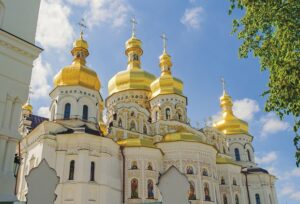
The National Reserve “Kyiv-Pechersk Lavra” terminates the lease agreement with the Svyato-Uspensky Monastery of the Ukrainian Orthodox Church (Moscow Patriarchate) from March 29, 2023.
“Between the national reserve “Kiev-Pechersk Lavra” and the Svyato-Uspenska Kiev-Pechersk Lavra (male monastery) of the Ukrainian Orthodox Church concluded an agreement №2 from July 19, 2013 on the free use of religious organization of religious buildings and other property, which is state property,” – said in a letter of the acting director of the reserve, which is published on the website of the monastery.
The letter says that the interdepartmental working group for the preparation of proposals and recommendations for the organization of certain tasks related to the activities of religious organizations in Ukraine, during its work, found a violation of the contract on the use of state property by the monastery.
In this regard, given the findings of the interdepartmental working group and the letter of the Ministry of Culture and Information Policy, the reserve warns about the termination of the contract with the March 29, 2023.
“In order to carry out the procedure for acceptance and transfer of state property to the monastery must take measures to release the buildings and structures (property), which are state property and are on the balance of the reserve, at the address: Kiev, Lavra Street, 11, Kiev, Lavra Street, 15 until 29.03.2023,” – the letter says.

Wind gusts of 15-20 m/s are expected on Sunday night, March 12, in Kyiv and Kyiv region, the press services of the Kyiv City State Administration and Kyiv Regional Military Administration report, citing information from the Ukrainian Hydrometeorological Center.
“Hazard level I, yellow. Such weather conditions can lead to complications in the work of the energy sector, utilities and disruption of traffic on certain sections of roads and streets. During strong gusts of wind, keep windows tightly closed. On the street, stay away from trees, billboards and power lines,” the statement said.

The presidential decree on sanctions against Parimatch LLC and a number of other companies of Parimatch holding led to the almost complete termination of its activities in Ukraine, the CEO of Parimatch holding Maxim Lyashko said at a press conference in Kiev on Saturday.
“Overnight banks started disabling the ability to withdraw client funds. About 250 million UAH of clients’ funds have been blocked, they are in the company’s current accounts,” he said, expressing confidence that players will be able to access their funds.
CEO of LLC “Parimatch”, which in Ukraine owns a license for betting and online casinos, Natalia Gilevich said that we are talking about several tens of thousands of customers.
Lyashko added that banks began to break off relations with the company in the last two or three weeks, and state banks were the first to do so.
According to him, the presidential decree on sanctions has not yet been officially published, which means it has not entered into force, so theoretically clients should be able to withdraw funds, but in fact they are blocked.
The CEO of Parimatch also noted that the company, under the terms of the license, continues to maintain the system, and players can continue to bet, but when the decree officially comes into force, the company will stop the work of the system.
Lyashko pointed out that the sanctions affected the main B2C companies in the holding, for which the Ukrainian market represented “the lion’s share. According to him, there is also a B2B direction in the holding. (In January of this year, the holding announced the launch of a new company, GR8 Tech, which will work on the B2B market and is the successor to Parimatch Tech – IF-U).
Speaking about the impact of the Ukrainian sanctions on the holding company’s operations on other markets, the CEO of Parimatch stressed that the reputational blow caused would be almost impossible to repair, but the Ukrainian sanctions do not apply to other markets and there is no broad practice of other jurisdictions adopting sanctions following Ukraine.
Lyashko once again noted that the company does not have any documents and a generally clear understanding of why sanctions were imposed on it. “The wording that all these companies have to do with Russian assets is categorically untrue,” the CEO said, recalling that relations with the Russian market were finally severed a year ago.
As for taxes, he said that last year the company paid 280 mln hryvnia in taxes due to its transition to a 2% simplified tax, whereas after the company abolished that option it paid over 400 mln hryvnia in January-February this year, and expected to pay 250-280 mln hryvnia in March and a comparable profit.
The representatives of the company said that according to the materials of the SBU the Economic Security Bureau is investigating the tax payments by “30-something” gambling market companies, among which there is “Parimatch”, but there are no decisions on it at the moment.
When asked whether any demands were made of the holding company or whether the sanctions were an attempt to clear the market, Lyashko said that “they may be inclined to something or clear it for someone”, but there was no evidence, so the company would not comment on this and would seek to lift the sanctions.
As Ukrainian News earlier reported, the President of Ukraine Volodymyr Zelensky signed a decree on March 10, which enacted the same day the decision of the National Security and Defense Council of Ukraine (NSDC) to impose sanctions against 120 individuals and 287 legal entities. Among them are Ukrainian LLC “Parimatch”, Financial Company “Leo”, “PokermatchUA”, “Your Betting Company” and “Play Fan Investment”.
From the Parimatch holding, the new sanctions also affected Parimatch United Investments Limited (UK) Fullgear Investments Ltd, Auspicia Limited (both Cyprus), Suncast Furure N.V. (Curacao, Netherlands), and Parimatch Foundation Limited (Cyprus), as well as a whole group of individuals abroad.
Of the five companies in the register that received a license from the Gambling and Lottery Regulatory Commission (KRAIL) for betting activities, the decree affected three: Parimatch, Your Betting Company and Play Fan Investment. The latter two already had their licenses revoked by the CRAIL earlier – in September and December 2022, respectively. The two remaining companies in the registry are bookmaker company “Favbet” and “Vbet Ukraine”.

Arrival, an electric car startup founded in Great Britain by former deputy head of the Russian Ministry of Communications Denis Sverdlov, which is restructuring its business amid a set of problems, posted a $1 billion net loss in 2022, according to a company report.
Arrival’s fourth-quarter loss rose to nearly $600 million from $67 million in the same period in 2021, according to preliminary unaudited filings. The figure includes non-cash impairment charges and write-downs of more than $400 million. For all of 2022, the company estimates a loss of about $1 billion, compared with a loss of $1.3 million in 2021, which included a one-time non-cash charge of $1.2 billion related to the merger of Arrival and CIIG.
Adjusted negative EBITDA for the fourth quarter will be up to $172 million compared to $85 million in the same period of 2021. The company attributes the increase to about $70 million more in payroll and contractor costs and about $25 million more in component spending. Expected adjusted negative EBITDA for 2022 is about $380 million versus $203 million in 2021.
The company’s cash balance decreased by $126 million in the fourth quarter to $205 million by year-end. The money was used for working capital ($104 million), interest payments on loans and lease obligations ($11 million), capex expenses and other operating expenses.
Sverdlov (formerly head of operator Yota, and in 2012-2013, deputy minister of telecommunications of the Russian Federation. – Sverdlov (formerly the head of Yota, and Deputy Minister of Communications of the Russian Federation from 2012 to 2013) created Arrival in 2015. The startup raised funds from international investors and planned to roll out mass production of electric vehicles for large cities, proposing the concept of assembly in so-called “microfactories” as an alternative to conveyor car production.
In March 2021 Arrival went public on the Nasdaq exchange through a merger with SPAC. The company’s capitalization immediately after the IPO was valued at $13.6 billion, and Sverdlov, who controls 75% of Arrival through Kinetik Sarl, broke into the top 20 of Forbes Russia last spring. The magazine estimated his fortune as of April 2021 at $10.6 billion.
However, the full-scale war unleashed by Russia against Ukraine, as well as the adjustment of the company’s ambitious production plans, the rejection of the European market and the layoff of some employees led to the fact that the share price of Arrival by the end of November 2022 collapsed by almost 99% – from $22 when it was placed to just over $0.3. The price of the securities below $1 caused Arrival to receive a warning about possible delisting from Nasdaq back in early November. The exchange gave the startup six months, during which its shares must rise above $1 and stay there for at least 10 days in a row.
Amid the problems, Arrival announced plans to focus resources on developing US Van vans for the U.S. market. The company hopes to begin producing them in the U.S. city of Charlotte in 2024 “subject to raising additional capital.” “We will use $330 million in funds to achieve our U.S. goals and look to raise additional funds,” Sverdlov was quoted by Arrival’s press office as saying in a press release for its Q3 2022 reporting.
In early November, Arrival reported that the company may not have its first revenue until 2024, rather than 2023 as previously planned. The company reported a tenfold increase in net loss in Q3 (to $310.3 million) and a $330 million cash reserve, noting that the reserve would fund the business for the next 12 months.
Sverdlov stepped down as CEO of Arrival in late November 2022 to head the board of directors. By the end of January, Peter Cuneo, the company’s acting head, had already handed over the CEO position to Igor Torgov, the former head of telecom operator Skartel (Yota brand), who had previously worked with Sverdlov at Yota.
“After a detailed evaluation of Arrival and the electric car market over the past two months, the company’s management and board of directors have taken decisive action to make better use of current resources and optimize the business. These actions reaffirm our commitment to becoming a leader in innovative products and new, more efficient methods of producing vehicles, especially in the important U.S. commercial electric car market,” Arrival’s press office quoted Torgov as saying in a January announcement.
In the same announcement, the startup confirmed its intention to cut up to 800 people — about half of its staff — to optimize costs. “Combined with other real estate and third-party cost-cutting measures, the company expects to halve its current business spending, to about $30 million per quarter,” the press release said.

Naftogaz of Ukraine on Friday improved a month-old proposal to restructure Eurobonds it defaulted on last summer, with the main changes affecting bonds maturing in 2022.
According to the presentation on Naftogaz’s website, it is proposed to increase the interest rate on Eurobonds-2022 from the date of approval of the proposal from 7.375% to 7.65% per annum, and also around April 15, together with overdue interest pay 5% of the principal amount of debt.
At the same time, Naftogaz offers to defer the payment of 50% of the principal debt for two years – until July 19, 2024, and the remaining 50% – until July 19, 2025, while in February it proposed to repay the entire issue on July 19, 2024.
As for the postponement of the redemption of Eurobonds-2026, the proposal remained the same: 50% for one year, until November 8, 2027, and another 50% until November 8, 2028.
Payment of interest on Eurobonds-2022 due on January 19, 2023, July 19, 2023, and January 19, 2024 is proposed to be postponed until July 19, 2024. For Eurobonds-2026 from November 8, 2022, May 8, 2023, November 8, 2023 and May 8, 2024 to November 8, 2024.
“Naftogaz wants to reserve the right to both early repayment of the overdue ones and to capitalize them.



