
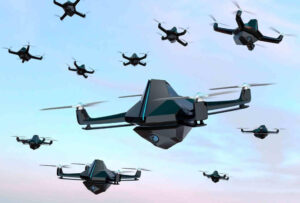
Ukrainian defense startup Swarmer, which went public on Nasdaq in March of this year (ticker SWMR), reported a net loss of $4.5 million for January–March 2026, compared to $0.7 million for the same period in 2025, according to a company statement.
“The increase (in the loss) was primarily due to higher costs for consulting and professional services related to becoming a public company, as well as increased investments in engineering and development initiatives,” Swarmer noted.
According to the data, revenue decreased to $20,300 from $110,700, while operating expenses rose to $4.5 million from $0.8 million.
It is noted that thanks to the IPO, cash and cash equivalents for the first quarter increased to $23.5 million from $9.3 million.
“The increase primarily reflects gross proceeds of approximately $17.3 million from the IPO, as well as approximately $3.5 million in gross proceeds from the sale of Series A-1 convertible preferred shares,” Swarmer clarified.
The company also announced a $2.8 million contract to supply more than 16,000 software licenses for SkyKnight bomber quadcopters and other drones.
Swarmer’s stock price fell 2.5% on Thursday to $29.53 per share, corresponding to a market capitalization of nearly $373 million. The company priced its IPO at $5. At its peak in early April, the stock rose to nearly $69.
The company’s core areas of activity include autonomous swarm coordination, integration of multi-domain unmanned systems, AI-based collaborative autonomy, and software for commanding and controlling distributed robotic operations, according to the press release. In addition, the company’s clients include drone manufacturers who license Swarmer’s software for integration with their hardware platforms.
The company was founded by Serhii Kuprienko and Alex Fink in May 2023. The company’s headquarters and marketing and sales office are located in Austin, Texas, while its engineering divisions are split between offices in Kyiv, Ukraine, and Warsaw, Poland. The company’s holding structure includes subsidiaries in Ukraine, Poland, and Estonia.
Prior to the IPO, Kuprienko owned 27.4%, Fink owned 15.1%, while other owners included Theseus Capital Partners—where board member Philip Wagenheim serves as managing partner—with 22%, D3 Fund (Evelin Buchatski) with 10.1%, RG.AI Technologies, led by Charles Eberle von Sexi, held 14%, Green Flag Fund I held 5.3%, and Radius Fund I held 6.9%
Swarmer’s revenue in 2025 fell to $0.31 million from $0.33 million a year earlier, while its net loss increased to $8.53 million from $2.07 million.

The European Commission (EC) has announced an increase in support for “Ukrainian innovators in the high-tech sector.”
“The European Commission has allocated €20 million to fund 41 cutting-edge Ukrainian startups and small and medium-sized enterprises through the European Innovation Council (EIC) competition to help them turn innovative ideas into real solutions,” according to an EC communiqué published on Wednesday.
“This funding will help integrate Ukrainian startups into the European innovation ecosystem, strengthening Ukraine’s long-term economic ties with the EU,” noted EC Commissioner for Startups, Research, and Innovation Katerina Zakharieva.
The statement notes that each company will receive between EUR300,000 and EUR500,000, as well as the opportunity for accelerated access to the EIC’s flagship funding program—the EIC Accelerator—which offers larger grants and equity investments through the EIC Fund.

Japanese startup JPYC has launched the world’s first stablecoin pegged to the yen, Reuters reports.
The stablecoin is also called JPYC and can be fully converted into yen. It is backed by internal cash reserves and Japanese government bonds.
The company intends to issue JPYC worth 10 trillion yen ($66 billion) over three years and ensure widespread use of this cryptocurrency abroad.
To stimulate its circulation, JPYC does not plan to charge transaction fees at the initial stage. It will generate income from interest payments on government bonds.
“We hope to stimulate innovation by enabling startups to pay low fees for transactions and settlements,” Chief Executive Officer Noritaka Okabe told reporters.
Blockchain-based stablecoins are usually pegged to fiat currencies, allowing for faster and cheaper payments.
More than 99% of stablecoins in the world are pegged to the US dollar, according to the Bank for International Settlements (BIS).
Nikkei reported in October that Japan’s three largest banks — Mitsubishi UFJ Financial Group, Sumitomo Mitsui Financial Group, and Mizuho Financial Group — would jointly issue their own stablecoins.
In September, nine European banks, including UniCredit and Raiffeisen, announced similar plans.

Ukrainian startup 3D UTU has created Ukraine’s first 3D-printed house in Irpen, Kiev region, the house was given to the family of the fallen military man Yaroslav Berezov, whose housing was destroyed during the occupation of the city by Russian troops, Ukrainian Digital Transformation Minister Mikhail Fedorov said.
“New housing for the family of the defender was built with a 3D printer from Ukrainian startup 3D UTU. The 130 m² house was built in just 58 motor hours, which is about 2 days of printer work. Yesterday, my wife and children received the keys to the house for free,” the minister said in his Telegram channel.
Fedorov emphasized that such construction is not only speed and economy, such technology allows to build energy-efficient and more environmentally friendly houses.
Fedorov thanked entrepreneurs, technologists and engineers who are “making efforts to rebuild the country already now.”

Arrival, an electric car startup founded in Great Britain by former deputy head of the Russian Ministry of Communications Denis Sverdlov, which is restructuring its business amid a set of problems, posted a $1 billion net loss in 2022, according to a company report.
Arrival’s fourth-quarter loss rose to nearly $600 million from $67 million in the same period in 2021, according to preliminary unaudited filings. The figure includes non-cash impairment charges and write-downs of more than $400 million. For all of 2022, the company estimates a loss of about $1 billion, compared with a loss of $1.3 million in 2021, which included a one-time non-cash charge of $1.2 billion related to the merger of Arrival and CIIG.
Adjusted negative EBITDA for the fourth quarter will be up to $172 million compared to $85 million in the same period of 2021. The company attributes the increase to about $70 million more in payroll and contractor costs and about $25 million more in component spending. Expected adjusted negative EBITDA for 2022 is about $380 million versus $203 million in 2021.
The company’s cash balance decreased by $126 million in the fourth quarter to $205 million by year-end. The money was used for working capital ($104 million), interest payments on loans and lease obligations ($11 million), capex expenses and other operating expenses.
Sverdlov (formerly head of operator Yota, and in 2012-2013, deputy minister of telecommunications of the Russian Federation. – Sverdlov (formerly the head of Yota, and Deputy Minister of Communications of the Russian Federation from 2012 to 2013) created Arrival in 2015. The startup raised funds from international investors and planned to roll out mass production of electric vehicles for large cities, proposing the concept of assembly in so-called “microfactories” as an alternative to conveyor car production.
In March 2021 Arrival went public on the Nasdaq exchange through a merger with SPAC. The company’s capitalization immediately after the IPO was valued at $13.6 billion, and Sverdlov, who controls 75% of Arrival through Kinetik Sarl, broke into the top 20 of Forbes Russia last spring. The magazine estimated his fortune as of April 2021 at $10.6 billion.
However, the full-scale war unleashed by Russia against Ukraine, as well as the adjustment of the company’s ambitious production plans, the rejection of the European market and the layoff of some employees led to the fact that the share price of Arrival by the end of November 2022 collapsed by almost 99% – from $22 when it was placed to just over $0.3. The price of the securities below $1 caused Arrival to receive a warning about possible delisting from Nasdaq back in early November. The exchange gave the startup six months, during which its shares must rise above $1 and stay there for at least 10 days in a row.
Amid the problems, Arrival announced plans to focus resources on developing US Van vans for the U.S. market. The company hopes to begin producing them in the U.S. city of Charlotte in 2024 “subject to raising additional capital.” “We will use $330 million in funds to achieve our U.S. goals and look to raise additional funds,” Sverdlov was quoted by Arrival’s press office as saying in a press release for its Q3 2022 reporting.
In early November, Arrival reported that the company may not have its first revenue until 2024, rather than 2023 as previously planned. The company reported a tenfold increase in net loss in Q3 (to $310.3 million) and a $330 million cash reserve, noting that the reserve would fund the business for the next 12 months.
Sverdlov stepped down as CEO of Arrival in late November 2022 to head the board of directors. By the end of January, Peter Cuneo, the company’s acting head, had already handed over the CEO position to Igor Torgov, the former head of telecom operator Skartel (Yota brand), who had previously worked with Sverdlov at Yota.
“After a detailed evaluation of Arrival and the electric car market over the past two months, the company’s management and board of directors have taken decisive action to make better use of current resources and optimize the business. These actions reaffirm our commitment to becoming a leader in innovative products and new, more efficient methods of producing vehicles, especially in the important U.S. commercial electric car market,” Arrival’s press office quoted Torgov as saying in a January announcement.
In the same announcement, the startup confirmed its intention to cut up to 800 people — about half of its staff — to optimize costs. “Combined with other real estate and third-party cost-cutting measures, the company expects to halve its current business spending, to about $30 million per quarter,” the press release said.

The electromobility department of ABB (Asea Brown Boveri Ltd, Sweden-Switzerland) has announced an investment in the Ukrainian startup Go To-U.
“This is the first equity round of the company’s investments, led by ABB EL Ventures and ABB Technology Ventures. The startup is also supported by the Techstars accelerator,” the companies said in a joint release.
The size of the investment has not been specified.
ABB indicates that this investment by its ABB EL Ventures and ABB Technology Ventures (ATV) divisions has expanded the strategic portfolio of ABB’s venture capital firms and its electromobility division, while Go To-U clarifies that it will remain a platform compatible with equipment from the leading manufacturers.
“The investment will contribute to the commercialization of GO TO-U software technology and further product development. The GO TO-U solution will be available worldwide,” the statement said.
Go To-U was founded in Lviv in 2016-2017, its software is aimed at owners of electric vehicles – the application is a map of charging stations with the ability to book and pay for services. The platform unites more than 300,000 charging stations in 47 countries of the world. In addition, the company provides services for the sale and installation of charging stations.
The startup took part in the European climate innovation voucher programs for the development of the client side of the back office for EUR50,000 and the ImpactConnected Cars acceleration program from Horizon2020 fund for EUR60,000. Earlier, in 2020, Go To-U received an investment of $ 100,000 from the accelerator Techstars, the company was valued at $ 3 million. The company’s headquarters are currently listed in Los Angeles.
ABB is an international company specializing in electrical engineering, power engineering and information technology, founded in 1988 after the merger of ASEA (Sweden) and Brown, Boveri & Cie (Switzerland), and is represented in more than 100 countries. Its manufacturing facilities are located in over 15 countries.



