

Switzerland followed the EU in imposing new sanctions against Russia, with 141 individuals and 49 legal entities added to the “black lists,” the Swiss government said in a statement.
“Switzerland, by amending the sanctions lists on December 21, thus joined the EU measures,” the press release said.
“Switzerland is amending the sanctions regime as part of the measures that the EU adopted in connection with the supply of Iranian drones to Russia and the continuing alarming situation in Ukraine,” the document specified.
The sanctions will take effect at 6 p.m. local time.
According to the statement, on December 16, the EU also imposed a ban on exports to Russia of a number of other categories of goods and services, and the Swiss government, in turn, will study these measures.
On December 16, the EU Council approved the ninth package of sanctions against Russia, which includes restrictions against the mining and energy sectors and a ban on exports of space industry goods and drones.
Among other things, the EU also added 168 more entities related to the defense industry of Russia to its “black lists. In addition, the ninth EU sanctions package against Russia included 144 individuals, including high-ranking Russian officials, MPs, military personnel and artists from Russia.

Ukraine in January-November this year, Ukraine has reduced imports of manganese ore and concentrate in kind by 64.6% compared to the same period last year – up to 135.070 thousand tons.
According to statistics released by the State Customs Service (SCS), in monetary terms, imports of manganese ore and concentrate fell by 62.7% to $17.978 million for the period.
In August-November, there were almost no imports of manganese ore.
For eleven months of 2022, Ukraine did not supply manganese ore and concentrate for exports.
As reported, Ukraine in 2021 decreased imports of manganese ore and concentrate in volume terms by 26.8% compared to 2020 – to 425.279 thousand tons. In monetary terms, imports of manganese ore and concentrate during this period decreased by 29.6% – to $53.917 million. At the same time, the main imports came from Ghana (99.87% of supplies in monetary terms), Brazil (0.07%) and Belgium (0.05%).
Last year, Ukraine supplied 770 tons of manganese ore and concentrate to Poland (94.38%) and Russia (5.62%) for $89 thousand, while in 2020, Ukraine exported 69.303 tons of manganese ore and concentrate worth $10.819 million.
In Ukraine, the Pokrovsky (formerly Ordzhonikidze) and Marganetsky mining and processing plants (both in Dnepropetrovsk region) extract and process manganese ore.
Consumers of manganese ore are ferroalloy plants.
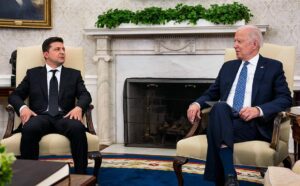
U.S. President Joe Biden will greet Ukrainian President Volodymyr Zelensky at the White House on Wednesday, December 21, at 21.00 Kyiv time.
The relevant information was published in the public agenda of the President of the United States.
At 21.30 Kyiv time, President Biden will host a bilateral meeting with Ukrainian President Zelensky. At 23.30, Biden and Zelensky are expected to hold a joint press conference.

European stock indices rose on Wednesday thanks to positive statistical data and forecasts from Germany as well as corporate news.
The Stoxx Europe 600 composite index of the region’s largest companies rose 0.8 percent to 427.51 points as of 11:30 a.m. The indicator ends 2022 with a decline of about 13% – the maximum since 2018, due to the negative impact of the situation in Ukraine, as well as the energy crisis on corporate profits and the economy as a whole, Bloomberg notes.
“We are facing a slowdown in economic growth, if not a recession, and we don’t see that factor being built into corporate earnings forecasts yet,” UBS Private Wealth Management financial adviser Sarah Poncheck said on Bloomberg TV.
Germany’s DAX stock index gained 0.76% in trading, France’s CAC 40 gained 0.91%, Britain’s FTSE 100 gained 0.44%, Italy’s FTSE MIB gained 0.68% and Spain’s IBEX 35 gained 0.55%.
Data from research firm GfK, released Wednesday, showed improved consumer sentiment in Germany. The leading indicator assessing consumer confidence prospects for January 2023 rose to minus 37.8 points from minus 40.1 points in December. The index has been rising for three months in a row thanks to measures taken by the German authorities to reduce energy costs for residents, GfK noted.
“It is clear that the steps taken by the German authorities to limit energy prices are having an effect. However, it is too early to say that all the problems are over. The improvement in consumer sentiment that we are seeing at the moment remains fragile,” said GfK consumer sector expert Rolf Bürkl.
“The German Employment Barometer, calculated by the Ifo economic institute, shows a positive outlook for the German labor market in the first quarter of next year. This is mainly due to improvements in the service sector, whose workers are optimistic about the near future, the Ifo said Wednesday.
Stock prices of European sports goods manufacturers rose on Wednesday thanks to stronger-than-expected reports from U.S. competitor Nike Inc. Shares of Adidas AG jumped 7.7%, Puma SE rose 8.5% and British sporting goods retailer JD Sports gained 6.7%.
Uniper SE shares rose 5.9% after the European Commission approved a stabilization package providing, in particular, to increase the capital of the energy company by 8 billion euros.
Among the leaders of growth in Germany were the shares of online retailer Zalando (+4.5%), real estate company Vonovia (+2.6%) and Deutsche Post (+1.3%).
In Britain, Prudential Plc (+1.5%), Shell (+0.9%), Diageo (+0.8%) gained strongly, in France – TotalEnergies SE (+1.6%), L’Oreal (+1.4%), Schneider Electric (+1.3%).
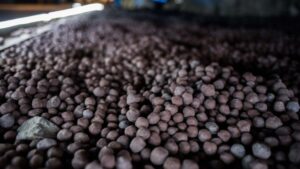
Mining company Ferrexpo with assets in Ukraine, after suspending production since early October at its facilities in the Poltava region due to restrictions on electricity supply due to the shelling of the energy infrastructure by the Russian occupiers, is resuming operations of one pellet production line.
“After suspending its operations in October 2022, the group is now receiving enough electricity to restart one pellet production line. This will allow the group, along with its existing stockpiled products, to fulfill existing contracts with customers,” the company stated in a stock exchange statement Wednesday.
It explains that the company produced about 0.3 million tons of pellets in October-November as a result of disruptions and continued volatility in power supply in the fourth quarter of 2022. Overall pellet production in 2022 is expected to be about 5.9 to 6 million tons (down almost half by 2021 – IF-U).
“Despite the group’s production disruptions, shipments to customers in the fourth quarter of 2022 continued at about 250,000 tons per month,” the press release noted.
As reported, pellet production for the first nine months of 2022 was 5.637 million tons, down 31% from the same period last year.
Ferrexpo in 2021 increased total pellet production by 0.02% over 2020 to 11.220 million tons. The company also produced 234,000 tons of saleable concentrate with 67% iron content (up 28%) in 2021.
Poltava GOK has four pellet production lines.
Ferrexpo is an iron ore company with assets in Ukraine.
Ferrexpo owns 100% of LLC “Yeristovsky GOK” and 99.9% of LLC “Belanovsky GOK”. Before the September 2022 court ruling, Ferrexpo also owned 100% of Poltava GOK PJSC.
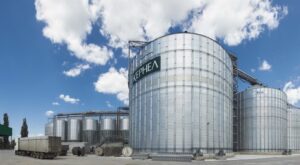
Kernel, one of the largest Ukrainian agro-industrial groups, will not pay dividends for FY2022 (FY, July-2021-June-2022) due to the net loss of $41.1 mln incurred by the holding for the period.
According to the company’s announcement on the Warsaw Stock Exchange Tuesday night, the decision was made by the holding company’s shareholders at a meeting on Dec. 2022.
“Kernel Holding S.A. announces its annual general meeting of shareholders on Dec. 20, 2022, at which it declared a zero dividend for the fiscal year ended June 30, 2022,” the group said in a stock exchange statement.
“Kernel was the world’s number one producer of sunflower oil before the war (about 7% of world production) and its exports (about 12%), and was the largest producer and seller of bottled sunflower oil in Ukraine. In addition, the company was engaged in cultivation of other agricultural products and their realization.
The largest co-owner of Kernel, through Namsen Ltd. is Ukrainian businessman Andrei Verevskyi, with a 39.3% stake.
In FY2022 (July-2021 – June-2022), the holding posted net loss of $41 mln against $506 mln net profit in the previous FY. Its revenue decreased by 5% – to $5.332 bln, while EBITDA decreased 3.7 times – to $220 mln.



