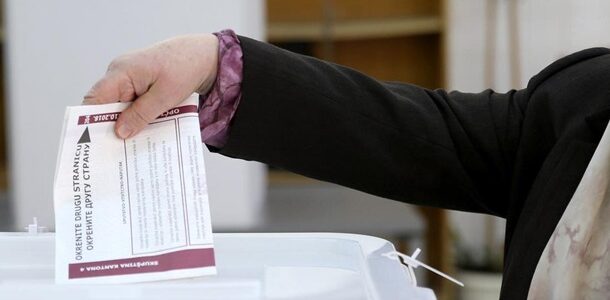
According to the “Serbian Economist,” the Central Election Commission of Bosnia and Herzegovina has scheduled general elections for October 4, 2026, the country’s election commission reports.
About 3.3 million registered voters will be called upon to elect the new composition of the country’s highest authorities at several levels. Voting will take place for members of the collective Presidency of Bosnia and Herzegovina, deputies to the House of Representatives of the Parliamentary Assembly of Bosnia and Herzegovina, the Parliament of the Federation of Bosnia and Herzegovina, the National Assembly of the Republika Srpska, the president and vice presidents of the Republika Srpska, as well as cantonal assemblies within the Federation of Bosnia and Herzegovina.
The elections will traditionally be one of the key political events in the region, as Bosnia and Herzegovina remains a state with a complex system of governance, where a significant portion of decisions depends on the balance between Bosniaks, Serbs, and Croats, as well as on relations between the two entities.
At the state level, citizens elect three members of the BiH Presidency: one Bosniak, one Croat, and one Serb. The Bosniak and Croat members are elected within the Federation of Bosnia and Herzegovina, while the Serb member of the Presidency is elected within the Republika Srpska. At the same time, a state-wide parliament is formed, upon which the work of the BiH Council of Ministers depends.
The elections will take place against the backdrop of ongoing political tensions in the country. In recent years, the Republika Srpska has remained the center of conflicts between the entity’s authorities, BiH state institutions, and the international community. Reuters previously noted that the leadership of the Republika Srpska had been pushing a separatist agenda, which hindered the implementation of reforms and the work of state-level institutions.
For the region, the election results will be significant in terms of Bosnia and Herzegovina’s stability, its European integration, relations with Serbia and Croatia, as well as the role of international institutions that continue to participate in supporting the Dayton system.
Bosnia and Herzegovina is structured as a complex state established following the 1995 Dayton Peace Agreement. The country consists of two main entities: the Federation of Bosnia and Herzegovina and the Republika Srpska, as well as the separate Brčko District with special status. The Federation of BiH, where the majority of the population consists of Bosniaks and Croats, is further divided into 10 cantons with their own authorities. The Republika Srpska has its own government, parliament, and president. The Brčko District formally belongs to both entities but effectively functions as a separate self-governing administrative unit under the sovereignty of BiH.
This system makes BiH one of the most complex countries in Europe in terms of governance. In practice, power is distributed among the state level, the entities, the cantons, and the Brčko District. Therefore, elections in the country are not only a contest between parties but also a test of the balance between different ethnic communities, levels of government, and foreign policy orientations.
Bosnia and Herzegovina, Central Election Commission, ELECTIONS