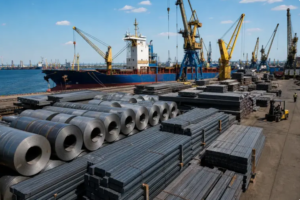
Global steel production in August 2026 fell by 1.2% compared to August of last year, to 144.2 million metric tons, according to data from the World Steel Association (Worldsteel) published on September 24.
The statistics cover 70 countries, which accounted for about 98% of global steel production in 2025. From January through August 2026, they produced 1.225 billion metric tons of steel, which is 0.7% less than a year earlier.
China remains the largest producer, having produced 74.6 million metric tons of steel in August, a 3.7% year-over-year decline. Thus, China accounted for more than half of global output.
India, which ranks second, increased production by 4.6% to 14.8 million metric tons. The United States increased production by 3% to 7.3 million metric tons, while Japan increased production by 0.4% to 6.7 million metric tons.
Russia produced about 5.5 million metric tons of steel, down 0.3% from August of last year, while South Korea increased production by 2.6% to 5.4 million metric tons.
Turkey produced about 3.4 million metric tons of steel, which is 0.4% less than last year’s figure. Brazil’s production fell by 6.2% to 2.7 million metric tons, while Germany increased its output by 1.7% to 2.6 million metric tons.
Among the largest producers, Vietnam showed the strongest growth: the country’s steel production rose by 36.4% to 2.7 million metric tons.
From January through August, China produced 651.9 million metric tons of steel, which is 3.1% less than a year earlier. India increased production by 6% to 115.9 million metric tons, and the United States by 5.5% to 57.5 million metric tons.
The top ten producers since the beginning of the year also include Japan (54 million metric tons), Russia (43.8 million metric tons), South Korea—42.8 million metric tons, Turkey—26.6 million metric tons, Germany—23.9 million metric tons, Brazil—21.8 million metric tons, and Vietnam—20.6 million metric tons.
Vietnam has also shown the fastest growth among this group since the beginning of the year—approximately 29%. Production in Russia fell by 5.1%, in China by 3.1%, and in Brazil by 1.8%.