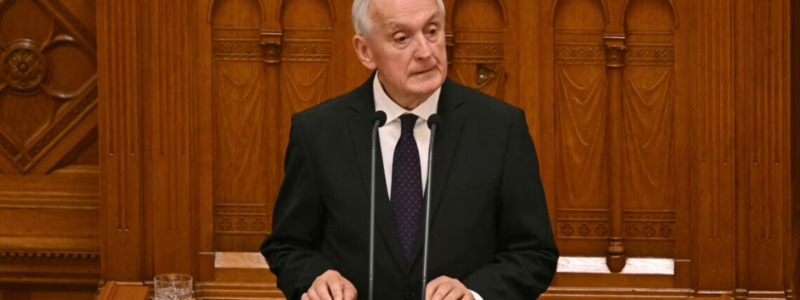
The Hungarian parliament has elected former Supreme Court president András Baka as the country’s new president, marking another important stage in the restructuring of Hungary’s political system following the end of Viktor Orbán’s 16-year rule.
On 11 August, 140 MPs voted for the 73-year-old lawyer, while six voted against. Representatives of the opposition Fidesz party did not participate in the vote, protesting against the early termination of the powers of the previous president, Tamás Sulyok. Baka is due to officially take office on 19 August.
Baka’s election is primarily of political and institutional significance. The president of Hungary does not head the government or determine the country’s economic or foreign policy, but can serve as a constitutional counterweight to the parliamentary majority and the cabinet. This function is particularly important now, as Prime Minister Péter Magyar’s Tisza party holds a constitutional majority in parliament and is carrying out sweeping changes to the institutions shaped under Orbán.
Baka fits well into this political arrangement. From 1991 to 2008, he served as a judge at the European Court of Human Rights, and in 2009 parliament elected him president of the Supreme Court of Hungary. His mandate was terminated early in early 2012 after he publicly criticised the Orbán government’s judicial reforms. The European Court of Human Rights subsequently found violations of his right of access to a court and freedom of expression.
Therefore, Baka’s return to one of the country’s highest public offices almost 15 years later has clear symbolic significance. It demonstrates the new authorities’ intention to distance themselves from the institutional model of the Orbán era while simultaneously making the independence of the judiciary one of the central themes of the political transformation.
“For Hungarian society, this is much more than an ordinary change of president. After sixteen years of dominance by a single political force, any large-scale restructuring of state institutions will inevitably be perceived differently by society. For supporters of change, this is an opportunity to restore the system of checks and balances, while for a significant proportion of Fidesz supporters, what is happening may look like political revenge by the new authorities,” said Oleksandr Poznii, an expert at the Experts Club analytical centre and co-founder and director of the Active Group research company.
According to Poznii, the key test will be the ability of the new institutions to demonstrate genuine independence from Péter Magyar’s government.
“Baka’s main task is not to become the president of the victorious party. If the new head of state can truly distance himself from the government and act as an arbiter between different political groups, this will be an important signal to society. Otherwise, Hungary risks seeing not the dismantling of the former model of concentrated power, but merely a change in the political force controlling that model,” Poznii noted.
The sociologist also draws attention to the high degree of political polarisation in Hungarian society. In such a situation, the significance of the presidential office is determined not so much by the scope of its formal powers as by the trust that different groups of the population place in the head of state.
“In countries with strong political polarisation, symbolic institutions can be far more important than the text of the constitution might suggest. The president may not manage the economy or foreign policy, but he can either reduce the level of conflict in society or, conversely, become another participant in that conflict. Therefore, the main measure of Baka’s success will not be the number of laws he blocks, but whether he can be perceived as the president of all Hungarians,” Poznii emphasised.
Following his election, Baka himself stated that under the previous authorities the system of checks and balances had effectively ceased to function, but stressed that political change should not turn into revenge against supporters of the former government. He also declared his intention to represent citizens with different political views.
Hungary is a parliamentary republic, meaning that the real centre of executive power is located not in the presidential palace, but in the government.
Under the Fundamental Law of Hungary, the president is the head of state, embodies the unity of the nation and is responsible for safeguarding the democratic functioning of state institutions. At the same time, the president has no executive power of his own and does not head the ministries.
Nevertheless, his powers extend beyond purely ceremonial functions. The president signs laws adopted by parliament and, before signing, may return a law to MPs once for reconsideration. If he considers a document to be contrary to the Fundamental Law, he may refer it to the Constitutional Court.
Following parliamentary elections, the president proposes a candidate for prime minister to parliament. He also formally appoints ministers upon the recommendation of the head of government, performs a range of personnel and representative functions, and represents the Hungarian state in foreign relations.
Thus, the head of state can delay certain decisions by the parliamentary majority or initiate a constitutional review of them, but cannot independently determine the country’s political course.
The prime minister, by contrast, is the effective head of the executive branch. The government is the principal body of executive power and public administration, while the prime minister determines its overall political course. It is the prime minister who forms the government team, directs the work of the cabinet and, through the parliamentary majority, implements the principal budgetary, economic, social and foreign policy decisions.
Therefore, the key political figure in Hungary remains Péter Magyar, who came to power following Tisza’s victory in the April parliamentary elections. The party won two-thirds of the seats in parliament, ending Orbán’s 16-year period of uninterrupted rule.
After coming to power, Magyar began seeking the replacement of the heads of a number of state institutions associated with the previous system of government. One of the most notable episodes was the early termination of President Tamás Sulyok’s term of office.
For the new authorities, Baka’s election is particularly symbolic because of his long-standing conflict with the Orbán system. The former president of the Supreme Court is effectively returning to the highest level of state politics after the defeat of the political force under which he lost his judicial post.
At the same time, this is precisely where one of the main risks facing Hungary’s new political system emerges. Tisza holds a constitutional majority and therefore has exceptionally broad powers to change laws and institutions. The new authorities must consequently dismantle the mechanisms created under Orbán while simultaneously proving that they are not replacing them with their own party control.
This is the paradox of Hungary’s new political arrangement: Magyar has obtained an exceptionally strong position thanks to his parliamentary majority, while Baka is expected to embody a limit on the excessive concentration of power.
For Ukrainian audiences, Hungary’s transformation also has foreign policy significance. Following Orbán’s defeat, Budapest’s position on Ukraine has become less confrontational, although Magyar does not present himself as an unconditional supporter of Kyiv and continues to link some bilateral issues to the situation of the Hungarian minority in Transcarpathia.
Therefore, the ultimate criterion for determining whether Hungary has entered a new political era will be not only the departure of officials from the Orbán era, but also whether the new authorities can establish a system of institutions capable of functioning independently of whichever party controls parliament and the government.