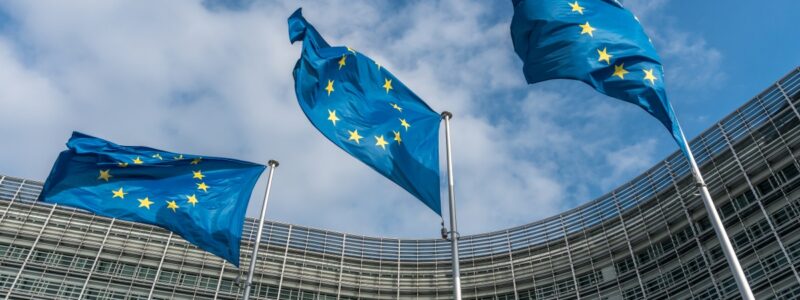
According to Experts.news, the European Commission is preparing proposals to reform the EU enlargement process, which are set to form the basis for a strategic discussion among EU leaders in October 2026. One of the key areas of discussion is the introduction of additional safeguards that would allow for the restriction of certain rights of new member states in the event they violate their obligations to the EU.
The European Commission has confirmed that it is preparing the reform. As early as July 6, an EC representative told Euronews that Brussels was working on its own proposals ahead of the October summit, as member states themselves are increasingly engaged in discussions regarding the new rules.
The European Council has officially confirmed that at its meeting on October 15–16, 2026, EU leaders will hold a strategic discussion on the Union’s enlargement and internal reforms. However, there is as yet no official confirmation that the European Commission will present the final package on October 15 specifically.
One of the most discussed options is a temporary restriction on certain voting rights of new member states.
Back in June, Germany, France, the Netherlands, Belgium, and Luxembourg proposed discussing the possibility of a transition period during which new EU members would be unable to block decisions in the most sensitive areas, where unanimity among all countries is currently required.
This primarily concerns foreign policy, the EU budget, and the Union’s further expansion.
In addition, the five countries propose including special safeguard mechanisms in future accession treaties. These would allow measures to be taken against a new member state in the event of a serious deviation from the principles of democracy, the rule of law, or media freedom.
These proposals are largely linked to Hungary’s experience under Viktor Orbán, when Budapest repeatedly used the unanimity requirement to block important EU decisions.
However, for now, the discussion centers on reform options rather than newly agreed-upon rules.
This discussion is of the greatest significance for Montenegro, which is currently the most advanced candidate for accession.
According to the European Commission, the country has opened all 33 negotiation chapters, 16 of which have already been provisionally closed. Podgorica intends to conclude negotiations and become the 28th member of the European Union in 2028.
European Commission President Ursula von der Leyen stated in June that Montenegro’s accession by 2028 is “achievable.” The EU has already begun drafting the future accession treaty.
Therefore, Montenegro’s accession treaty could potentially become the first document of a new generation, providing additional guarantees for the EU following the country’s admission.
However, the European Commission is concerned about a scenario in which new conditions would be developed exclusively for Montenegro. That is why Brussels wants to establish a universal approach that can also be applied to future candidate countries.
The reform will be of direct importance to both Ukraine and Moldova.
Negotiations with both countries accelerated significantly in the summer of 2026. In June, the EU opened the first negotiation cluster with Ukraine and Moldova, focusing on fundamental issues—the rule of law, democratic institutions, and public administration. In July, negotiations also made progress on foreign policy issues.
That said, Ukraine and Moldova are much further from concluding negotiations than Montenegro.
For Kyiv, the future model is particularly important: if the EU does indeed introduce transitional restrictions on the right of veto, Ukraine could potentially gain full membership but would initially have limited ability to block decisions in certain areas.
At the same time, such a system could facilitate political consensus on Ukraine’s membership within the current EU, as some member states fear that expanding from 27 to more than 30 members would significantly complicate decision-making.
The assertion that France, Germany, and the Netherlands are generally opposed to rapid EU enlargement requires clarification. These countries support further enlargement but belong to a group of states that demand prior strengthening of institutional safeguards and stricter oversight of future members’ compliance with the rule of law. Together with Belgium and Luxembourg, they have proposed developing a new template for accession treaties.
France, in particular, takes a cautious stance regarding Ukraine’s accelerated accession. Officials in Paris are concerned about the budgetary implications, the impact of Ukraine’s large agricultural sector on the single market, and the potential for the decision-making process to become more complicated in an expanded EU.
Germany, on the other hand, actively supports enlargement but at the same time insists on reforming the European Union itself and is considering options for the gradual integration of new member states.
Essentially, the debate boils down to an attempt to resolve the tension between two objectives.
On the one hand, the geopolitical situation is prompting the EU to accelerate the accession of Montenegro, Albania, Ukraine, and Moldova. Brussels views enlargement as a tool for strengthening European security and limiting the influence of Russia and China in the Western Balkans and Eastern Europe.
On the other hand, existing member states are reluctant to admit new members who, once admitted, could use their veto power to exert pressure on other EU countries.
Therefore, the future model may be based on the following principle: full membership is granted more quickly, but some of the new member state’s political tools remain limited during a transition period, and compliance with obligations continues to be monitored even after accession.
The final parameters of such a system have not yet been agreed upon. The main political discussion is set to take place at the European Council on October 15–16, 2026, after which it will become clearer which of the proposed mechanisms may be included in the future accession treaties for Montenegro, Ukraine, Moldova, and other candidates.