

The U.S. dollar is getting stronger against the euro and the pound sterling after declining in the previous session, but it keeps getting cheaper in pair with the yen.
The ICE index showing the dollar’s movement against six currencies (euro, Swiss franc, yen, Canadian dollar, pound and Swedish krone) is gaining 0.16%, while the broader WSJ Dollar Index is 0.12%.
The ICE dollar index fell sharply Thursday after the release of U.S. inflation data, near its lowest level in seven months.
U.S. consumer prices (CPI) rose 6.5% in December compared to the same month last year, the nation’s Labor Department said Thursday. Thus, inflation slowed from 7.1% in November to its lowest level since October 2021. Consumer prices fell 0.1% from the previous month, the first month-over-month decline since 2020.
Traders believe the Federal Reserve (Fed) may slow the pace of prime rate hikes to 25 basis points at its next meeting due to slowing inflation, Trading Economics noted.
The euro/dollar pair is trading at $1.0840 as of 8:00 a.m., up from $1.0854 at the close of the previous session. The pound/dollar exchange rate dipped to $1.2182 during trading on Friday from $1.2212 the day before.
On Thursday, the dollar depreciated by 0.9% against the euro and by 0.5% against the pound.
The value of the American currency in pair with the yen continued to decline on Friday after a 2% decline the day before.
The exchange rate of the dollar fell to 129.19 yen during the trading session, compared to 129.3 yen at the close of the previous one.
JPY was supported by the report of the Japanese newspaper Yomiuri Shimbun that the leaders of the Bank of Japan plan to discuss the unintended consequences of their approach to the monetary-credit policy at the meeting that will be held on January 17-18.
According to the newspaper, the Japanese Central Bank will consider adjustments to monetary policy, including by changing the conditions of the bond purchase program to “reduce its negative impact.
Experts interrogated by Bloomberg expect that the Japanese Central Bank will pass to toughening of monetary policy earlier than it was supposed before.
Almost all respondents of the agency forecast that the Bank of Japan won’t change the main parameters of its policy next week. At the same time 38% of respondents expect its adjustment either in April or in June.

Oil prices are down on Friday, but finished the week with a strong increase due to signals of increased demand in China.
Chinese authorities significantly raised oil import quotas for local companies, which suggests that refineries are about to increase production.
Investor optimism about the prospects for the U.S. economy provides additional support to the market, notes Bloomberg. Statistics data published the day before showed a slowdown in inflation in the U.S., which reinforced expectations of an imminent end to the cycle of base interest rate increases in the country.
The cost of March futures for Brent crude oil on London’s ICE Futures exchange was $83.67 a barrel by 7:15 a.m. on Friday, down $0.36 (0.43%) from the previous session’s closing price. Those contracts rose $1.36 (1.7%) to $84.03 a barrel at the close of trading on Thursday.
The price of WTI futures for February crude oil at electronic trades of NYMEX fell by $0.22 (0.28%) by that time to $78.17 per barrel. By closing of previous trades these contracts grew by $0.98 (1.3%) to $78.39 per barrel.
U.S. consumer prices (CPI) rose 6.5% in December from a year earlier, the Labor Department said Thursday. Thus, inflation slowed from 7.1% in November, the lowest since October 2021. Consumer prices fell 0.1% from the previous month, the first month-over-month decline since 2020.
“The inflation data show that the Fed is probably almost done with the rate hike and the U.S. economy will be able to avoid a recession,” notes OANDA chief analyst Edward Moya, quoted by Market Watch.
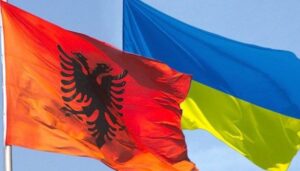
Albania intends to open an embassy in Ukraine – for the first time during the period of diplomatic relations between the countries, Albanian Foreign Minister Olta Djacka said on the occasion of the 30th anniversary of diplomatic relations between the countries.
“Albania and Ukraine are part of the family of free democratic nations, the future of both is in the Euro-Atlantic family. On the occasion of the 30th anniversary (of diplomatic relations – IF-U) I am pleased to announce that Albania will expand its diplomatic presence in Kiev by opening an embassy in Ukraine,” she wrote on Twitter.
The foreign minister added that Ukraine’s heroic resistance is a fight for freedom and a rejection of a return to the tyranny from which both states emerged.
“That is why Albania will support Ukraine and its people as best it can until they are defeated in the illegal war of aggression by the Russian Federation,” Olta Djacka explained.
The minister stressed that she looks forward to working closely with her Ukrainian counterpart Dmitry Kuleba to further develop and strengthen cooperation in the future.

The Verkhovna Rada of Ukraine adopted as a basis the “agricultural” bill #8166-d, which introduces the regime of export security and regulation of the balance of payments of Ukraine for exports of agricultural products during martial law, which allows to ensure the full and timely receipt of foreign currency proceeds.
MP Yaroslav Zheleznyak (Golos faction) said in a Telegram channel that draft law No. 8166-d “On Amendments to the Customs Code of Ukraine and other laws of Ukraine on the introduction of special export procedures during martial law, state of emergency” was adopted as a whole at Thursday’s meeting by 231 votes (with the minimum required 226).
According to the explanatory note to the document, the bill allows the export of goods subject to the export security regime exclusively to legal entities – value added tax payers, whose registration is not suspended. In addition, in order to export goods for which the export security regime is applied, they will need to have a positive history in terms of the return of foreign currency proceeds for the previous six months and the absence of violations of currency legislation.
It is specified that if the exporter does not have a positive history or if its volume of export transactions considerably exceeds the previous six months, a legal entity must register the relevant tax invoices in the Unified Register of tax invoices.
“In such case the exporter will receive the right for budget refund for operations on export of goods outside the customs territory of Ukraine, in relation to which the export security regime is applied, only if the bank of Ukraine, which services such taxpayer, completes currency supervision over the resident’s compliance with the deadline for settlements of the respective operation on export of goods,” the explanatory note to the document specifies.
According to the author of the bill, such measures are caused by a significant debt of non-residents to the Ukrainian subjects of foreign economic activity, which amounted to $7.37 billion as of January 1, 2022, of which $5.08 billion was owed on export operations. At that, during nine months of 2022, the debt increased to $7.62 billion, and the debt on export operations increased to $5.45 billion.
“The adoption of the bill will facilitate the receipt of foreign currency proceeds and will prevent unjustified capital flight from the state by creating safeguards to reduce the cases of purchase of agricultural products for cash and the subsequent export of these products without the return of foreign currency proceeds from such transactions in Ukraine,” the explanatory note to the bill states.
Earlier, the Ministry of Agrarian Policy and Food of Ukraine specified that the draft law No. 81660-d agreed with the agrarian sector was proposed instead of the draft law No. 8166 the provisions of which were strongly criticized by agricultural associations. The amended document allows farmers to use the tax credit as collateral for the return of foreign exchange earnings and not to use working capital, as it was stipulated in the basic version of the bill.
According to the ministry, the document allows legal agribusiness to export agricultural products without any additional regulation within the established limit. The monthly amount of this export limit is calculated as double the amount of the average monthly volume of foreign exchange earnings returned by a legal entity, calculated for the previous six months. Within the limit, exports can be made according to the current procedure, without any additional legislative regulation.
In the event that the company’s export needs exceed the calculated limit, a tax invoice at the rate of 14% must be registered for this overtime amount. After the foreign currency proceeds are returned, it is possible to adjust such an invoice at the tax rate from 14% to 0% and receive a VAT refund on it.
“In fact, this makes it possible to use a tax credit as collateral for the return of foreign currency proceeds, and not just cash in hand, as it was envisaged in the basic version of the bill,” the Ministry of Agrarian Policy emphasized in the message.

The agricultural service cooperative (ASC) Ukrainian Agro Connection, founded by the owner of A.G.R.. Group owner Misak Khidiryan, is working on the creation of a Water Users Organization (WUO) in the Mykolayiv region.
The project is planned to be implemented on a part of Inguletskaya irrigation system in Mykolaiv region, the Chairman of the cooperative Bogdan Kupriyanov told Interfax-Ukraine.
According to him, OVP as a legal entity is created by owners or users of agricultural land for the use and maintenance of engineering infrastructure of state land reclamation systems. The purpose of its creation is to provide irrigation services for land plots in the WUA service area.
In addition, the establishment of the WUA on the Inguletskaya irrigation system as one of the largest irrigation systems in Ukraine will contribute to strengthening the economy, ensuring food security of Ukraine and preventing the negative effects of climate change.
Kupriyanov specified that now there are three OVPs operating in Ukraine – on the territory of Trushevskaya (Cherkasy region), Suvorovskaya (Odessa region) and Kilchenskaya (Dnepropetrovsk region) irrigation systems. They were registered in December 2022. Thus, the OVP created by the Ukrainian Agro Connection cooperative may well become the largest in the country.
The chairman of the cooperative explained that one of the initiators of the OVP on the Inguletskiy irrigation system was A.G.R. Group LLC “Agro-Dilo” (Partizanske village, Mykolaiv oblast), which in cooperation with other land users will form an initiative group to address organizational issues related to the creation of the WUA. In addition, the initiative group will establish communications with allied water users, address technical, legal and financial issues of the organization.
Head of the Ukrainian Agro Connection noted in his comment that the day before members of the cooperative had met with Taras Kot, First Deputy Head of the State Agency for Land Reclamation and Fishery and got the agency’s support, discussed prospects and advantages of creating WUAs in the region as well as opportunities and ways to attract international investors and grants for development and operation of the land reclamation system.
He said that Inguletskaya irrigation system provides services for land irrigation on the territory of 121,5 thousand hectares, 103,3 thousand hectares of which are in Nikolaev region and 18,2 thousand hectares – in Kherson region. The system consists of two pumping stations with total capacity of 58.6 thousand kW and a capacity of 62.4 cubic meters of water per second. The total length of the main and distribution channels is 343 km, and there are 621 hydraulic structures.
Kupriyanov also underlined, that on the 10th of March this year the cooperative organizes the meeting of Ukrainian agrarians with government representatives, agribusiness experts and cooperators, in order to determine the main problems of the branch and to find the ways of their solution together.
As it was reported, on August, 27, 2022 the Cabinet of Ministers of Ukraine has approved the model statute of OVP that regulates the main aspects of such organizations, their legal status, the order of creation of such legal entities, OVP managing bodies and their authorities, main directions of OVP activity, the order of business activity and OVP termination. Already in December of the same year there were created 3 TCCs.
The cooperative Ukrainian Agro Connection was created at the end of 2021. It consists of farmers with a total land bank of 17 thousand hectares.
The members of the cooperative have an opportunity to sell general grain lots under direct export contracts, rent and lease agricultural machinery without disrupting the harvesting period. The cooperative helps them with the additional processing and storage of grain. It also gives them the opportunity to get discounts and preferential rates for the services of a network of partners, including banks, leasing and transport companies, suppliers of agricultural machinery, spare parts, fuel and fertilizers.
A.G.R. Agroholding. Group includes more than 20 companies. The main fields of its activities are trading of agricultural products, cultivation and storage of grain crops, and livestock breeding.
A.G.R. Group cultivates land in Poltava, Kiev, Chernigov, Nikolaev and Sumy regions. The grown products are sold on foreign markets.
The president of the holding and head of its supervisory board is businessman Misak Khidirian.

The 19th Extraordinary Congress of Judges of Ukraine elected all eight members of the High Council of Justice (HCJ) according to its quota in Kyiv on Thursday, the Council of Judges of Ukraine has said.
“The delegates of the 19th Extraordinary Congress of Judges of Ukraine elected all eight members of the High Council of Justice according to the quota from the judiciary,” it said on the website.
Judge of the Civil Cassation Court under the Supreme Court Serhiy Burlakov, who was elected during the second round of secret ballot, became the eighth member of the Supreme Court, the Council of Judges said.
“Thus, the 19th Extraordinary Congress of Judges of Ukraine elected all eight members of the High Council of Justice, which will allow the resumption of the work of the body of judicial self-government, unblock a number of processes in the judiciary related to the work of the courts and personnel issues, as well as continue the implementation of tasks related to judicial reform,” it said.
Thus, according to the quota of the judicial community, Judge of the Kharkiv Court of Appeal Alla Kotelevets, Judge of the Civil Cassation Court under the Supreme Court Hryhoriy Usyk, Judge of the Lviv District Administrative Court Oleksandr Sasevych, Judge of the Economic Court of Donetsk Region Yulia Bokova, Judge of the Northern Economic Court of Appeal Olha Popikova, Judge of the Mykolaiv Court of Appeal Tetiana Bondarenko, Judge of the Kherson District Administrative Court Olena Kovbiy, Judge of the Civil Cassation Court under the Supreme Court Serhiy Burlakov became members of the HCJ.
All newly elected members of the HCJ have taken the oath and will work in the body of the judiciary for the next four years.
“The election of candidates from the Congress of Judges of Ukraine will allow unblocking the work of the High Council of Justice and restore its institutional ability to make decisions, since with the newly elected members the quantitative composition of the HCJ will be 15 people, and this is the necessary quorum for the work of a collective body,” the Council of Judges said.
As reported, the G7 Ambassadors’ Support Group in Kyiv said it expects the appointment of eight new members of the High Council of Justice from the candidates vetted by the Ethics Council.
“G7 ambassadors look forward to the Congress of Judges appointing eight 8 new members of the High Council of Justice from the pool of candidates vetted by Ethics Council. Making the HCJ operational ASAP is an important step in Ukraine’s judicial reform, in line with its European path,” it said on Twitter on Tuesday.
The 19th Unscheduled Congress of Judges of Ukraine will be held on January 11-13.



