

KYIV. May 5 (Interfax-Ukraine) – Two more Ukrainian companies, Cheese Club (Kaniv, Cherkasy region) and PJSC Vinnytsia Roshen Dairy Factory, have been allowed to export dairy products to the European Union.
“Ukrainian companies are increasingly gaining the markets of the EU member states. Two more companies, Cheese Club and Vinnytsia Roshen dairy plant, have got the right to export dairy products to the EU market,” Deputy Minister of Economic Development and Trade Natalia Mykolska wrote on her Facebook page.
According to her, after the introduction of free trade with the EU more and more companies and manufacturers are entering the EU market. In particular, Milk Alliance group of companies was first among dairy companies in Ukraine to start exports to the EU.
Ukrainian manufacturers in 2015 also increased exports of berries to the EU. The leaders in exports growth were raspberry (up by 90%), strawberry (65%), and blueberry (64%).
KYIV. May 5 (Interfax-Ukraine) – OTP Bank (Kyiv) saw UAH 327.3 million of profit in January through March 2016 compared to loss of UAH 1.1 billion year-over-year, the bank has said in a press release.
Net interest income increased by 5.2%, to UAH 779.1 million.
Net fee income totaled UAH 174.2 million and this was 32.3% up year-over-year.
Assets in Q1 2016 increased by 7%, to UAH 22.7 billion.
A slight expansion of the entire deposit portfolio over the period by UAH 463 million was seen, to UAH 18.8 billion. Deposits of individuals grew by UAH 571 million, to UAH 9.3 billion and companies’ funds amounted to UAH 9.5 billion.
The entire credit portfolio in Q1 2016 increased by UAH 1.5 billion, to UAH 27.2 billion mainly thanks to growth of credits and debts of companies by UAH 1.3 billion.
Regulatory capital as of April 1, 2016 totaled UAH 1.75 billion.
Current liquidity – 64.43% (NBU’s requirement is no less than 40%).
OTP Bank was founded in 1998. Its sole shareholder is Hungary’s OTP Bank Plc. OTP Bank is part of OPT banking group, which also includes OTP Factoring Ukraine LLC, AMC OTP Capital, OTP Leasing LLC, and OTP Credit LLC.
OTP Bank ranked 13th among 123 banks operating in the country on October 1, 2015 by total assets (UAH 23.055 billion), according to the National Bank of Ukraine.

KYIV. May 5 (Interfax-Ukraine) – Ukraine and China will begin intergovernmental consultations on the liberalization of the visa regime between the two countries in May.
The corresponding agreement was reached after the talks between Chinese and Ukrainian foreign ministers, Wang Yi and Pavlo Klimkin, on the sidelines of the 5th meeting of foreign affairs ministers of Member States and Observers of the Conference on Interaction and Confidence Building Measures in Asia, which was held in Beijing on Wednesday, Chinese Ambassador to Ukraine Zhang Xiyun said at the second national forum on the support of export in Kyiv on Thursday.
“Yesterday, the two ministers [of foreign affairs] of Ukraine and China agreed to start the dialogue on the liberalization of the visa regime [between the countries]. The consultations on the liberalization of the visa regime will start on May 10,” he said.
According to the Chinese ambassador, since the beginning of 2016, a simplified visa regime for foreign citizens, including Ukrainians, has been already effective in Shanghai, Hangzhou and Nanjing.
Ukraine has made an important step towards the reform of the energy sector in line with European standards.
The National Commission for Energy, Housing and Utilities Services Regulation has for the first time introduced methods of forming a wholesale and retail price of electricity and the limit prices of the power grids, having thus fulfilled the requirements of the Antimonopoly Committee of Ukraine. The market-oriented procedure for determining energy prices allows for minimizing administrative interference in the energy sector and fully meets the European principles and international commitments of Ukraine. Work on the new approach lasted for more than a year and a large circle of participants were engaged, namely these were experts, representatives of power generating companies, the regulator itself and related ministries.
Since the creation of the current model of Ukraine’s electricity market, no document has been prepared before to regulate the formation of the wholesale market price: its components, criteria and the grounds for review. It resulted in the situation when power rates were set in far from the transparent way, assets between power generation companies were distributed in a manual mode, the market remained unpredictable, and there was no correlation between the prices of energy resources in the world and Ukraine.
Previously, the price of coal produced by state enterprises in Ukraine was set up by the regulators, and often did not cover production costs. Senior analyst at Dragon Capital Denys Sakva said that “the new approach will help break the vicious circle of mutual debts owed by thermal power plants, state-run enterprise Energomarket, and Ukrainian coal mines.”
Head of Ukraine’s National Commission for Energy, Housing and Utilities Services Regulation Dmytro Vovk sees two steps that one may take to resolve the situation. “The first one is to develop the guidelines for the formation of the wholesale and retail price while the old model of the market is in operation. And the other step is a new law on the electricity market, which would foresee a liberal pricing model for power generating companies with a fully competitive market, and the Commission will set prices for power rates. What is more, we think that several synchronized measures need to be taken to ensure a comprehensive approach,” Vovk said.
Amid the absence of the full-fledged coal market in Ukraine, global indices: API2 (Amsterdam, Rotterdam, Antwerp), API4 (Richards Bay, South Africa), Argus / McCloskey’s Newcastle were used as the benchmark for prices. Thus, the formation of prices of energy resources on the basis of prices in the international markets is already used in the gas sector of Ukraine.
“To form the prices of coal to set tariffs, we should consider the following parameters: API2, logistics and fixed costs. API2 is a key index for Europe, used for coal shipments to Europe. 90% of coal derivatives in the world are quoted on the basis of API2. Logistics is calculated in the following way: freight – delivery to Ukraine and rail transportation inside Ukraine. The reasons for this are the following: 40% of the coal that should be shipped to the Ukrainian thermal power plants in accordance with the Energy Ministry’s balance is A grade coal, which is not produced in Ukrainian-controlled territory. And the Commission takes measures to create conditions for regular and smooth coal supplies to the thermal power plants,” Dmytro Vovk said.
Denys Sakva adds that the formation of the wholesale and retail price based on the global indices makes pricing more transparent and minimizes the subjective factor of intervention by officials. “Pegging coal prices to international indices and avoiding forcible fixing of prices by the Fuel and Energy Ministry will remove the subjective component in setting tariffs. This is a more market-oriented method, which has not been used before at all,” Denys Sakva said.
Transparent pricing in the electricity sector is one of the basic conditions for the integration of the power grids of Ukraine and the EU (ENTSO-E). In 2011, Ukraine became a member of the Energy Community. One of the main objectives of the organization is to attract investments in power generation and boost competition. The transition to the unified principles of market pricing of electricity to stimulate its economy and transparency of energy markets is part of the coalition agreement.
“We believe that today we need to move the way as the Europeans did. [We need to] merge the markets to ensure that a larger number of players could come up with their bids. This requires technical measures and capital investment, but the Commission is ready to support these requests, allocate funds in the tariff for Ukrenergo, a backbone operator, in order to let the merger happen until the electricity market has been introduced. According to the draft law, which we have developed, the market will finally start operating from January 1, 2019.
Even if we move to market-oriented prices of coal, we still have the problem when Ukrainian thermal power plants are unable to compete. It could firstly be solved by replacing old facilities with newer ones. Because almost all of them are significantly worn out. They should be replaced with more efficient equipment that will meet international standards or at least the standards of the market which we are being merged with,” Vovk said.
It should be noted that the Commission on March 3, 2016, issued resolution No.289, which endorsed the procedure for forming the target wholesale and retail price of electricity.
KYIV. May4 (Interfax-Ukraine) – Exporter of sunflower oil Kernel-Trade, part of Kernel Group, has raised a $5 million credit line from Pravex-Bank (Kyiv).
“The general credit agreement with a limit of $5 million was signed for three years. A credit was issued for 12 months to finance current operations,” the bank said in a press release.
The bank said that there are prospects to credit agro-industrial complex – both producers and processing companies.
Pravex-Bank was founded in 1992. Its only shareholder as of October 2015 was Intesa Sanpaolo S.p.A.
Kernel is a vertically integrated company which has been operating in the Ukrainian agribusiness sector since 1994. The group produces sugar and sunflower oil, distributes bottled oil under the brand names Schedry Dar, Stozhar and Chumak Zolota, exports oil and grain, and provides elevator storage services for grain and oilseeds.
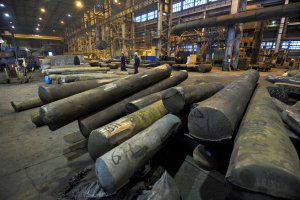
KYIV. May 4 (Interfax-Ukraine) – Zaporizhia Titanium and Magnesium Combine LLC has become a supplier of titanium sponge to Italy’s TiFast S.r.l., a titanium products manufacturer.
The Ukrainian enterprise said in a press release on Thursday that TiFast specialists performed an audit of the combine and the enterprise also obtained the EN 9100 aerospace industry standard certificate.
TiFast has been operating on the market for over 10 years and it is a large player on the European titanium market. The company’s core business is production of ingots, slabs and bars made of titanium and its alloys. TiFast is a member of the International Titanium Association. The Italian manufacture has the UNI EN ISO 9001 certificate permitting supply of products for bio-medical and aerospace industries.
“TiFast for Zaporizhia Titanium and Magnesium Combine is a second global company after China’s BaoTi that confirmed that the quality of titanium sponge of the enterprise fully meets international requirements. This means that the Zaporizhia enterprise’s products could be used without restrictions in production of any goods, including bio-medical and aerospace products,” Zaporizhia Titanium and Magnesium Combine Director Volodymyr Sivak said.
Zaporizhia Titanium and Magnesium Combine in August 2015 received an EN 9100:2009 standard certificate from Bureau Veritas. This helped the enterprise to register its products in the Online Aerospace Supplier Information System (OASIS). The enterprise started performing audits by global titanium goods manufacturers.



