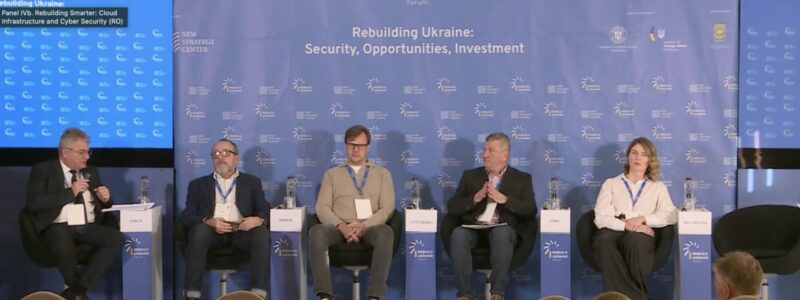
At the Rebuilding Ukraine: Security, Opportunities, Investments forum in Bucharest, participants in a panel discussion on the role of the private sector in Ukraine’s reconstruction emphasized that attracting private capital is critical for the implementation of large-scale projects, but its participation is impossible without effective mechanisms for financing, insurance, and reducing investment risks.
The panel “Private Sector – A Key Actor in the Reconstruction of Ukraine. Financing and Insurance Instruments” was moderated by Victor Srayer, managing partner of Otto Broker (Romania). The discussion was joined by Volodymyr Tsabal, secretary of the Verkhovna Rada Committee on Budget, and Susan E. Walton, senior advisor on new markets – global risks and sustainability (USA) Susan E. Walton, CEO of BCR – Romanian Commercial Bank Sergiu Manea, Director of Legal and External Relations at Vodafone Romania Alexandra Olaru, and JBIC Regional Head for EMEA, Resident Executive Officer of the Japan Bank for International Cooperation Takayuki Sato.
Participants noted that the private sector, both Ukrainian and foreign, faces a double challenge. Ukrainian companies have limited access to debt financing due to high interest rates, war risks, and domestic capital market constraints. Foreign investors, in turn, are forced to take into account political and military risks, as well as regulatory peculiarities of working in Ukraine.
The main solutions identified were the use of blended financing instruments, the involvement of international financial organizations to cover part of the risks, and the creation of a guaranteed framework by the state and partners that makes projects “bankable” for commercial structures. “For private capital to enter the reconstruction process, investors need to clearly see which risks are assumed by the state and international financial institutions, and which are assumed by themselves. Without this, projects either do not start or remain at the conceptual level,” Manea noted.
Special attention was paid to the role of political and military risk insurance, as well as the importance of transparent information and local partner networks. According to the speakers, successful project implementation requires strategic coordination between government agencies, donors, and private businesses, particularly in terms of selecting priority projects, structuring agreements, and monitoring their implementation.
The panel participants also emphasized that reconstruction is impossible without reliable digital and energy infrastructure. The experience of neighboring countries that have undergone large-scale infrastructure programs can be used to implement practical solutions in Ukraine. “Private capital, combined with government support and good governance, can significantly accelerate post-war recovery. The state’s task is to create predictable rules of the game and an institutional environment that will make this possible,” Walton concluded.
Following the discussion, participants concluded that the private sector has significant potential in rebuilding Ukraine, but that realizing this potential depends on the availability of financial instruments, effective insurance protection mechanisms, and coordinated action between public and private actors.
The forum “Rebuilding Ukraine: Security, Opportunities, Investments” is being held on December 11-12 in Bucharest under the auspices of the Romanian Ministry of Foreign Affairs and the Ukrainian Ministry of Foreign Affairs and is organized by the New Strategy Center. According to the organizers, more than 30 panel discussions and parallel sessions are planned over two days with the participation of representatives of governments, international organizations, the private sector, financial institutions, and experts from Europe, North America, and Asia. The topics of the panels cover security and defense, infrastructure, financing and investment, green energy, digitalization, human capital, and cross-border cooperation.