
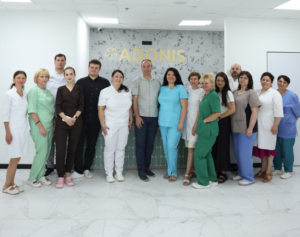
The ADONIS network of medical centers has reopened its branch at 8-B Raisa Okipna Street in Kyiv following renovations to the premises and medical facilities, as well as the installation of new diagnostic and treatment equipment.
According to a press release from ADONIS on July 30, 2026, the center is once again seeing adult and pediatric outpatients, providing diagnostic services, and has resumed operations at its same-day surgery unit.
The diagnostic and pediatric departments are located on the first floor of the medical center. Patients have access to CT scans, X-rays, mammograms, ultrasound diagnostics, and laboratory tests conducted in the center’s own laboratory.
Consultations are provided by pediatricians, family physicians, infectious disease specialists, allergists, pulmonologists, and orthopedic surgeons. Under the National Health Service of Ukraine’s (NSZU) medical guarantee program, patients with a health declaration can receive free consultations with a pediatrician and a family physician. The center also conducts screenings under the “Health Screening 40+” program.
The Department of Clinical Research and the educational center are located on the second floor. Patients can participate in clinical trials conducted at ADONIS. The center is also used for medical resident rotations and continuing professional development events for healthcare professionals.
The fourth floor houses the adult outpatient clinic, the same-day surgery unit, endoscopy, dentistry, and rehabilitation medicine. Consultations are provided by more than 20 specialists in various fields, including internists, cardiologists, gastroenterologists, endocrinologists, gynecologists, urologists, surgeons, neurologists, ophthalmologists, breast specialists, and otolaryngologists.
The branch also offers dermatology, trichology, dermatosurgery, non-invasive cosmetology, and regenerative medicine. For the diagnosis of skin and hair conditions, the clinic uses the HEINE DELTAone dermatoscope, the Aram Huvis API digital trichoscope, and a Wood’s lamp.
The day surgery department performs minimally invasive procedures and treatments on an outpatient basis without the need for extended hospitalization. The endoscopy department offers diagnostic procedures, including those performed under sedation.
The Dental Department provides therapeutic and surgical care for adults and children. Dental treatment under sedation is also available. The network plans to further expand the range of medical services at the renovated branch.
The medical center is located about a seven-minute walk from the “Livoberezhna” metro station. It is open Monday through Friday from 8:00 a.m. to 8:00 p.m., Saturday from 8:00 a.m. to 7:00 p.m., and Sunday from 9:00 a.m. to 5:00 p.m.
ADONIS is a Ukrainian network of multidisciplinary medical centers for adults and children, founded in Kyiv in 1997. The network’s first private cardiology and family medicine practice was opened on Raisy Okipna Street. According to the company, by 2026 the network will include medical centers in Kyiv and the Kyiv region and will offer services in 89 medical specialties.

The ADONIS Medical Network (Kyiv) is launching a new format for professional collaboration—a free expert consultation for doctors dealing with complex or ambiguous clinical cases.
According to its press release, the consultation provides an opportunity to obtain a second opinion from the ADONIS team of specialists and jointly determine the next steps in the patient’s diagnosis and treatment.
“In medical practice, there are cases where test results or the opinion of a single specialist are insufficient to make a final decision. The patient may require additional tests, consultations with doctors from different specialties, or a review of the treatment plan already proposed. The consultation does not replace the attending physician but helps them obtain additional expert support,” ADONIS notes.

As the company told the “Interfax-Ukraine” news agency, the new service is designed to ensure continuous medical support for patients and a timely response to changes in their condition outside the hospital.
Home care services include the development of an individualized medical monitoring plan, visits by a nurse or paramedic, in-home doctor consultations, diagnostic procedures, monitoring of the patient’s condition, and, if necessary, the involvement of specialized physicians.
In addition, home care services include the option of emergency hospitalization in the event of a deterioration in the patient’s condition.
“The home care service is designed for patients who require medical assistance outside the clinic, particularly those with limited mobility, a need for regular monitoring, or undergoing rehabilitation. This format allows for a comprehensive approach to treatment without hospitalization, providing patients with high-quality medical care in the comfort of their own homes,” Adonis noted.
Adonis is a multidisciplinary medical center for adults and children, founded in 1997. The medical group includes seven modern clinics in Kyiv and the surrounding region, over 80 medical specialties, its own laboratories, surgical centers, inpatient facilities, and departments staffed by specialized professionals.

The ADONIS Medical Group’s private higher education institution (PHEI) has begun recruiting for its residency program. As Lilia Ponamaryova, ADONIS’s Vice Rector for Strategic Development, told Interfax-Ukraine, the residency program is conducted at ADONIS’s modern medical centers, which are equipped with state-of-the-art equipment.
As part of the new recruitment drive, training programs are now available in the following specialties: surgery, neurology, otorhinolaryngology, dermatology and venereology, orthopedics and traumatology, general practice—family medicine, obstetrics, and gynecology.
Interns will work under the supervision of experienced physicians who serve as mentors and impart practical skills and clinical experience.
“We eagerly await new interns who are eager to develop, learn, and work in modern medicine. ADONIS creates all the conditions for professional growth and the start of a successful medical career,” said Ponamaryova.
She noted that the institute already has a successful track record of training interns, and a systematic training model has been developed at the university that combines theory, clinical reasoning, and real-world practice.
ADONIS emphasizes that the residency program is focused on training doctors who work according to the principles of evidence-based medicine, confidently make clinical decisions, and are ready to work with patients from the very first years of their professional careers.
“Our goal is not simply to produce a certified specialist, but a doctor who thinks critically, analyzes, and takes responsibility for clinical decisions. That is why interns are fully engaged in practical work and learn directly in a clinical setting. A high-quality internship is a key stage in a doctor’s development, and we continue to refine our training programs in line with modern medical standards and the needs of the healthcare system,” said Ponamaryova.
The private higher education institution “Institute of General Practice – Family Medicine” was established in 2007 by the ADONIS medical group to train specialists who will receive a state-recognized diploma in the field of specialized and general medical practice. The institution holds a valid license for medical practice.
Founded in 1997, Adonis is a multidisciplinary medical center for adults and children. The medical group includes seven modern clinics in Kyiv and the region, over 80 medical specialties, its own laboratories, surgical centers, inpatient facilities, and departments staffed by specialized professionals.

Adonis Medical Network has begun cooperation with the National Health Service of Ukraine (NHSU) and is signing declarations to provide primary medical care under the Medical Guarantees Program (MGP).
According to Interfax-Ukraine, as part of the cooperation with the NSHU, patients who have signed a declaration will receive a full range of services under the MGP, including consultations with a family doctor, therapist, or pediatrician, dynamic monitoring of chronic diseases, issuance of sick leave certificates, medical certificates, electronic referrals to narrow-profile specialists, and electronic prescriptions under the Affordable Medicines Program, as well as basic laboratory and instrumental examinations.
According to the National Health Service of Ukraine, 479 private medical institutions and 953 individual entrepreneurs have been contracted for primary medical care under the PMG for 2026.
Founded in 1997, Adonis is a multidisciplinary medical center for adults and children. The medical group includes seven modern clinics in Kyiv and the region, more than 80 medical specialties, its own laboratories, operating centers, inpatient facilities, and departments of specialized specialists.

Adonis Multidisciplinary Medical Center has launched the Metabolic Reset program for weight control and obesity treatment.
According to the center’s press release, the new standard of obesity treatment, Metabolic Reset | GLP-1 clinic, involves a comprehensive medical approach that begins with identifying the causes of weight gain, more than 15 laboratory tests, and seven instrumental studies to assess hormonal balance, metabolic status, insulin resistance, body composition, and internal organ function.
“Based on the results of the study, a personalized treatment strategy is developed: drug therapy, correction of eating habits, and elimination of metabolic disorders,” the clinic notes.
The weight control program at Adonis is led by endocrinologist and therapist Kateryna Komisarenko, who has more than 10 years of experience. She specializes in the treatment of metabolic disorders, insulin resistance, and hormone-related weight gain.
According to a study by STEPS and the Ukrainian Ministry of Health, 59% of the country’s adult population is overweight, and about 25% is obese. This means that virtually one in four Ukrainians is obese.
Founded in 1997, Adonis is a multidisciplinary medical center for adults and children. The medical group includes seven modern clinics in Kyiv and the surrounding region, more than 80 medical specialties, its own laboratories, operating centers, inpatient facilities, and departments of specialized specialists.



