

Ukraine could increase its annual agricultural exports from $24.2 billion to over $100 billion by shifting from exporting raw materials to increasing the production of deeply processed products, which would require $85 billion in investments, said Leonid Kozachenko, president of the Ukrainian Agrarian Confederation (UAC).
“We have the best opportunities among other countries, as almost 30% of the world’s black soil is concentrated in Ukraine. However, it is surprising that a country like the Netherlands, with 4.5 times less land, produces food and derivative products worth about $108 billion. They use less than 20% of their own raw materials, import 80%, but rank 2nd or 3rd in the world, while we, with our raw materials, are only in the third ten,“ he said at the conference ”Profitable Agribusiness 2026.”
According to the expert, the total capitalization losses of the agricultural sector from the Russian Federation’s military aggression are currently estimated at more than $120 billion, while direct losses amount to $11.5 billion. In particular, almost 4.7-5 million hectares of land remain mined or contaminated with heavy metals. Livestock losses amount to 5 million chickens, 350,000 pigs, and 150,000 cows. In addition, more than 7,000 units of agricultural equipment and hundreds of logistics facilities have been lost.
Kozachenko expressed confidence that if the genetic potential of plants and animals is realized by at least 90%, Ukraine will be able to reach production levels of 150 million tons of grain and oilseeds, 25 million tons of milk, and up to 10 million tons of meat.
To realize this potential, according to the UAC president, Ukraine needs to attract $85 billion in investments over the next 10 years. These funds should be directed towards the development of the food, pharmaceutical and perfume industries ($37 billion), livestock farming ($18 billion), crop production ($8 billion), irrigation restoration ($7 billion) and bioenergy development ($5.5 billion). Another $10 billion should be allocated to logistics, horticulture, and greenhouse farming.
To stimulate the development of the agricultural sector, the UAC proposes introducing land and network connection incentives for deep processing plants, introducing a 25% subsidy for equipment, and creating a specialized mortgage banking institution. It is also proposed to involve international companies in the certification of products according to European standards directly in Ukraine.
“We have found financial resources of over $50 billion that were ready to be given to us to create the first mortgage bank in Ukraine. We have everything we need to launch this mechanism, so let’s work together to convince officials to start using it. We really need to cross the $100 billion gross output threshold, and this should be our strategic priority for the next decade,” Kozachenko emphasized.
The UAC president also announced joint proposals from a number of agricultural associations to accelerate the privatization of state-owned enterprises that can be involved in processing chains and to stimulate the development of industrial parks with special fiscal conditions. In particular, agricultural associations propose introducing subsidies of 10% for enterprises that use domestically produced deep-processed raw materials in their production and providing state guarantees to foreign creditors for the purchase of technological equipment.
An important aspect remains the digitization of the industry, in particular the creation of digital platforms for entering global markets, following the example of the Ukrainian resource Allbiz, which specializes in e-commerce and structuring offers in the B2B sector, as well as the introduction of European licensing practices through accredited offices of international certification companies, the UAC president concluded.

Ukraine maintains a significant positive trade balance with a number of key partners, which partially offsets the deficit in relations with China and EU countries.
The largest surplus in the first half of 2025 was recorded in trade with Egypt — $605.0 million. Spain ranks second with a balance of $515.3 million, followed by the Republic of Moldova — $448.4 million. Positive dynamics are also observed in relations with the Netherlands ($357.6 million), Algeria ($276.6 million), and Lebanon ($243.8 million).
Ukraine also has a high trade surplus with Iraq ($189.0 million), Libya ($133.6 million), Saudi Arabia ($128.4 million), and Kazakhstan ($113.6 million).
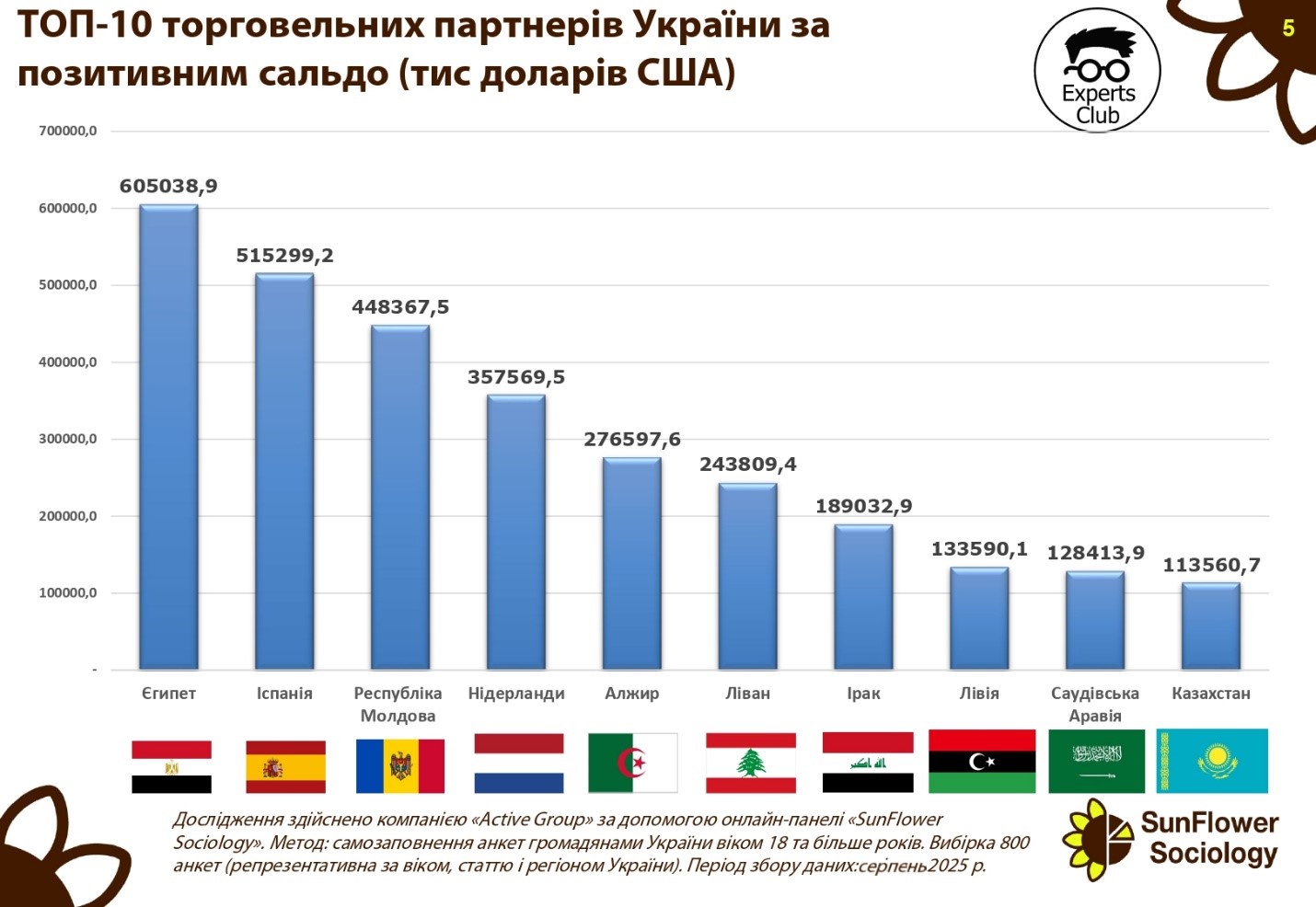
“The positive trade balance indicates that Ukraine is capable of competing effectively in international markets, especially in the agricultural sector and metallurgy. At the same time, it should be borne in mind that these markets are vulnerable to changes in the global economic situation, price fluctuations, and political factors,” emphasized Maksim Urakin, founder of Experts Club and economist.
According to him, maintaining a positive balance in relations with the countries of the Middle East and North Africa is a key element of Ukraine’s foreign trade strategy.
“Egypt, Spain, and the countries of the Arab world are stable importers of Ukrainian agricultural products. This is a strategic direction that needs to be developed further, as it creates a safety cushion for the economy against the backdrop of significant import costs,” Urakyn emphasized.
Analysts note that consolidating positions in the African and Middle Eastern markets could become a long-term factor in strengthening Ukraine’s foreign economic balance.
Agricultural exports, ALGERIA, ECONOMY, EGYPT, EXPERTS CLUB, FOREIGN TRADE, IRAQ, KAZAKHSTAN, LEBANON, LIBYA, MOLDOVA, NETHERLANDS, positive balance, SAUDI ARABIA, SPAIN, UKRAINE, МАКСИМ УРАКИН
The value of Ukrainian agricultural exports in May 2025 rose to $432.7 per ton, which is 37.4% more than a year earlier, when this figure was $315 per ton, said Minister of Agrarian Policy and Food Vitaliy Koval.
“This is clear evidence that Ukraine is increasingly exporting products with higher added value,” he wrote on Telegram.
The minister noted that in May 2025, farmers exported $2.29 billion worth of products, shipping 4.69 million tons.
According to Koval, the top five countries importing Ukrainian agricultural products in May (by value) were Turkey ($404.9 million), the Netherlands ($147.4 million), Poland ($138.3 million), Italy ($127.7 million), and Egypt ($109.8 million).
He recalled that the development of deep agricultural processing is a priority for the Ministry of Agrarian Policy. And it is already yielding concrete results. In May 2025, exports of butter amounted to $20.5 million (2.9 thousand tons), which is $7,077 per ton of product, and exports of juices (fruit and vegetable) amounted to $19.8 million (almost 9 thousand tons) at a cost of $2,213 per ton.
“The figures show that Ukrainian products are competitive and in demand on world markets. We are continuing to work on establishing Ukraine as a supplier of high-quality products with high added value,” the Minister of Agrarian Policy concluded.

Agricultural exports account for more than 50% of Ukraine’s total exports, up 4.5% compared to March 2024, Prime Minister Denys Shmyhal said during a government meeting on Friday.
As he wrote on Telegram, “agricultural exports remain the basis for our trade and account for more than 50% of everything Ukraine sells abroad.”
Shmyhal also informed that last year, exports of Ukrainian goods increased by 13%, and in March of this year, the positive dynamics of export growth continued – plus 4.5% compared to March last year.
“In the face of global trade turbulence, the Ukrainian government will strengthen support for national producers and Ukrainian exporters. We have provided all the necessary tools for this,” the Prime Minister emphasized.
At the same time, he reminded that the “Made in Ukraine” program, in particular, provides UAH 500 million for compensation for the purchase of Ukrainian agricultural machinery. The state compensates farmers for up to 25% of the cost of this equipment if it is made in Ukraine.
“In total, this year we will allocate more than UAH 6 billion from the budget to support the agricultural sector alone,” Shmyhal emphasized.
As reported, Ukraine exported 9.98 million tons of goods worth $3.6 billion in March 2025.
In 2024, Ukraine increased its exports of goods by 15% to $41.7 billion, while agricultural exports brought the country half of 50% of its export earnings of $20.9 billion, according to the review of Ukraine’s economy during the war, which is conducted monthly by the Center for Economic Strategies in cooperation with the German Economic Team (GET).
The analysts noted that the mining and metallurgical complex received $6.9 billion (17%) of export earnings in 2024, the food industry – $3.7 billion (9%), and machine building – $3.6 billion (9%). At the same time, sugar exports in 2024 reached 750 thousand tons and brought producers $420 million, the highest figure since 1997, when Ukraine started keeping statistics.
The top ten export products that brought Ukraine the highest foreign exchange earnings included sunflower oil and corn – $5.1 billion each, wheat – $3.7 billion, iron ore – $2.8 billion, steel and rolled products – $2, 4 billion, rapeseed – $1.8 billion, soybeans and meal – $1.3 billion each, wood and timber – $1.1 billion, poultry – $1 billion, furniture – $0.8 billion, steel pipes and barley – $0.6 billion each, and cast iron – $0.5 billion.
At the same time, total imports in 2024 grew by 11% to $70.7 billion, experts said.
According to their information, the main imported goods last year were oil and oil products – $6.8 billion (10%), cars – $4.4 billion (6%), pharmaceuticals – $2.0 billion (3%), mobile phones – $1.3 billion (2%), fertilizers – $1.2 billion (2%) and drones – $1.1 billion (2%).
Prime Minister Denys Shmyhal says that in the medium term, there is every opportunity to double Ukraine’s agricultural exports and provide food for up to 600 million people worldwide.
“The aggressor is trying to prevent our agricultural exports in every possible way and thus condemn dozens of vulnerable countries to starvation. Fortunately, together with you, our friends and partners, we are successfully counteracting this strategy,” Shmyhal said at the 3rd International Food Security Conference GRAIN FROM UKRAINE on Saturday.
The Prime Minister said that Ukraine has already harvested its third crop during the full-scale war, which amounts to more than 53 million tons of grains and legumes.
He noted that the 2024 harvest is still ongoing and will be sufficient for both domestic needs and exports.
Shmyhal also said that thanks to the Black Sea Logistics Corridor and other routes, Ukraine has restored its export capacity, in particular, in 10 months of 2024, the country exported more goods than in the whole of 2023, and food (sunflower oil, corn, wheat) is the main export structure.
“We supply products to more than 100 countries for more than 400 million people. These are mainly countries in Southeast Asia and Africa. In the medium term, there is every opportunity to double the volume of agricultural exports and provide food to 600 million people around the world,” the Prime Minister emphasized.



