
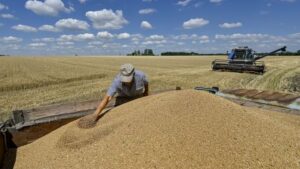
As of late September–early October, agricultural exports from Ukraine—amid Russia’s ongoing blockade of Black Sea ports—amount to up to 50% of the potential volume, Minister of Agrarian Policy and Food Taras Vysotsky told reporters on Friday.
“Without access to deep-water Black Sea ports, we can export about half of our produce—the portion that has been grown and is intended for export. When we talk about the consequences, this means we are unable to export approximately 30 million metric tons of agricultural products worth about $30 billion during the current marketing year,” he noted.
The minister clarified that in September, 2.4 million metric tons were exported—46% of what was supposed to be exported—including 1.4 million metric tons of grains (38%), 444,000 metric tons of oilseeds (83%), oil—311,000 metric tons, or 64%, and meal—280,000 metric tons, or 46% of the potential required exports.
“This 46% figure has, in fact, remained unchanged since September 20. In other words, we are achieving what we predicted: that 45–50% is the objective maximum given the current logistics channels,” Vysotsky concluded.
According to him, 41%—or 993,000 metric tons—was exported by rail, which is in line with forecasts; 54%—or 1.3 million metric tons—via the Danube; and 5%—or 120,000 metric tons—by road.
“In September, we saw an increase in both rail and Danube shipments compared to August,” the minister added.
From September 1 to 21, 2026, Ukraine exported 1.6 million metric tons of agricultural products, which represents 43% of the volume that would have been exported had the logistics system been operating at full capacity, Minister of Agrarian Policy and Food Taras Vysotsky said at a briefing on Thursday.
He specified that 275,000 metric tons of oilseeds were shipped abroad, or 75% of the volume that would have been exported under normal logistics conditions; 190,000 metric tons of oil (55%); 173,000 metric tons of meal (41%); while grain exports totaled 960,000 metric tons (38%).
“We see that the share of grains (compared to potential volumes – IF-U) is the smallest, and, accordingly, the share of oilseeds, oil, and meal is larger. Therefore, yes, as of today, the priority remains on exporting value-added products,” Vysotsky said.
As reported, during the first 15 days of September, Ukraine exported 131,000 metric tons of oil, which accounted for 62% of the volume that would have been exported during this period if the ports had been operating freely.
The European Union is not yet ready to review the volume of quotas for Ukrainian agricultural products, but Ukraine will continue the dialogue on expanding them, particularly with regard to bioethanol, said Minister of Agrarian Policy and Food Taras Vysotsky at a briefing on Thursday.
“The current socio-political situation in the EU does not allow for a review of agricultural product quotas in any category. We will nevertheless continue the dialogue and make our case for what is important,” he said.
According to the minister, one of the areas where Ukraine considers it appropriate to review the quota is bioethanol. Among his arguments, he cited the reduction in EU corn production for bioethanol to about 15 million metric tons and the European Union’s continued imports of corn.
“Essentially, increasing the quota is really just a way to allow the export of bioethanol, which will then be re-exported to Ukraine,” Vysotsky noted.
The head of the Ministry of Agrarian Policy added that Ukraine imports gasoline from the EU that contains about 7% bioethanol.
“We are requesting a quota to export approximately the same amount of bioethanol that Ukraine already imports as part of fuel—in gasoline from the European Union—plus 60,000 metric tons,” the minister explained.

From September 1 to 9, Ukraine exported 630,000 metric tons of grains, oilseeds, and products derived from them, Minister of Agrarian Policy and Food Taras Vysotsky said at a briefing on Friday.
“From September 1 to 9, 630,000 metric tons of grains, oilseeds, and their processed products were exported. As of today, this represents 40% of what we could have exported. We ended August at 33%. Our forecast remains unchanged—to reach 50% of the target for September–October,” Vysotsky said.
According to him, 380,000 metric tons of grains were exported (35% of demand), 94,000 metric tons of oilseeds (64%), 97,000 metric tons of oil (66%), and 60,000 metric tons of meal (33%).
Vysotsky noted that compared to 2025, exports of grains, oilseeds, and their processed products have decreased by 60%.
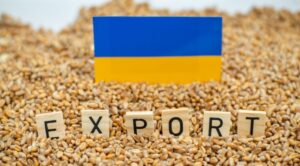
From August 1 to 27, Ukraine exported 47.5% less agricultural produce than during the corresponding 27 days in July—1.726 million metric tons versus 3.287 million metric tons, according to a weekly market review by the brokerage firm Spike Brokers.
According to its data, the decline was less significant in monetary terms—25.6%: exports of goods in groups 01–24 of the Ukrainian Classification of Goods for Foreign Economic Activity (UKT ZED) for the first 27 days of August totaled $1.060 billion, compared to $1.424 billion in July. At the same time, the average price per metric ton of the export basket rose from about $433 to $614, primarily due to a shift in the commodity structure of exports.
The main decline in physical volumes was in grains. Total exports of wheat, corn, and barley fell by 69.5% to 740,000 metric tons. Specifically, 486,600 metric tons of wheat were shipped (-49.8% compared to July), 190,700 metric tons of corn (-84.3%), and 62,600 metric tons of barley (-74.5%). The share of these three crops in total agricultural exports fell from 73.9% to 42.9%, respectively.
At the same time, rapeseed exports surged in August as seasonal shipments began. From August 1–27, rapeseed exports reached 255,200 metric tons, compared to 11,800 metric tons during the same period in July. Rapeseed’s share of total exports rose from 0.4% to 14.8%. Rapeseed oil exports increased more than 4.5-fold, reaching 69,400 metric tons.
The processed products segment contracted significantly less than the grain segment. Exports of the three main vegetable oils—sunflower, rapeseed, and soybean—totaled 234,000 metric tons, down 16.7% from the corresponding period in July.
Exports of sunflower and soybean meal fell to 153,800 metric tons (-6.4%), and sunflower oil exports dropped to 131,300 metric tons (-42.5%); however, shipments of sunflower meal rose to 83,100 metric tons (+28%).
The geography of exports also changed. The largest destinations by physical volume in August were Germany—195.7 thousand metric tons, Italy—159.7 thousand metric tons, Poland—151.9 thousand metric tons, the Netherlands—147.2 thousand metric tons, and Spain—125.3 thousand metric tons. Exports to Turkey fell by 79%—to 114,000 metric tons, down from 544,800 metric tons in July. In contrast, Germany increased its imports from Ukraine by approximately fourfold, largely due to rapeseed.
According to Spike Brokers, 279,3 thousand metric tons of agricultural products were exported by road through border crossings from August 1–27, which is 11.3% more than during the same period in July.
At the same time, rail shipments of grain as of August 26 fell by 42.4% compared to July—to 951,000 metric tons—and by 57% compared to August 2025. The average daily shipment volume was 37,600 metric tons.
Meanwhile, the average daily transit of grain railcars through western border crossings over the first 25 days of August rose to 173.7 railcars, compared to 71.3 railcars in July—a 2.4-fold increase. As of August 26, 9,822 railcars had accumulated en route to the border crossings, of which 1,508 were carrying grain.
At the same time, rail transportation of grain to port stations—including domestic transport to Izmail—decreased by 81.8% during the current period in August, to 230,600 metric tons, compared to 1.265 million metric tons in July.
Only 55,700 metric tons of grain were transported to the ports of Greater Odesa, which is 95.5% less than the July figure. Specifically, shipments to Chornomorsk-Port-Export totaled 31,600 metric tons (-93.5%), to Odesa-Port—17,200 metric tons (-92.2%), and to Chornomorska for TIS—6,600 metric tons (-97.8%).
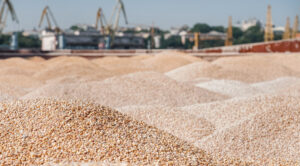
From August 1 to 26, Ukraine exported 1.423 million metric tons of grains, oilseeds, and their processed products via alternative routes, which accounts for one-third of the volume required for this period, Minister of Agrarian Policy and Food Taras Vysotsky said at a briefing on Friday.
“From August 1 to 26, 1,423 thousand metric tons of grains, oilseeds, and products derived from them were exported. This accounts for 33% of the demand for this period. Grains accounted for the smallest share—822 thousand metric tons. For grains, we exported only 21% of the potential demand. The rest consists of oil, oilseeds, and meal. In principle, export volumes in these categories meet current demand,” he said.
Vysotsky noted that exports by rail and via the Danube each amounted to approximately 600,000 metric tons, while road transport remains the smallest in volume—about 80,000 metric tons. Of this volume, about 40,000 metric tons are oilseeds, which is due to the high cost of road transport.
According to him, if the current pace is maintained, Ukraine could export about 1.5 million metric tons of agricultural products via alternative routes by the end of August.
By the end of September, up to 2 million metric tons could be exported via alternative routes, as previously forecast by the Ministry of Agrarian Policy.



