
According to Experts Club, Turkey has the highest net positive sentiment among Ukrainians among the Middle Eastern countries included in the study—44.9 percentage points. More than half of those surveyed—52.3%—view the country positively. At the same time, neutral attitudes prevail toward Saudi Arabia and Jordan, while Lebanon is the only country in this group with a negative balance. This is evidenced by the results of the third wave of the study “Ukrainians’ Attitudes Toward Countries Around the World,” conducted by Active Group in collaboration with Experts Club, according to the Experts Club Information and Analytical Center.
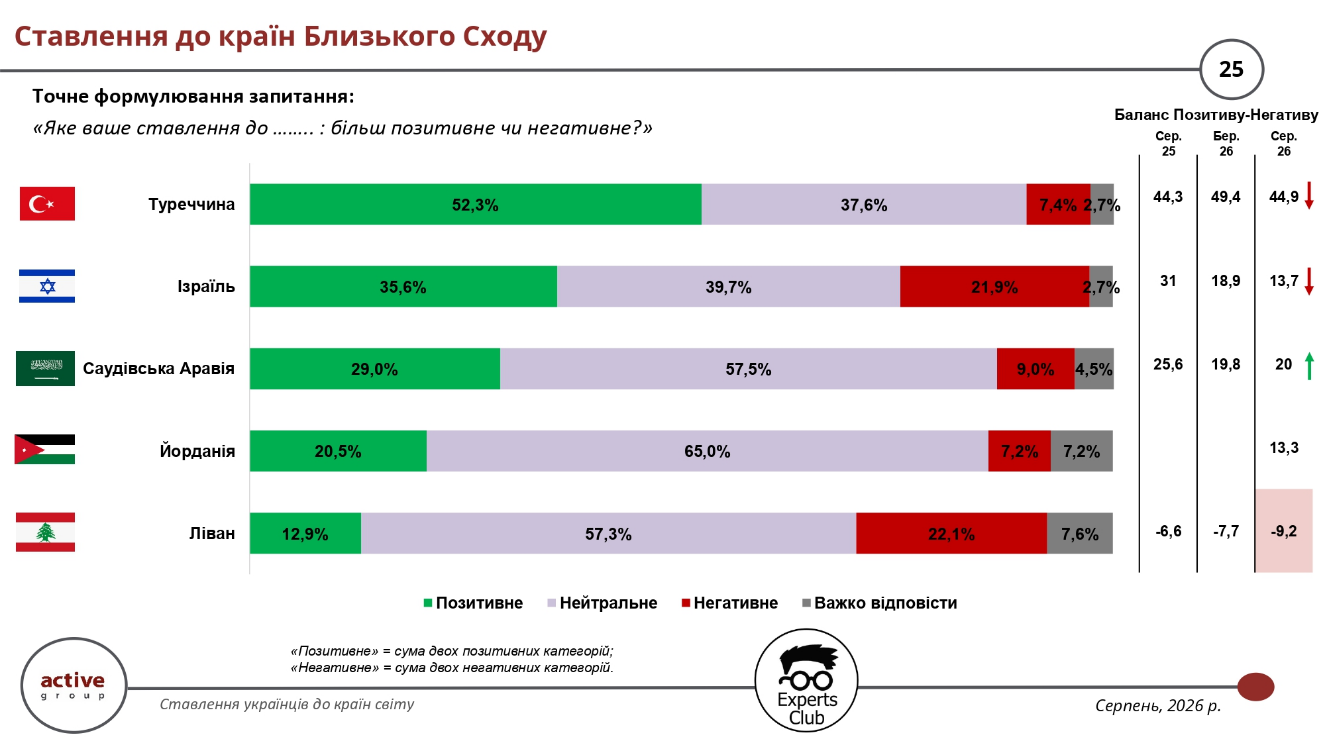
52.3% of respondents view Turkey positively, 37.6% neutrally, 7.4% negatively, and another 2.7% were undecided. The balance of positive and negative assessments stands at 44.9 percentage points, compared to 49.4 percentage points in March 2026 and 44.3 percentage points in August 2025. Thus, following a spring increase, the indicator has returned to roughly last year’s level.
Israel ranks second among the countries shown on the slide in terms of the share of positive assessments—35.6%. 39.7% of respondents view it neutrally, 21.9% negatively, and another 2.7% were undecided. The balance stands at 13.7 percentage points and continues to decline: in August 2025, it was 31 percentage points, and in March 2026, it was 18.9 percentage points.
Saudi Arabia is viewed positively by 29% of Ukrainians, while the majority—57.5%—hold a neutral stance. The share of negative assessments is 9%, and the balance is +20 percentage points, compared to 19.8 percentage points in March. Compared to August 2025, when it stood at 25.6 percentage points, the figure remains lower.
Regarding Jordan, 65% of respondents hold a neutral stance—the highest figure in this regional group. 20.5% of those surveyed view the country positively, 7.2% negatively, and another 7.2% are undecided. The balance of positive and negative assessments stands at 13.3 percentage points.
Lebanon has the lowest score. 12.9% of Ukrainians view the country positively, 22.1% negatively, and 57.3% neutrally. The balance stands at minus 9.2 percentage points and is gradually deteriorating: from minus 6.6 percentage points in August 2025 to minus 7.7 percentage points in March and minus 9.2 percentage points in August 2026.
Maksym Urakin, founder of the Experts Club information and analytical center, emphasized the importance of foreign governments maintaining constant communication with the Ukrainian public.
“The first recommendation is to regularly showcase specific achievements and concrete actions. Second, be open to questions and inquiries from the media and the public,” Urakin noted. He also recommended that diplomatic missions systematically inform Ukrainians about the concrete results of cooperation.
Oleksandr Pozniy, director of the research company Active Group, drew attention to the need to combine an information presence with the practical development of bilateral relations.
“We should focus not only on raising general awareness. First and foremost, business associations, the Ministry of Economy, and the Ministry of Foreign Affairs need to take action,” Pozniy noted.
In his view, economic and diplomatic institutions should more actively tap into the potential of markets where Ukraine can expand its cooperation.
Overall, the study shows that Ukrainians’ perceptions of Middle Eastern countries vary significantly. Turkey has a distinctly positive image, while neutrality dominates perceptions of Saudi Arabia and Jordan; assessments of Israel are more polarized, and negative assessments of Lebanon outweigh positive ones.
The survey was conducted in August 2026 using self-administered online questionnaires in the SunFlowerSociology panel among 800 Ukrainian citizens aged 18 and older. According to the organizers, the sample is representative by age, gender, and region, and the maximum theoretical statistical margin of error is 3.5%. This is the third wave of the study, following surveys conducted in August 2025 and March 2026.
ACTIVE GROUP, EXPERTS CLUB, ISRAEL, JORDAN, LEBANON, MIDDLE EAST, SAUDI ARABIA, SOCIOLOGY, TURKEY, UKRAINE

Lebanon is preparing to launch a “golden residence permit” program for foreign investors with a minimum investment threshold of $500,000. The initiative is intended to help the country attract capital, create jobs, and support economic recovery following a long-standing financial crisis.
The bill was approved by Lebanon’s parliamentary committee on finance and budget. The bill must now undergo further review and receive parliamentary approval.
Under the initiative, foreign investors will be able to obtain a residence permit in Lebanon provided they invest at least $500,000 in approved economic sectors. This is specifically a residency program, not a direct sale of citizenship or passports.
Lebanon is attempting to join the global competition for wealthy investors, a field in which countries in the Middle East, Europe, and the Caribbean are already actively engaged. Such programs typically offer foreigners the right to reside in exchange for investments in real estate, businesses, funds, government securities, or strategic sectors.
For Lebanon, launching such a program is of particular importance. Since 2019, the country has been experiencing one of the most severe financial and economic crises in its history: the banking system has restricted depositors’ access to their funds, the national currency has sharply depreciated, and public finances remain under pressure.
Under these circumstances, the “golden visa” is viewed as a tool for attracting foreign capital without immediately increasing the debt burden. The potential impact could manifest in investments in real estate, tourism, services, infrastructure, private healthcare, education, and technology projects.
However, this model also carries risks. For Lebanon’s program to be effective, it requires transparent rules for selecting investors, verification of the origin of funds, a clear list of permitted sectors, safeguards against speculative investments, and oversight to ensure that investments actually contribute to the economy rather than merely granting a formal right of residence.
International experience shows that “golden visas” can quickly attract capital, but under conditions of weak regulation, they become a source of reputational, tax, and financial risks. Therefore, for Lebanon, the key issue will not be the launch of the program itself, but the quality of its administration.
If the program is implemented transparently, it could become one of the additional channels for restoring confidence in the Lebanese economy. However, it will not be able to replace comprehensive structural reforms, stabilization of the banking system, and political predictability.
The results of a sociological survey conducted in March 2026 by the research company Active Group in collaboration with the Experts Club information and analytical center show that Lebanon remains one of the countries with a predominantly neutral perception among Ukrainians, though with a trend toward increasing negative assessments. The largest share of responses is a neutral attitude—62.5%, which indicates the country’s limited presence in Ukraine’s information space.
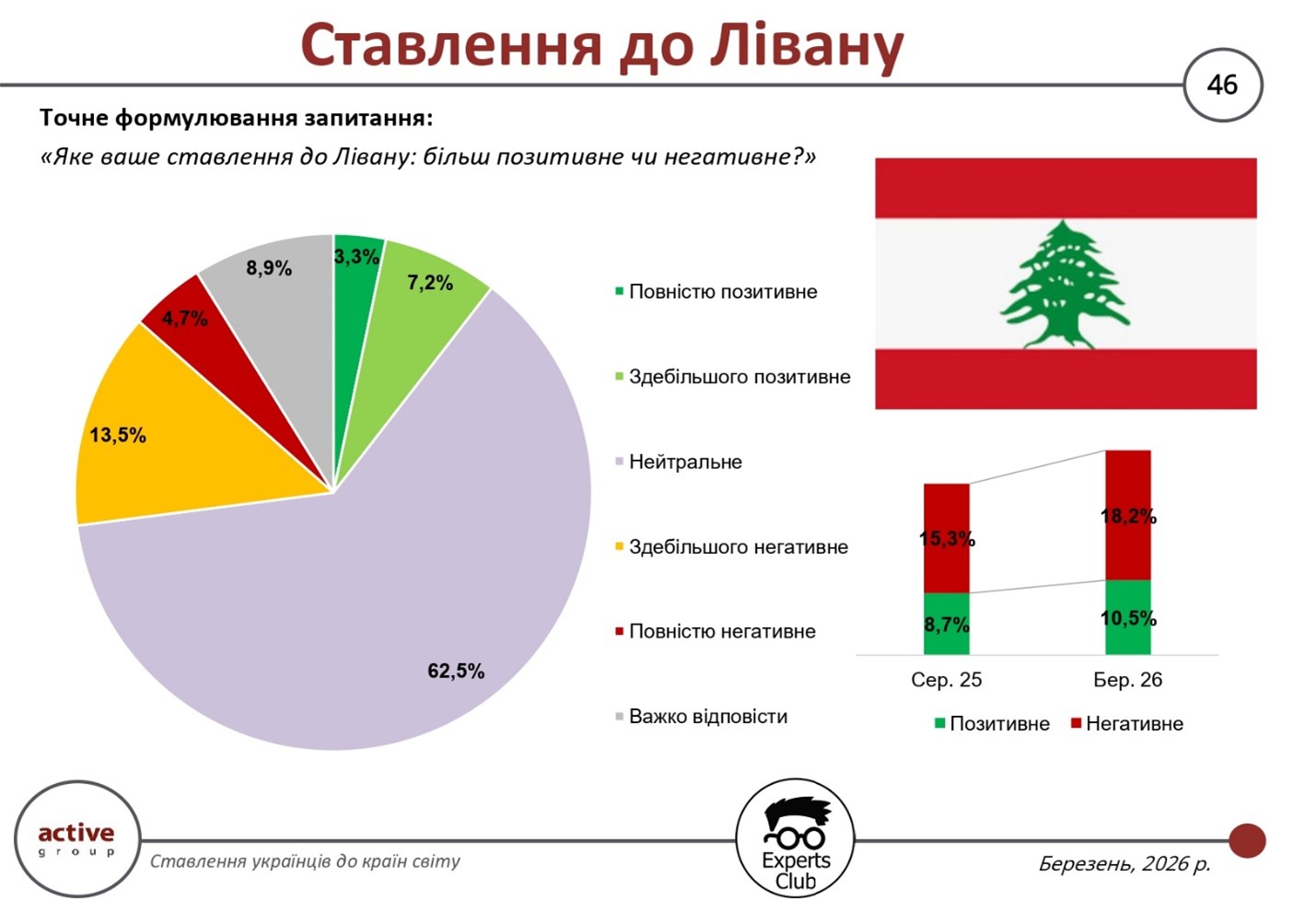
The share of positive attitudes toward Lebanon is relatively low—10.5%. Specifically, 3.3% of respondents indicated a “completely positive” attitude, and 7.2% — a “mostly positive” one. At the same time, negative assessments are significantly higher — 18.2% in total, of which 13.5% represent a “mostly negative” attitude and another 4.7% — a “completely negative” one. Additionally, 8.9% of respondents were unable to determine their position.
Compared to August 2025, there has been a simultaneous increase in both positive (from 8.7% to 10.5%) and negative (from 15.3% to 18.2%) attitudes. This trend indicates the gradual formation of a more defined image of Lebanon in Ukrainian society, although the neutral segment remains dominant.
A high level of neutrality combined with a rise in negative assessments may point to a fragmented perception of the country, shaped not through systematic interaction but through isolated information signals. Under such conditions, even a limited information background or media events can significantly influence the balance of assessments.
“When we see that, alongside neutrality, the share of negative assessments is also beginning to rise, it means that the country is gradually entering the information space, but this process is not accompanied by a sufficient number of positive signals. In such cases, an asymmetrical perception forms, where individual events or news stories have a disproportionately large impact. That is why it is important for countries with a similar profile to work not only on their presence but also on the content of that presence,” noted Maksym Urakin, founder of the Experts Club information and analytical center.
Thus, Lebanon is among the group of countries with a weak established image in Ukraine, where neutrality is gradually shifting toward a more polarized perception. The future trajectory of these assessments will largely depend on the intensity of contacts, media presence, and the nature of interaction between the countries.
According to a study conducted by the Experts Club Information and Analytical Center based on data from the State Customs Service, Lebanon ranks 33rd in total trade volume of goods with Ukraine, with a figure of $532.9 million. This is one of the most striking examples of a trade surplus for Ukraine, as Ukrainian exports far exceed imports from Lebanon.
The study was presented at the Interfax-Ukraine press center; the video can be viewed on the agency’s YouTube channel. The full version of the study can be found at this link on the Experts Club analytical center’s website.
ACTIVE GROUP, EXPERTS CLUB, LEBANON, Pozniy, SOCIOLOGY, SURVEY, UKRAINE, URAKIN
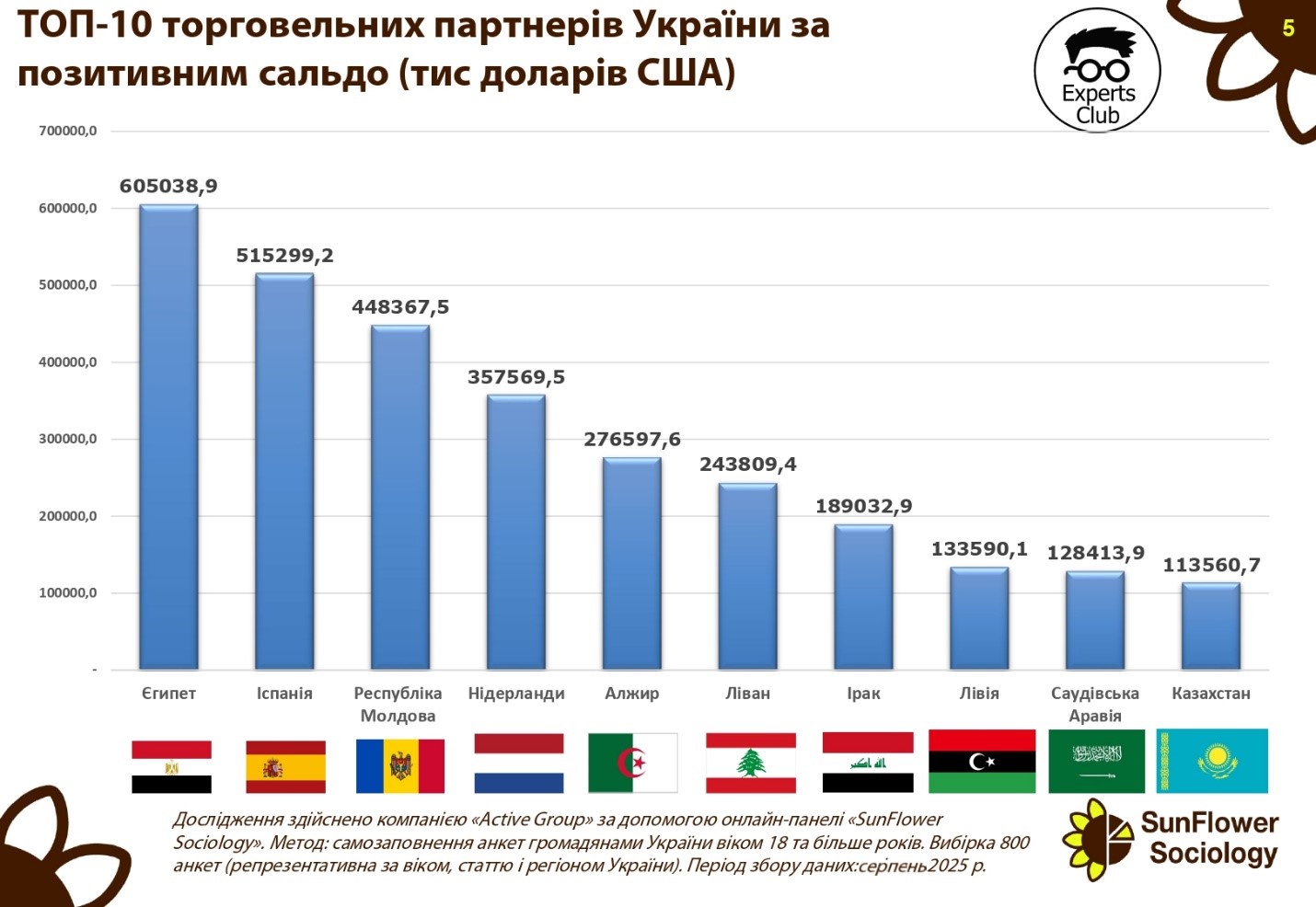
Ukraine maintains a significant positive trade balance with a number of key partners, which partially offsets the deficit in relations with China and EU countries.
The largest surplus in the first half of 2025 was recorded in trade with Egypt — $605.0 million. Spain ranks second with a balance of $515.3 million, followed by the Republic of Moldova — $448.4 million. Positive dynamics are also observed in relations with the Netherlands ($357.6 million), Algeria ($276.6 million), and Lebanon ($243.8 million).
Ukraine also has a high trade surplus with Iraq ($189.0 million), Libya ($133.6 million), Saudi Arabia ($128.4 million), and Kazakhstan ($113.6 million).
“The positive trade balance indicates that Ukraine is capable of competing effectively in international markets, especially in the agricultural sector and metallurgy. At the same time, it should be borne in mind that these markets are vulnerable to changes in the global economic situation, price fluctuations, and political factors,” emphasized Maksim Urakin, founder of Experts Club and economist.
According to him, maintaining a positive balance in relations with the countries of the Middle East and North Africa is a key element of Ukraine’s foreign trade strategy.
“Egypt, Spain, and the countries of the Arab world are stable importers of Ukrainian agricultural products. This is a strategic direction that needs to be developed further, as it creates a safety cushion for the economy against the backdrop of significant import costs,” Urakyn emphasized.
Analysts note that consolidating positions in the African and Middle Eastern markets could become a long-term factor in strengthening Ukraine’s foreign economic balance.
Agricultural exports, ALGERIA, ECONOMY, EGYPT, EXPERTS CLUB, FOREIGN TRADE, IRAQ, KAZAKHSTAN, LEBANON, LIBYA, MOLDOVA, NETHERLANDS, positive balance, SAUDI ARABIA, SPAIN, UKRAINE, МАКСИМ УРАКИН
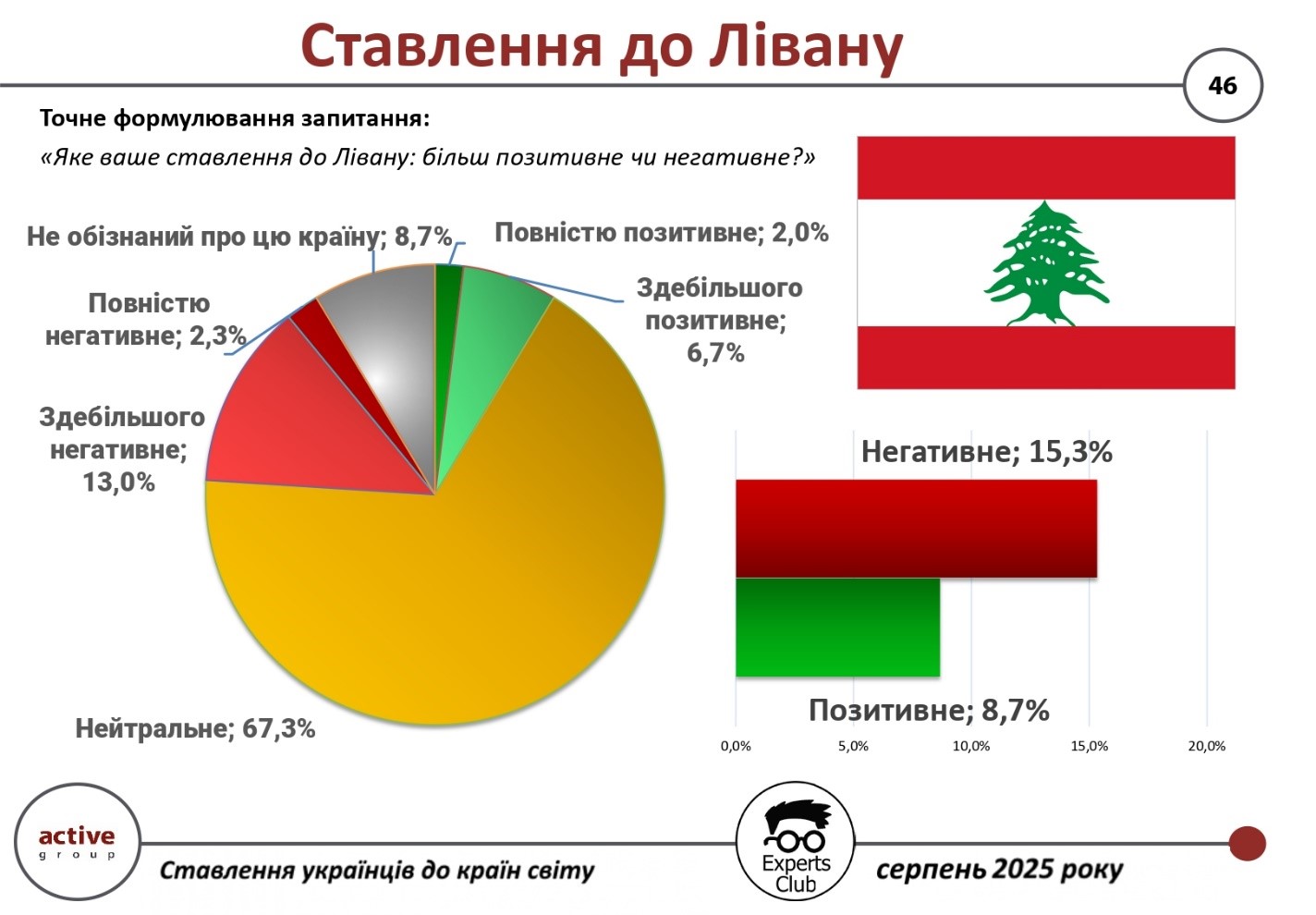
The vast majority of Ukrainians express a neutral attitude towards Lebanon. This is evidenced by the results of a sociological survey conducted by Active Group in cooperation with the Experts Club think tank.
According to the survey, 67.3% of respondents said they had a neutral attitude towards Lebanon. Only 8.7% of respondents expressed a positive attitude (2.0% — completely positive, 6.7% — mostly positive). On the other hand, 15.3% of Ukrainians demonstrated a negative attitude (2.3% — completely negative, 13.0% — mostly negative). Another 8.7% admitted that they were not familiar with this country.
“These results can be explained by the lack of significant historical or cultural ties between Ukraine and Lebanon, as well as Lebanon’s weak informational presence in Ukrainian society,” said Alexander Pozniy, head of Active Group.
In turn, Experts Club founder Maksim Urakin emphasized the economic aspect.
“In the first six months of 2025, trade turnover between Ukraine and Lebanon amounted to $249.3 million. At the same time, exports from Ukraine amounted to $246.5 million, while imports amounted to only $2.7 million. Thus, the positive balance exceeded $243.8 million, which indicates Lebanon’s unilateral interest in Ukrainian products.”
Thus, relations between Ukraine and Lebanon remain predominantly economic, and public perception of this country in Ukraine is still neutral.
The full video can be viewed at: https://www.youtube.com/watch?v=YgC9TPnMoMI&t
You can subscribe to the Experts Club YouTube channel here: https://www.youtube.com/@ExpertsClub
ACTIVE GROUP, EXPERTS CLUB, LEBANON, Pozniy, SOCIOLOGY, TRADE, UKRAINE, УРАКИН
Ukraine exports more than $400m worth of products to Lebanon, although the potential is $1bn, the supplies of cattle, meat and dairy products are promising, Minister of Agrarian Policy and Food Vitaliy Koval said after a visit to Lebanon and a meeting with businessmen.
The Ministry of Agrarian Policy and Food noted that Koval met with Lebanese businessmen – representatives of more than 12 companies involved in imports: flour millers, traders, entrepreneurs who buy food products, meat and cereals from Ukraine.
According to the Minister, Lebanese businessmen import tens of thousands of tons of cattle. They have recently started importing sheep to Lebanon. It is these areas of cattle breeding because of the shortage of meat can be promising for Ukrainian agrarians.
“Today we export more than $400 million worth of products to Lebanon, although the potential is $1 billion. That is why the task of the Ministry of Agrarian Policy is to increase imports of our products to Lebanon. I discussed with their businesses what should be done to increase trade turnover. Lebanese businessmen noted some bureaucratic moments and logistical problems. Now I clearly understand what needs to be simplified in procedures. Lebanon is an important trade partner for us, so we will work on developing our relations further,” Koval emphasized.
The Minister drew attention to the fact that the Ukrainian community is very active in Lebanon. During the meeting with its representatives, the Ukrainian delegation discussed the logistic communication with Ukraine and the increase of domestic products in Lebanese stores.
Koval urged the diaspora to be ambassadors of Ukraine: to popularize Ukrainian products and emphasize their quality.



