

The farms of the KSG Agro agricultural holding have begun harvesting sunflowers, which cover more than 5,800 hectares this year; work has already been completed on approximately 29% of the planted area, the agricultural holding’s press service reported.
“Our main task now is to make the most efficient use of every weather window for harvesting. Precipitation has somewhat slowed down the pace of work, so we are closely monitoring the condition of the crops and the readiness of each field for threshing,” said Vitaliy Nekhay, head of the crop production division.
According to him, the sunflower ripening period was accompanied by rainfall, with a total accumulation of 5–7 mm in some fields. As a result, the natural drying of the plants is proceeding more slowly, which affects the ability to deploy machinery to the fields promptly.
To accelerate and standardize sunflower ripening across an area of approximately 400 hectares on KSG Agro’s farms, pre-harvest desiccation was carried out—a measure that speeds up and standardizes the drying of plants before harvest.
According to preliminary estimates by agronomists, the oil content of sunflower seeds is currently slightly lower than expected, at 44–48%. Final harvest quality indicators will be determined after harvesting is complete and laboratory analyses have been conducted.
The harvested sunflowers are sent to elevators, a processing plant, and the agricultural holding’s storage facilities.
AGRICULTURAL HOLDING, HARVEST, harvest season, KSG AGRO, SUNFLOWER
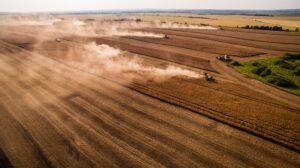
The agricultural holdings TAS Agro, IMC, and Eridon do not plan to reduce their winter wheat acreage, while HarvEast intends to decrease grain crops in favor of sunflowers and soybeans, company representatives reported during a survey at the 17th International Conference “Effective Management of Agricultural Companies” (LFM 2026).
Oleg Zapletnyuk, CEO of “TAS Agro,” noted that the company will maintain its wheat acreage, as this crop plays an important role in crop rotation: wheat is the primary preceding crop for rapeseed. According to him, rapeseed currently accounts for the bulk of the company’s revenue and liquidity.
“TAS Agro” has already completed sowing the planned 15,000 hectares of rapeseed and is continuing to sow wheat. At the time of the survey, approximately 35% of the planned acreage had been sown, Zapletnyuk noted.
The IMC agricultural holding also has no intention of reducing its wheat acreage. Its CEO, Oleksandr Verzhikhovsky, reported that the company plans to plant 2,700 hectares of wheat.
Serhiy Krolevets, the owner of “Eridon,” said that due to unfavorable weather conditions, the company has practically abandoned rapeseed planting. The company plans to plant wheat at roughly the same level as last year, although work is currently being carried out in dry soil while awaiting rainfall.
Meanwhile, the HarvEast agricultural holding plans to reduce the acreage planted with wheat and corn in favor of sunflowers and soybeans. CEO Dmytro Skornyakov explained this by the need to ensure the business’s economic stability in the coming season.
“… Oilseeds are currently much more profitable, and we will increase sunflower and soybean acreage while reducing corn and wheat,” he said.
Maria Osyka, Director of Strategic Development at the Agroprosperis agricultural group, announced plans to plant 10,000 hectares of seed wheat and 55,000 hectares of rapeseed.
Agricultural holding company Astarta reported a net loss of EUR14.07 million in the first half of 2026, compared to a net profit of EUR42.27 million for the same period last year, according to a report filed by the company with the Warsaw Stock Exchange on Thursday.
According to the report, while all segments generated net profit in January–June of last year, each segment recorded a loss this year: in sugar production, a loss of EUR3.83 million replaced a profit of EUR8.35 million; in crop production, a profit of EUR20.07 million turned into a loss of EUR3.76 million; in cattle farming, a loss of EUR2.41 million was recorded instead of a profit of EUR10.68 million; and in soybean processing, a loss of EUR2.27 million was recorded instead of a profit of EUR5.84 million.
Crop production and soybean processing reported operating profits, while sugar production and livestock farming posted operating losses. Furthermore, livestock farming also reported a gross loss.
According to the report, Astarta’s consolidated revenue for the first half of the year decreased by only 0.1% to EUR 226.47 million, with export sales accounting for 62% compared to 61% in the first half of last year.
The agriculture sector led the way, with sales growing by 27% to EUR78 million, or 34% of total revenue. In sugar production, sales fell by 10% to EUR72 million, or 32% of total revenue; in soybean processing, by 7% to EUR51 million; and in livestock farming, by 15% to EUR25 million.
Gross profit for January–June of this year fell by half—to EUR46.01 million—as the cost of goods sold rose by 10% compared to the same period last year, and the estimated value of crops and livestock was reduced due to falling agricultural prices and rising costs.
Consolidated EBITDA fell 2.4-fold compared to the same period last year, to EUR34.32 million.
It is noted that net investments decreased by 41% to EUR27 million following the completion of investments in a protein concentrate production plant and ongoing planned capital expenditures in other segments.
According to the report, in the first half of 2026, net financial debt (excluding lease obligations) amounted to EUR81 million, compared to EUR28 million in the first half of 2025. Total net debt (including leases) increased by 44% to EUR220 million.
“Astarta” is a vertically integrated agro-industrial holding operating in eight regions of Ukraine and is the largest sugar producer in Ukraine. It comprises six sugar plants, agricultural enterprises with a land bank of 220,000 hectares, dairy farms with 22,000 head of cattle, an oil extraction plant in Hlobine (Poltava Oblast), seven grain elevators, and a biogas complex.
Astarta’s net profit for 2025 fell 4.2 times—to $19.94 million—while consolidated revenue decreased by 23%—to $472 million.

Agricultural holding company IMC reported $34.28 million in net profit for the first half of 2026, down 33% from the first half of 2025, according to the company’s report filed with the Warsaw Stock Exchange on Thursday.
“The decline in normalized EBITDA and net profit … was driven by lower corn and sunflower prices compared to the same period last year—in contrast to the sharp price increases in the first half of 2025—as well as rising logistics costs and the depreciation of the hryvnia,” the document states.
According to the report, EBITDA fell by 22% to $50.23 million.
The company’s consolidated revenue in the first half of 2026 rose by 6% to $88.88 million. Corn sales accounted for the largest share—98.1% compared to 97.8% in the first half of last year.
It is noted that the company’s cost of goods sold rose from $66.4 million in January–June 2025 to $79.9 million in January–June 2026.
IMK added that over the six-month period, the Ukrainian hryvnia depreciated by 5.5% against the U.S. dollar, whereas in the first half of last year it depreciated by only 1.0%; consequently, the company recognized a net loss from foreign exchange differences of $2.11 million.
Net cash flow from operating activities decreased to $12.0 million from $15.0 million in January–June 2025, primarily due to lower prices for agricultural products and higher operating expenses.
According to the report, IMC’s net cash outflow from investing activities decreased to $8.2 million in the first half of 2026 from $10.5 million in the first half of 2025, in line with the group’s capital expenditure program.
IMK Agroholding is an integrated group of companies operating in the Sumy, Poltava, and Chernihiv regions (northern and central Ukraine) in the crop production, grain elevators, and warehousing segments. Its land bank totals 115,000 hectares, storage capacity stands at 554,000 metric tons, and grain and oilseed production in 2025 reached 838,000 metric tons.
IMK’s net profit in 2025 rose by 24% to $67.5 million, while consolidated revenue fell by 10% to $190.5 million.
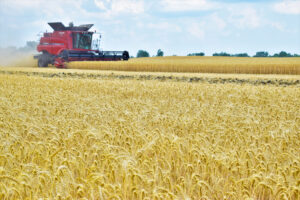
The agricultural holding company “Astarta” has completed the harvest of early grain crops and winter rapeseed across an area of 54,000 hectares, yielding approximately 256,000 metric tons, the company reported.
According to the report, the agricultural holding harvested over 210,000 metric tons of wheat and 43,000 metric tons of winter rapeseed.
The average yield of winter wheat at Astarta was 5.4 metric tons per hectare, and that of winter rapeseed was 3.1 metric tons per hectare. The highest yields were recorded at Khmilnytske LLC in the Vinnytsia region—7.7 metric tons per hectare of winter wheat and 3.8 metric tons per hectare of winter rapeseed.
Andriy Zagorulko, Director of the Agricultural Holding’s Department of Crop Production, Logistics, and Mechanization, noted that the season was challenging due to unfavorable weather conditions and diseases affecting winter rapeseed.
Astarta has already begun preparing the soil for the winter crop planting season.
Astarta is a vertically integrated agribusiness holding company operating in seven regions of Ukraine and is the country’s largest sugar producer. The company’s portfolio includes five sugar refineries, agricultural enterprises with a land bank of 214,000 hectares (including 129,000 hectares in the Poltava region, 42,000 hectares in the Khmelnytskyi region, and 16,000 hectares in the Vinnytsia region), and dairy farms with 30,000 head of cattle. The holding company also operates a soybean processing plant and a bioenergy complex in the Poltava region, as well as a network of six grain elevators.
Astarta’s net profit for 2025 fell 4.2-fold to $19.94 million, while consolidated revenue decreased by 23% to $472 million.

The “Agrain” Group of Companies has begun sowing winter rapeseed for the 2027 harvest, for which it has allocated over 18,000 hectares this season, the company’s press service reported.
The farms in the Chernihiv cluster were the first to begin planting—work there started in early August. In the Odesa and Kharkiv clusters, they are waiting for sufficient productive moisture to accumulate in the soil.
“We only plant when there is sufficient moisture in the topsoil. We constantly monitor weather conditions and adjust the pace of work depending on the situation in each region. Our goal is to complete sowing within the optimal timeframe, ensure uniform emergence, and create the right conditions for plant development before winter sets in,” the press service quotes Chief Agronomist Taras Korniyenko as saying.
“Agrain” is engaged in the cultivation and storage of grain and oilseed crops, as well as livestock farming. Prior to the full-scale Russian invasion, the agricultural holding comprised 11 agricultural enterprises; that number has now grown to 13. The group of companies cultivates approximately 110,000 hectares in the Zhytomyr, Kharkiv, Chernihiv, Odesa, and Cherkasy regions.
The group includes two large grain elevators and two mini-elevators, with a combined capacity of 320,000 metric tons. The agricultural division comprises nine enterprises. Four enterprises are engaged in livestock farming. The beef cattle herd numbers 5,500 head, and the dairy herd numbers 1,750 head, including over 800 milking cows.
The holding company is owned by SAS Investcompagnie (France).
AGRICULTURAL HOLDING, GRAIN, HARVEST, planting season, RAPESEED



