
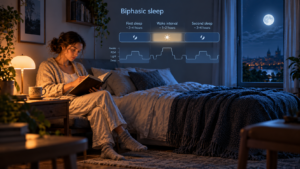
The historical practice of biphasic sleep, in which people slept in two separate periods with an interval of wakefulness in the middle of the night, has attracted renewed attention amid growing interest in the quality of rest and the problem of professional burnout. However, experts warn that deliberately interrupting nighttime sleep has no proven benefits for health or productivity. This was reported by Fast Company.
In medieval Europe and in the period before the widespread adoption of artificial lighting, nighttime sleep often consisted of two parts. After the first period of rest, people could wake up around midnight and remain awake for one or two hours, doing household chores, reading, praying, or reflecting, and then go back to sleep until dawn.
This pattern became known as biphasic sleep. Historian Roger Ekirch drew attention to evidence of the existence of the so-called first and second sleep in historical sources in the 1980s.
Modern interest in the practice increased following an experiment by Anna Fox, a graduate student at North Carolina State University, who tried waking up between 1:30 a.m. and 3:30 a.m. in the summer of 2026. During this time, she read, wrote letters, and engaged in creative activities, avoiding her smartphone, bright overhead lighting, and work-related to-do lists.
According to Fox, the experiment did not eliminate her chronic fatigue, but the nighttime hours without distractions had a positive effect on the creative process. She noted that during this period she was able to write poetry better than usual.
At the same time, researchers associate the historical prevalence of biphasic sleep primarily with living conditions before industrialization. The spread of artificial lighting allowed people to remain active longer in the evening, while the development of industrial production established rigid work schedules and the habit of concentrating sleep into one continuous period.
Nevertheless, experts do not recommend viewing the medieval sleep pattern as a universal way to increase productivity. Sleep researcher Alen Yuginovich, who works at Harvard Medical School, notes the lack of convincing evidence that regularly dividing sleep into separate periods provides significant cognitive or medical benefits. A review of studies published in the journal Sleep Health in 2021 also found no benefits of polyphasic sleep and pointed to possible adverse consequences for health and work performance.
According to experts, sufficient total sleep duration is the most important factor for adults. The American Academy of Sleep Medicine recommends that adults regularly sleep at least seven hours per day. Clinical psychologist and sleep specialist Michael Breus advises aiming for seven to nine hours of rest and, whenever possible, maintaining a consistent schedule for falling asleep and waking up.
Experts also note that the feeling of a creative boost during nighttime hours may be associated with silence, solitude, and the absence of external distractions. However, this does not mean that reducing sleep or deliberately waking up at night enhances creative abilities in the long term.
Thus, the historical practice of biphasic sleep raises the question of how much modern work habits limit the time available for rest and recovery. However, instead of artificially changing sleep patterns, experts primarily recommend ensuring sufficient rest and reducing distractions.



