
The Czech Republic and Moldova have the highest net sentiment—the balance of positive and negative attitudes—among Ukrainians among the Central and Eastern European countries included in the study—56.2 and 48.2 percentage points, respectively. At the same time, the balance of attitudes toward Poland turned negative in August 2026, while assessments of Slovakia and Hungary improved significantly compared to previous waves. This is evidenced by the results of the third wave of the study “Ukrainians’ Attitudes Toward Countries Around the World,” conducted by Active Group in collaboration with Experts Club, according to the Experts Club Information and Analytical Center.
The Czech Republic received the highest share of positive assessments in this group—61.3%. 32.1% of respondents have a neutral attitude toward it, 5.1% have a negative attitude, and another 1.6% were undecided. The balance of positive and negative attitudes stands at 56.2 percentage points, compared to 64.4 percentage points in March 2026 and 58.7 percentage points in August 2025.
Regarding Moldova, 55.4% of respondents have a positive attitude, 35.6% are neutral, and 7.2% have a negative attitude. The balance stands at 48.2 percentage points, which is lower than the 54.7 percentage points recorded in March but higher than the 46.6 percentage points recorded in August of last year.
Regarding Romania, 45.2% of respondents expressed a positive attitude, 42.3% were neutral, and 9.8% were negative. The balance fell to 35.4 percentage points from 41.7 percentage points in March. In Bulgaria, positive assessments accounted for 42.7%, neutral ones for 47.6%, and negative ones for 7.4%, with the balance standing at 35.3 percentage points, compared to 51.5 percentage points in March.
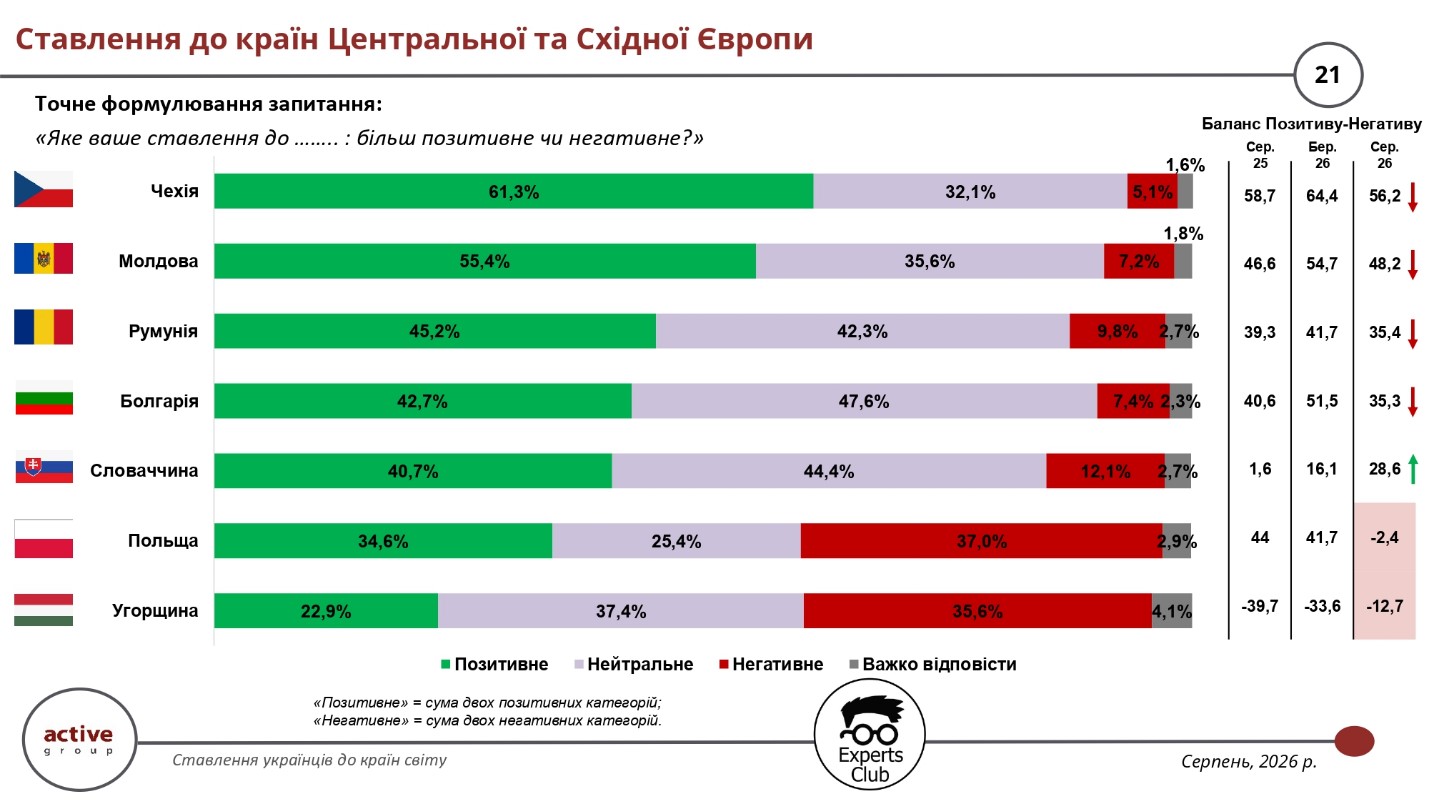
Unlike most countries in the group, attitudes toward Slovakia showed a noticeable improvement. It is viewed positively by 40.7% of respondents, negatively by 12.1%, and neutrally by 44.4%. The balance rose to 28.6 percentage points from 16.1 percentage points in March 2026 and just 1.6 percentage points in August 2025.
The sharpest negative trend was recorded regarding Poland. 34.6% of Ukrainians view it positively, 37% negatively, and 25.4% neutrally. As a result, the net balance stands at minus 2.4 percentage points, whereas in March 2026 it was plus 41.7 percentage points, and in August 2025—plus 44 percentage points. The deterioration in attitudes toward Poland was one of the most notable shifts in the third wave of the survey.
Hungary remains in the negative zone: 22.9% of respondents expressed a positive attitude, 35.6% a negative one, and 37.4% a neutral one. At the same time, its balance improved to minus 12.7 percentage points compared to minus 33.6 percentage points in March and minus 39.7 percentage points in August 2025.
Maksym Urakin, founder of the Experts Club Information and Analytical Center, deputy director of the Interfax-Ukraine news agency, and candidate of economic sciences, emphasized that public perception of countries must be analyzed in parallel with Ukraine’s actual economic ties.
“That is why it is very important for us to analyze our main partners. The first recommendation is to regularly showcase concrete projects, specific actions, and the presence here of foundations, embassies, teams, and diplomats in the humanitarian sphere and in science. We also need to use our sociological data to draw conclusions and strengthen our relations, particularly trade relations,” Urakin noted.
Oleksandr Pozniy, director of the research firm Active Group, highlighted the practical significance of the study’s findings for economic and diplomatic policy.
“We should focus on developing more than just general awareness. First and foremost, business associations, the Ministry of Economy, and the Ministry of Foreign Affairs need to work to develop bilateral relations and improve the balance of trade. We must expand cooperation with countries where we can achieve a positive trade balance,” Pozniy noted.
The survey was conducted in August 2026 using self-administered online questionnaires in the SunFlowerSociology panel among 800 Ukrainian citizens aged 18 and older. According to the organizers, the sample is representative by age, gender, and region, with a maximum theoretical margin of error of 3.5%. This is the third wave of the study, following surveys conducted in August 2025 and March 2026.
ACTIVE GROUP, BULGARIA, Central Europe, CZECH REPUBLIC, EASTERN EUROPE, EXPERTS CLUB, HUNGARY, MOLDOVA, POLAND, Pozniy, ROMANIA, SLOVAKIA, SOCIOLOGY, UKRAINE, URAKIN
The top of the ITCI-2025 ranking is once again dominated by countries with the most “neutral” tax structures: Estonia is in first place, Latvia is in second, and Lithuania is in fifth (plus Hungary in ninth and the Czech Republic in tenth).
The Tax Foundation notes that Estonia’s leadership is supported by four elements: a 20% corporate tax levied only on distributed profits; a flat income tax of 20% (without taxation of personal dividends in the same format); a property tax focused on land value; the territorial principle of taxation of foreign income applies.
Latvia has “caught up” thanks to the introduction of a corporate income tax model similar to Estonia’s and relatively effective labor taxation. Lithuania stands out with its low corporate tax rate (17%) and strong capital cost recovery rules.

The British consulting company Skytrax has presented the winners of The World’s Best Airports in 2022 rating according to the results of a passenger survey, Boryspil International Airport took the seventh place.
According to a report on the airport’s website on Wednesday, the top ten included the airports of Batumi, Budapest, Tallinn, Bucharest, Riga, Tbilisi, Boryspil International Airport, as well as Belgrade, Bratislava and Zagreb airports.
In 2021, Boryspil ranked fifth in the Skytrax rating.
“The fact that Boryspil International Airport was ranked among the top ten airports demonstrates its standards of work with passengers to ensure their comfort and safety. The war suddenly suspended the operation of the airport. But nothing will change our confidence in the victory of Ukraine, its peaceful and independent development. I believe in the future of the main air gates of the country – Boryspil International Airport,” Oleksiy Dubrevsky, CEO of the airport, is quoted in the message.
Skytrax is a British consulting company that has been evaluating the quality of service for airports and airlines around the world since 1989.
The World Airport Awards are presented based on a survey of more than 13 million passengers at 550 airports around the world.

The European Bank for Reconstruction and Development (EBRD) has appointed Matteo Patrone as Managing Director for Eastern Europe and the Caucasus, according to a report on the EBRD’s website. “Matteo Patrone will be responsible for the bank’s operations and engagement in Ukraine, Belarus, Moldova, Armenia, Azerbaijan, and Georgia. The EBRD’s combined investment in the six countries stands at almost EUR 24 billion throughout all sectors of their economies to date,” the report says. “Patrone will work in Kyiv. He is taking over the position from Francis Malige, who was the first Managing Director of the EBRD’s Eastern Europe hub and has recently been appointed Managing Director, Financial Institutions, at the bank’s headquarters in London,” according to the document.
“I am honored and humbled to take on this new position at the EBRD in an exciting region. We have seen impressive progress in all countries under my predecessor and it will be my priority to create the conditions for our strong local teams to build on this and expand further. The needs are huge and our offer is attractive. Our aim will be to continue promoting the competitiveness of the local economies as they are moving closer to Europe,” Patrone said.
“Patrone, an Italian national, joined the EBRD in 2008 in London as a member of the corporate equity team after a successful career in the private sector. He was appointed Director for Serbia in 2012 and Regional Director for Romania and Bulgaria in 2015.
The EBRD is the largest international financial investor in Ukraine. Since the beginning of its activities in the country in 1993, the bank has undertaken total commitments to provide almost EUR 12.1 billion for about 400 projects.
CAUCASUS, DIRECTOR, EASTERN EUROPE, EBRD, ITALY, MATTEO PATRONE



