
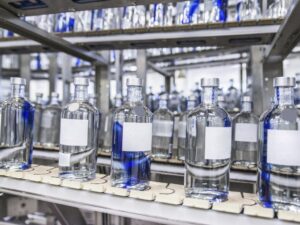
The Cabinet of Ministers of Ukraine has refined the procedure for determining the maximum production capacity of equipment used to produce ethyl alcohol and bioethanol, according to the industry publication SEEDS.
The government adopted the corresponding resolution on September 23, 2026. The new rules are intended to ensure a more accurate and technically sound calculation of equipment capacity. This metric is used to determine the guaranteed excise tax liability for alcohol and bioethanol producers.
In particular, the calculations now require determining the actual capacity of processing equipment and taking it into account. The regulations also clarify which changes to equipment should be considered a change in its maximum capacity.
The government has established a mechanism for performing the updated calculation and provided for the possibility of accounting for permissible deviations in actual capacity related to the specifics of the production process or the characteristics of measuring instruments.
One of the most significant changes is the allowance for actual production capacity of process equipment to deviate from the calculated maximum production capacity by up to 3% inclusive.
In addition, the procedure for applying coefficients related to the cleaning and disinfection of production equipment has been clarified. Calculations will take into account the possibility of performing such work during scheduled production shutdowns.
The government explains the need for these changes by citing the technological characteristics of the alcohol industry. The actual productivity of equipment may be influenced by the characteristics of the raw materials used, auxiliary materials, seasonal changes in energy source parameters, and other factors, which in and of themselves do not imply a change in the enterprise’s maximum technical productivity.
Thus, the updated procedure must simultaneously take into account both the technical characteristics of the equipment and the actual technological conditions of ethyl alcohol and bioethanol production.
The mechanism for determining maximum production capacity was introduced by Cabinet of Ministers Resolution No. 350 of March 28, 2025, in accordance with amendments to tax legislation regarding the specifics of excise taxation of ethyl alcohol and bioethanol. The calculation is performed by an authorized state agency based on the technical and technological parameters of production.
According to the government’s assessment, updating the methodology should increase the predictability of operating conditions for alcohol and bioethanol producers and ensure a more accurate determination of the indicators used to calculate excise tax liabilities.
ALCOHOL, Bioethanol, CABINET OF MINISTERS, EXCISE TAX, UKRAINE

The rise in artisanal gasoline production within Ukraine was one of the factors behind the decline in official fuel imports in August 2026, according to the A-95 Consulting Group.
According to the group, imports of automotive gasoline in August totaled 152,000 metric tons, which is 7% less than a year earlier.
“In August, gasoline shipments were lower due to large carryover stocks and the growth of domestic illicit production, driven by the ability to add tax-exempt solvents,” A-95 reported.
Experts believe that government agencies—primarily the State Tax Service—need to strengthen oversight of this sector.
“This is not only a matter of losses to the state budget but also of the questionable quality of such fuel,” the group emphasized.
The use of components not subject to excise tax as motor fuel potentially allows producers to lower the cost of gasoline blends and gain an advantage over legal market participants who pay fuel taxes in full.
At the same time, there was no overall gasoline shortage on the Ukrainian market in August. Since the beginning of 2026, official import volumes have remained higher than last year’s: 1.12 million metric tons of gasoline were imported over eight months, which is 16% more than a year earlier.
The largest importers remain OKKO, WOG, UPG, and Ukrnafta, while the main supplier countries are Lithuania and Poland.
EXCISE TAX, FUEL, GASOLINE, TAX, UKRAINE

PJSC “Philip Morris Ukraine” and LLC “Philip Morris Sales and Distribution” paid a total of 31.7 billion UAH in taxes for January–June 2026, which is 10% higher than the figures for the same period last year, according to a company press release.
The bulk of the payments consisted of excise tax—24 billion UAH—and value-added tax (VAT)—7.1 billion UAH.
“In the first half of the year, we managed to increase the amount of taxes paid by 10%. This was made possible by an increase in excise tax rates on tobacco products, despite a decline in market volumes and the consequences of the missile attack on our factory and warehouses,” the press service quoted Serhiy Kalnoochenko, CFO of Philip Morris Ukraine, as saying.
According to Kalnoochenko, since the start of the full-scale invasion, the company has paid more than 212 billion hryvnias to the budget, which is one of the highest figures among businesses in Ukraine.
“This is a real contribution by our business to funding defense, social programs, and economic recovery. However, this amount could have been at least 25–28 billion hryvnias higher if the country had been able to overcome the problem of the illegal tobacco trade. Instead, the market for illegal cigarettes continues to grow every quarter,” Kalnoochenko emphasized.
According to estimates by Kantar Ukraine in April 2026, the volume of the illicit tobacco market has grown again and now stands at 19.8%. With such market volumes, annual losses to the state budget due to unpaid taxes are estimated at a record 33.3 billion hryvnias, the statement noted.
Philip Morris Ukraine PJSC has been operating in the Ukrainian market since 1994 and is one of the largest taxpayers. In 2024, the company opened a new factory in the Lviv region, investing $30 million and creating 250 jobs. Last year, the company invested $5 million in promoting its “ZYN” nicotine pouch brand in Ukraine; this year, it plans to invest another $10 million in developing the nicotine pouch category and launching a new product line under the brand.
In late January 2026, part of the company’s Kharkiv factory was damaged in a nighttime missile strike; operations at the facility have been suspended since February 24, 2022. The company’s preliminary estimate of the damages is $16 million.
On the night of July 8, the company lost its finished goods warehouse in Kyiv due to Russian shelling.
The company also provides humanitarian aid to communities in the Kharkiv, Lviv, and Kyiv regions, and collaborates with the rehabilitation funds Superhumans, U+System, and UNBROKEN. Since the start of the full-scale invasion, projects totaling 431 million hryvnias have been implemented.

According to Open4business, excise tax revenues to the general fund of the state budget in January–March 2026 amounted to UAH 74.1 billion, compared to UAH 60.0 billion for the same period last year, the Ministry of Finance reported, citing data from the State Treasury.
In March, excise tax revenues amounted to 29.1 billion UAH, compared to 22.6 billion UAH in March 2025, the ministry added.

Revenues from excise tax on manufactured and imported goods in January-May 2025 reached UAH 69.7 billion, compared to UAH 46.9 billion in the same period last year, according to Ruslan Kravchenko, head of the State Tax Service (STS).
“In five months, the budget has already received UAH 11.3 billion (+19.3%) more than planned. In May 2025, UAH 15.3 billion in excise tax was received,” he said.
Kravchenko explained that the overperformance was due to an increase in imports of excisable goods, in particular tobacco products.
“Systematic control over the circulation of excisable goods is also yielding noticeable results,” added the head of the State Tax Service.

The Verkhovna Rada intends to reduce the rate of excise tax on beer to UAH 1.39 per liter from UAH 2.78 per liter for producers whose annual production volume does not exceed 200,000 hectoliters, as well as introduce the term “small beer producers.”
At a plenary session of parliament last week 284 MPs with the required minimum of 226 votes backed bill backed at first reading No. 5118 on amendments to Article 215 of the Tax Code of Ukraine.
According to an explanatory note to the document, there are 204 breweries in Ukraine with an annual production volume of up to 3,000 hectoliters, which pay UAH 30,000 per year for a wholesale beer trade license, and 28 breweries with a production volume of up to 200,000 hectoliters (for their annual license is UAH 500,000).
These companies account for 13% of the beer market in Ukraine, while the remaining 87% is divided among nine large beer producers. According to the document, the total tax burden per 1 liter of beer produced by small producers is significantly higher than the same indicator at the enterprises of the beer giants.
In addition, the authors of the bill said that all small beer producers are under significant regulatory and financial pressure, since they pay other tax payments along with the excise tax. In this regard, the reduction in the excise tax rate is proposed.
The bill will determine the entities of applying the reduced rate by introducing the term “independent small brewery” – an enterprise legally and economically independent from any other brewery, geographically located separately from other breweries.
According to the explanatory note, the bill brings the tax legislation of Ukraine closer to the EU legislation, complies with the EU Council Directive 92/83/EEC on the harmonization of the structures of excise duties on alcohol and alcoholic beverages dated October 19, 1992.
As expected, the implementation of bill No. 5118 will result in a decrease in annual budget revenues by UAH 328.3 million due to a decrease in excise tax rates on beer. At the same time, in the long term, due to the expected growth in beer production by about 20 million liters, the budget will be significantly replenished with tax receipts in the form of excise tax, single social security contribution, personal income tax, etc.



