

Only a third of active companies in the country submitted their reports
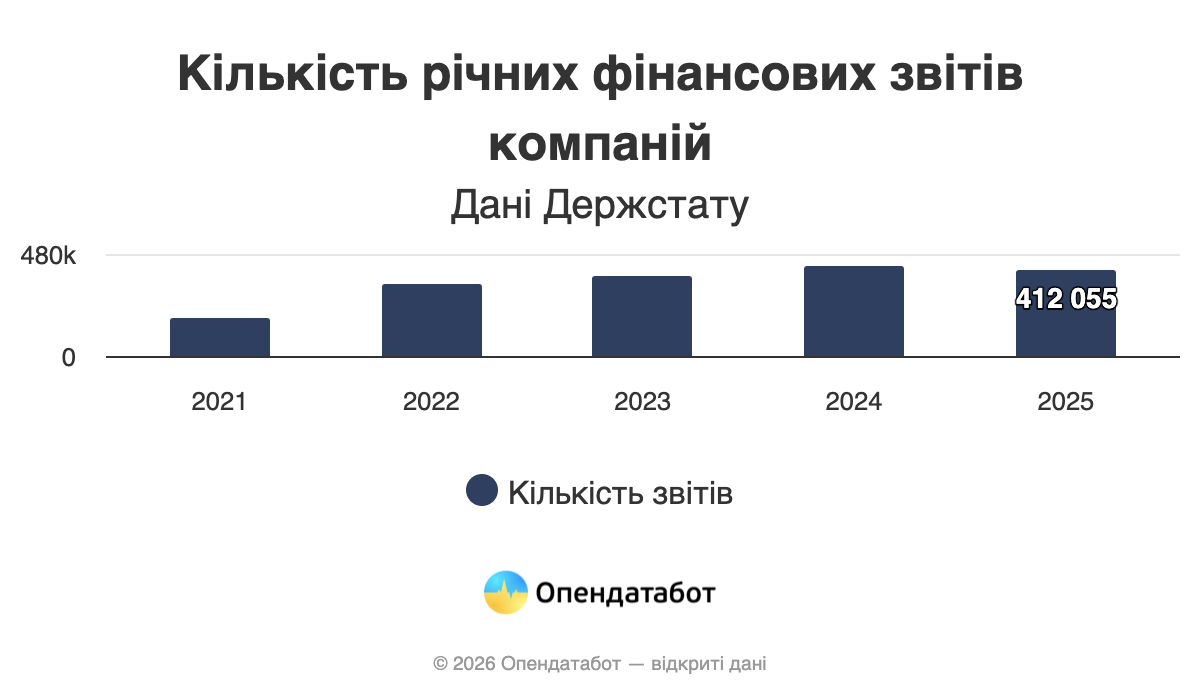
Almost half a million financial reports for the past year were submitted by Ukrainian businesses on time. This is 30% of the 1,374,026 companies registered in the country as of the end of last year.
Every year, fewer and fewer companies submit their financial reports on time. This is probably due to the fact that at the beginning of the full-scale invasion, the obligation to submit reports was canceled. However, even the reinstatement of responsibility for this data has not improved the situation: 412,055 reports have been submitted so far, which is 4% less than last year.
“Financial reporting is not a formality, but the basis of transparent business. It allows partners, customers, and the business itself to see the real state of the company, its position in the market, and its potential for growth. It is the openness of data that builds trust and new opportunities for cooperation — and this is much more important than any penalties for failure to submit reports,” comments OpenDataBot CEO Alexey Ivanov.
As a reminder, from July 5, 2025, enterprises, institutions, and organizations will once again be required to submit state statistical and financial reports. Data for previous periods could be clarified until the beginning of October last year.
Revenue shows the company’s income from all types of activities and characterizes its place in the market, while net profit shows whether the business model is profitable.
To check any business in OpenDataBot, enter the name or code of the enterprise in the search bar at the top of the page and go to the company’s page.
https://opendatabot.ua/analytics/financial-reporting-2025
The International Monetary Fund (IMF), in cooperation with Ukraine, is working to improve corporate governance in all state-owned enterprises, not just selected ones. This work includes transparency in the formation of supervisory boards, improving the efficiency of the decision-making process, and transparency, as reflected in the new four-year Extended Fund Facility (EFF) program, said Suchanan Tambunleurtchai, Deputy Head of the IMF Mission to Ukraine.
“One of the commitments made by the authorities is to start publishing the financial statements of key state-owned enterprises in order to make these key performance indicators available to the public so that the public and other stakeholders can also assess the performance of these state-owned enterprises,” she said at a briefing on Friday.
At the same time, Tambunleurtchai clarified that the IMF does not have specific quantitative targets for state-owned enterprises under the program.
According to Ukraine’s economic and financial policy memorandum published by the Fund on Friday, the publication of financial statements of leading state-owned enterprises in accordance with IFRS standards will resume by the end of June 2026, with appropriate edits to protect critical infrastructure and an extended publication period of up to one year.
“We will introduce mandatory annual financial audits for leading state-owned enterprises, for which adequate funding will be provided, by making appropriate legislative changes if necessary. We will ensure the publication of audit reports, starting with the 2025 financial audits, by the end of August 2026,” the memorandum also states.
By the end of June 2026, the development of an annual report for state-owned enterprises will also begin in accordance with the requirements of the Standard Operating Procedure (SOP), which will be appropriately expanded to include information on the financial performance of leading state-owned enterprises using a common set of indicators, payments to the state budget and fiscal support, specific PSO obligations, and quasi-fiscal activities of each enterprise. Such a report will be published annually, starting at the end of September 2026 for 2025, and will be gradually expanded to cover more state-owned enterprises.
In addition, Ukraine has committed to ensuring the publication of financial statements reflecting the separation of PSO-related and non-PSO-related activities for all state-owned enterprises subject to PSOs by the end of June 2027.
“We will amend the State Property Policy and the Law ”On Joint Stock Companies” (2465-IX) to provide that all charters of state-owned enterprises require a simple majority of votes for supervisory board decisions, except for the approval of the strategic development plan, and we will avoid provisions allowing veto or dominant majority requirements by the end of June 2026,” the memorandum also states.
According to the memorandum, all nominations and dismissals of CEOs of state-owned enterprises will be decided by a simple majority vote of the supervisory boards, with corresponding amendments to the charter, if necessary.
“We will ensure that a comprehensive financial audit, compliance audit, and performance audit for all non-defense state-owned enterprises by reputable independent auditors is initiated by the end of June 2026,” the document states.
Another commitment is to publish a revised State Ownership Policy by the end of May 2026, which will more closely align with the OECD Guidelines for Corporate Governance of State-Owned Enterprises, as recommended in the 2025 OECD Review.
The government also noted that, in close consultation with international partners, it is exploring options for improving the management of state-owned enterprises, which also includes the potential introduction of a centralized model. This involves, in particular, defining the roles and mandates of key state institutions involved in the management of state-owned enterprises, such as the Ministry of Finance, the Ministry of Economy, the Cabinet of Ministers, other relevant sectoral ministries, and the State Property Fund (SPF).
“We will ensure a strong role for the Ministry of Finance as the body responsible for financial oversight of state-owned enterprises, limit quasi-fiscal risks, and help protect debt sustainability. It is important that any new system of state-owned enterprise management should not erode the government’s authority over dividend policy, ensuring that dividends from state-owned enterprises are directed to the state budget and reported transparently to ensure accountability and oversight,” the memorandum also notes.
Overall, the ultimate goal of centralizing state-owned enterprise ownership should be to professionalize the state’s ownership function, and any centralized management system should operate with caution, the memorandum says.
“This should be based on a clear legal mandate, ensure proper oversight by the Ministry of Finance and fiscal transparency, include reliable safeguards against political interference to ensure professional merit-based management, and require strict, internationally agreed reporting and accountability,” the memorandum emphasizes.



