
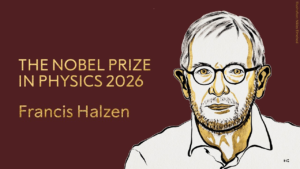
The 2026 Nobel Prize in Physics has been awarded to Belgian-American physicist Francis Halzen for his decisive contribution to the creation of the IceCube neutrino observatory and the discovery of high-energy neutrinos of astrophysical origin, the Royal Swedish Academy of Sciences said on Tuesday.
“For decisive contributions to the IceCube Neutrino Observatory and the discovery of high-energy neutrinos of astrophysical origin,” the official wording of the Nobel Committee states.
Halzen’s work effectively opened a new way of studying the Universe. Unlike conventional telescopes that detect electromagnetic radiation, IceCube makes it possible to observe cosmic processes using neutrinos — extremely light, electrically neutral elementary particles that interact with matter only very rarely.
Neutrinos can pass through planets, stars and other objects practically without interacting with them. They also have no electric charge, so magnetic fields do not change the direction of their motion. Thanks to this, high-energy neutrinos can carry information to Earth directly from the sources of the most powerful processes in the Universe and help scientists determine where ultra-high-energy cosmic rays originate.
Halzen proposed using the transparent ice of Antarctica to detect such particles. This concept eventually led to the creation of the IceCube observatory at the South Pole.
IceCube is a gigantic detector with a volume of about 1 cubic km. More than 5,000 light-sensitive sensors are placed deep within the Antarctic ice. When a neutrino, on rare occasions, interacts with an atomic nucleus, the resulting secondary particles produce characteristic radiation that is detected by the sensors. From the direction and characteristics of such a signal, scientists can obtain information about the neutrino that arrived from space.
Halzen proposed the idea of using Antarctic ice to search for cosmic neutrinos as early as 1988. Construction of IceCube was completed in 2011, and already in 2013 the observatory reported the first detection of high-energy neutrinos that had arrived from beyond the Solar System.
In 2017, IceCube detected a high-energy neutrino that was successfully linked to the active nucleus of a distant galaxy. In 2022, the observatory obtained evidence of high-energy neutrino radiation from an active galaxy about 47 million light-years from Earth, and in 2023 — from our Milky Way galaxy.
Such observations have become an important part of so-called multi-messenger astronomy, in which the same cosmic process is studied simultaneously through electromagnetic radiation, neutrinos, cosmic rays and gravitational waves.
The Royal Swedish Academy of Sciences notes that IceCube data make it possible to investigate the conditions under which high-energy neutrinos arise and, in the future, may lead to the discovery of previously unknown cosmic phenomena.
Halzen was born in 1944 in Tienen, Belgium. He is a professor of physics at the University of Wisconsin–Madison and the principal investigator of the IceCube project. He has worked at the university since 1972.
The amount of the Nobel Prize in Physics in 2026 is 12 million Swedish kronor, or about $1.2 million. Since Halzen became the sole laureate in this category, he will receive the entire prize amount.
The Nobel Prize in Physics is awarded by the Royal Swedish Academy of Sciences for the most significant discoveries and achievements in the field of physics. The prize was established in accordance with the will of Swedish inventor and entrepreneur Alfred Nobel. The first Nobel Prizes were awarded in 1901.
According to Nobel’s will, the awards are presented for achievements in physics, chemistry, physiology or medicine, literature, and for activities aimed at promoting peace. The Prize in Economic Sciences in Memory of Alfred Nobel was established later by Sweden’s central bank.
The laureates receive a medal, a diploma and a monetary award. The Nobel Prize award ceremony traditionally takes place on December 10, the anniversary of Alfred Nobel’s death. The prizes in physics, chemistry, medicine, literature and economics are awarded in Stockholm, while the Nobel Peace Prize is awarded in Oslo.
ASTROPHYSICS, FRANCIS HALZEN, ICECUBE, NEUTRINOS, NOBEL PRIZE, Physics



