

The International Monetary Fund (IMF) has included in the Extended Fund Facility (EFF) program a new structural benchmark with a deadline of December 31, 2026, which calls for the submission to the Verkhovna Rada of specific rules to combat tax evasion under the simplified tax system.
According to the updated EFF Memorandum of Understanding, the new legislation is intended to address the issues of artificially splitting businesses to maintain preferential limits, manipulative switching between tax regimes, and the use of the simplified system to conceal actual employment relationships and evade taxes on wages and the Unified Social Tax (UST).
At the same time, IMF experts recommended revising the draft of the new Labor Code regarding the definition of employment, noting that the requirement to meet at least five of eight criteria to establish an employment relationship places an excessive burden of proof on regulatory authorities, whereas meeting three criteria is sufficient.
According to the memorandum, the fight against the shadow economy requires additional resources for all tax authorities; therefore, following the appointment of a new head of the State Customs Service (SCS) in April 2026, the government must ensure sufficient funding is available for the re-certification of all customs officials, which is scheduled to begin in mid-2026. In addition, the 2027 budget must provide sufficient funding for the State Customs Service (SCS), the State Tax Service (STS), and the Economic Security Bureau (ESB) to improve their ability to hire and retain qualified personnel.
In the document, the government highlighted the challenges of passing legislation in parliament but noted that it remains committed to eliminating the VAT exemption for sole proprietors, given its importance for combating the shadow economy, mobilizing revenue, EU accession, and attracting donor support. Although the government considers improving tax administration to be extremely important, it sees greater risks in this area than the Fund’s staff does, as administrative reforms could lead to revenue losses if they are not carefully planned and implemented.
As reported, the IMF Executive Board approved the first review of Ukraine’s four-year EFF program early Tuesday morning, allowing for the immediate disbursement of approximately $690 million in the second tranche; however, it noted the failure to meet several performance criteria and cautioned against backsliding on reforms. Taking the first tranche into account, total disbursements under the program—which has a total value of $8.1 billion and was approved in late February of this year—will amount to approximately $2.2 billion.
The updated Memorandum on Ukraine’s Economic and Financial Policies under the Extended Fund Facility (EFF) program with the International Monetary Fund (IMF), following the results of its first review, also includes seven new structural benchmarks, six of which are fiscal.
de-shadowing, IMF, Individual entrepreneurs, simplified system, TAX

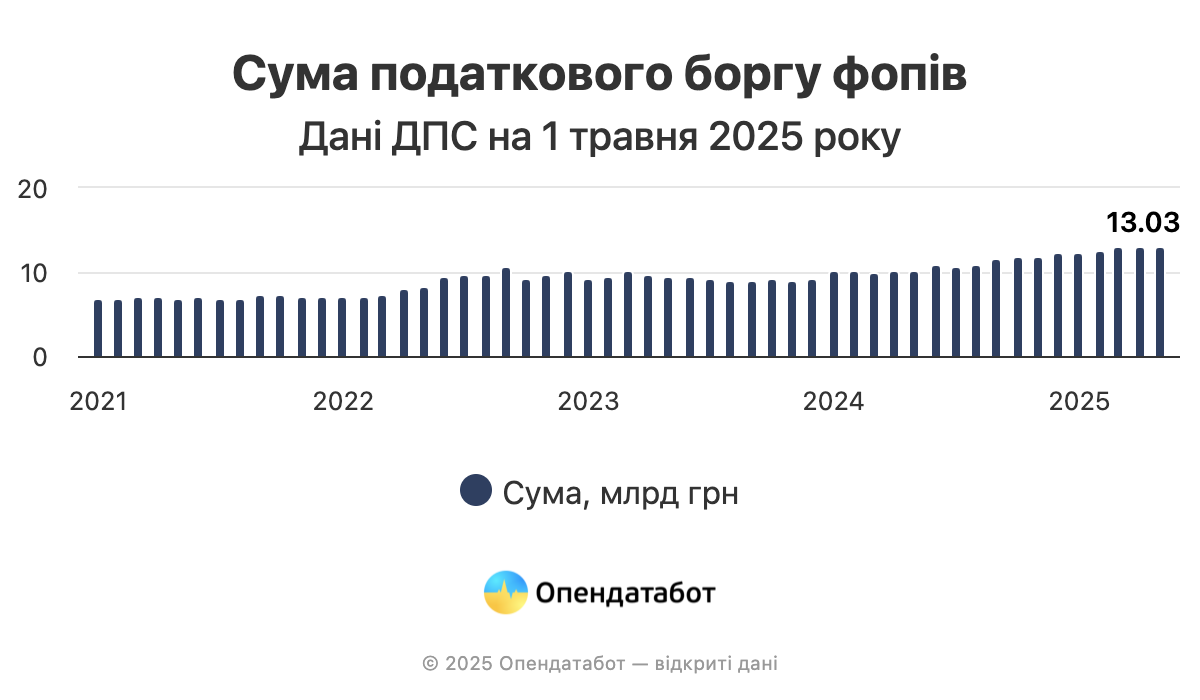
As of May 2025, 1.29 million entrepreneurs owed the state more than UAH 13 billion in taxes. This is according to data from the State Tax Service obtained by OpenDataBot. Since the start of the full-scale war, the number of debtors has increased.
The number of sole proprietors with tax debts in Ukraine has almost doubled in the last three years, from 670,000 in February 2022 to 1.29 million as of early May 2025. A third of this increase (namely, 213,000 entrepreneurs) occurred in March 2022.
The largest number of new debtors appeared in the first year of the full-scale war. At that time, the number of entrepreneurs who owed taxes increased by 1.6 times. The surge occurred in March: +31% per month.
The following year, entrepreneurs adapted to the new realities and the growth slowed to 4% per year. However, in 2024, the situation worsened again, and the number of new debtors increased by 16% over the year.
At the beginning of this year, another 42,282 entrepreneurs were burdened with tax debts, an increase of 3.3%. However, over the following months, sole proprietors paid off their debts, so by the beginning of May, the increase was already 2%, or 24,275 entrepreneurs.
The total tax debt of sole proprietors has increased by almost UAH 6 billion since the start of the full-scale war — almost twice as much.
UAH 30 million of these debts are owed by sole proprietors who are single tax payers in groups 1 and 2 and who have been mobilized. As of April this year, a total of 3,145 entrepreneurs in the ranks of the Armed Forces of Ukraine have tax debts from the payment of single tax and military tax. It should be noted that the actual number of mobilized entrepreneurs with tax debts is currently impossible to calculate.
Since the start of the full-scale war, it has been impossible to check the tax debt of sole proprietors, as the Tax Service has closed this data, considering it critical. However, OpenDataBot now allows you to check information about debts that have already been transferred to the enforcement service for compulsory collection.
Simply enter the individual taxpayer identification number (RNOIKPP) to obtain data on the individual entrepreneur and find out if they have any debts.
https://opendatabot.ua/analytics/fop-debts-2025

More than half of the respondents plan to close because of old-new taxes
Opendatabot has conducted the largest study of the status and plans of individual entrepreneurs in Ukraine. Almost 32 thousand entrepreneurs took part in the survey. 27% of respondents plan to close in the near future. More than half of these businesses stop working due to a sharp increase in the tax burden. In December, 2 entrepreneurs closed for every 1 open business. For comparison, a year ago the situation was completely opposite: 4 new entrepreneurs accounted for 1 closure.
Opendatabot conducted a large-scale survey of Ukrainian entrepreneurs to find out what small and medium-sized businesses plan to do in the near future. The survey involved 31,694 respondents who said they were working as sole proprietors.
27% or 8621 surveyed entrepreneurs plan to close their business in the near future. 2297 or 7% planned to close this year. Another 20%, or 6324 participants, said they planned to stop their business next year.
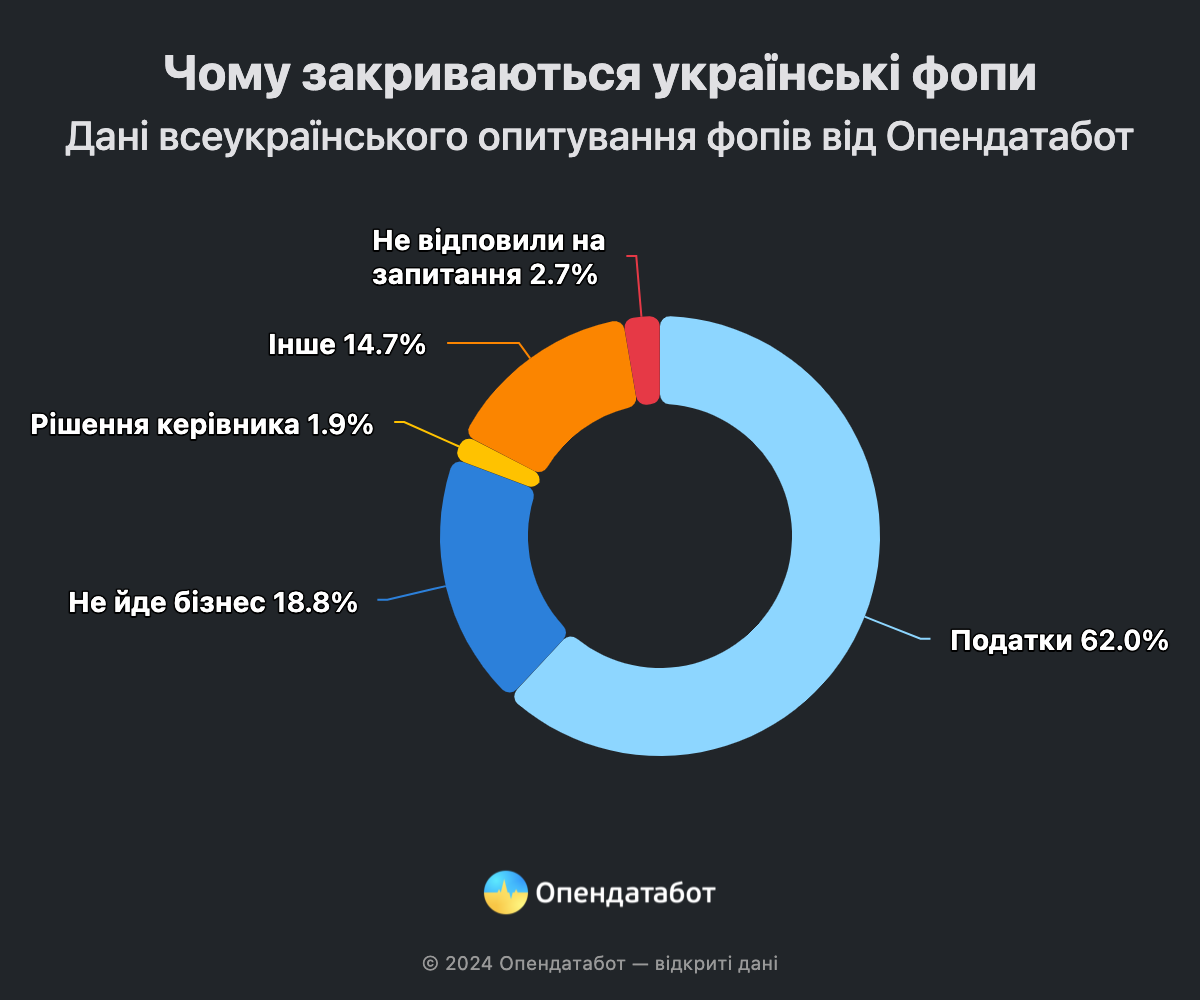
More than half of those who plan to close – namely 62% – decided to close because of tax increases. Another 19% of entrepreneurs are shutting down due to business problems. It is worth noting that currently, due to a large-scale attack by pro-Russian hackers on state registries, closing a business is either very difficult or impossible.
The majority of the surveyed entrepreneurs work in retail (24.6%), and another 21% work in IT.
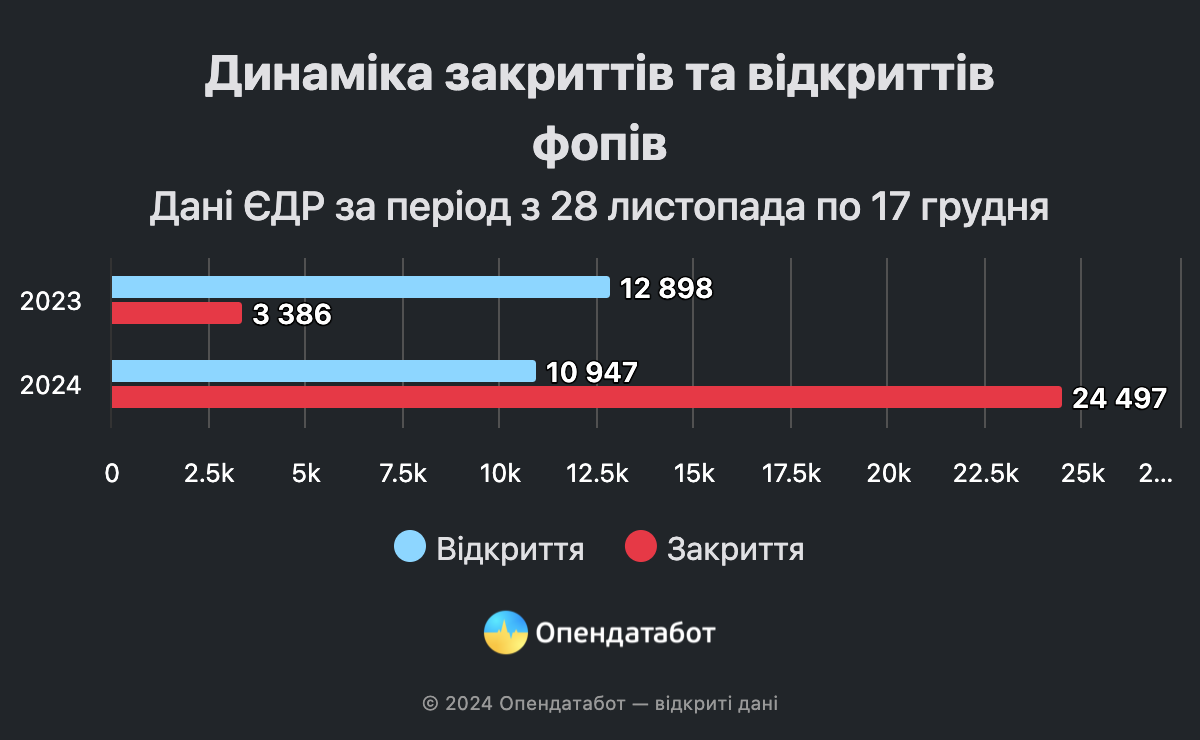
Since the law on the introduction of the military tax for small and medium-sized businesses was signed, 2 new businesses have closed for every 1 new one. Thus, 24,497 entrepreneurs ceased operations between the time the President signed the law and December 17. During the same period, 2.2 times fewer new businesses were opened: 10 947. For comparison, in the same period last year, 4 new fops accounted for only 1 closing.
Opendatabot asked the Chairman of the Committee on Finance, Taxation and Customs Policy Danylo Hetmantsev for a comment. However, at the time of publication, we did not receive a response.
https://opendatabot.ua/analytics/fops-pool-result
closure of individual entrepreneurs, Individual entrepreneurs



