
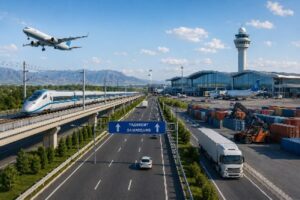
Uzbekistan plans to implement a number of large-scale infrastructure projects in the fields of road and air transport, aimed at improving regional connectivity, developing logistics, and increasing the country’s transit potential.
One of the key projects will be the construction of the alternative “Tashkent–Samarkand” highway. The new 282-km road will pass through the Tashkent, Sirdarya, Jizzakh, and Samarkand regions. This first-class highway, featuring a concrete pavement and six lanes, will allow speeds of up to 150 km/h.
The project includes the construction of 12 interchanges, 91 bridges, 16 overpasses, 60 underpasses, and over 250 drainage structures. There are also plans to implement an intelligent transportation system, build terminals, roadside service facilities, and weigh stations. The goal is to accelerate negotiations with potential investors and begin construction as soon as possible.
At the same time, the modernization of aviation infrastructure is underway. Currently, seven international airports are being reconstructed, and in recent years, new airports have opened in Muynak, Kokand, Zama, Shakhrisabz, Saryasi, and Soh districts. The total number of airports in Uzbekistan has reached 18.
Particular attention is being paid to the development of the Navoi International Airport as a major logistics hub. By 2030, the number of flights here is planned to increase 2.3-fold—to 7,000 per year. Passenger traffic is expected to reach 150,000 people, and cargo traffic—45,000 tons annually. A “free port” economic zone is also planned on the airport grounds, focused on providing technical and commercial services to aircraft.
The project to build the “New Tashkent” International Airport has also been reviewed. The new aviation complex will be able to serve up to 20 million passengers per year. The project involves the construction of a terminal with an area of over 208,000 square meters, the construction of two runways, each four kilometers long, and the creation of 169 aircraft parking bays. Preparatory work and negotiations with design and contracting organizations are currently underway.
Another priority will be the development of a system to supply civil aviation with jet fuel. By 2030, jet fuel production is planned to reach 600,000 tons per year, and storage capacity is to be increased from 49,000 to 80,000 tons. New fuel complexes will be built at the airports in Navoi, Andijan, Bukhara, Urgench, and New Tashkent.
A phased transition to international standards for aircraft storage and refueling is also planned, along with the full digitization of fuel complex management and stricter monitoring of compliance with technical requirements.

The Ministry of Economy and Finance of the Republic of Korea has launched a new Economic Innovation Partnership Program (EIPP) with Ukraine for the next four years, for which the Korean government will allocate $10 million, according to a statement on the website of the Ministry of Economy of Ukraine on Friday.
According to the Ministry of Economy, the initiative provides for strategic consulting, project development, and pre-project research aimed at long-term economic cooperation between the two countries. It is expected that up to 25 initiatives may be implemented under this program.
During a meeting with First Deputy Minister of Economy of Ukraine Oleksiy Sobolev, representatives of the delegation from the Korea Infrastructure and Urban Development Corporation (KIND) outlined which projects would be prioritized.
The Ministry of Economy, in turn, noted that it sees great prospects for partnership with KIND under the new program, both in the public and private sectors, in particular with regard to possible involvement in financing priority initiatives for the government within the framework of the Unified Project Portfolio of Public Investments, as well as private projects presented in the investment guide.
“We hope that KIND will participate in the technical preparation of projects, as we do within the PPF and PPU with the World Bank, the European Investment Bank (EIB), and the European Bank for Reconstruction and Development (EBRD). Another promising area is privatization, consulting assistance, and attracting investors,” the ministry’s press service quoted Sobolev as saying.
The Ministry of Economy reported that KIND is ready to join the master planning of industrial parks in Ukraine and work on reducing risks for investors. The parties discussed the possibility of involving the Republic of Korea in cooperation with the Multilateral Investment Guarantee Agency (MIGA) and export credit agencies to expand military risk insurance mechanisms.
The parties agreed to coordinate work in each area of cooperation and to sign a memorandum of understanding that would allow work to begin on selecting projects for financing and implementation.
The Korean state corporation KIND has been implementing projects to rebuild Ukraine for more than two years, including a transport master plan for the Kyiv region, a plan to reconstruct and rebuild Ukrainian airports, railway renovation, and other projects involving cities and municipalities.

President of Ukraine Volodymyr Zelensky met in Kiev with American businessman and philanthropist, founder and CEO of real estate investment company Wasatch Group Dell Loy Hansen, who presented six new infrastructure projects for Ukraine.
In particular, as reported by the President’s press service, Loy Hansen presented to Zelensky the Phoenix initiative, which together with the state Ukrainian program “eVidnovlennya” restores damaged housing in Andriyivka, Moshchun and Makarov in Kyiv region.
It is noted that the first one hundred houses should be restored by December this year.
In addition, the businessman plans to build a full-cycle center for patients on the basis of the Kiev Center for Rehabilitation Medicine, as well as schools in ten communities in the Kiev region.
Zelensky and Hansen also discussed the projects already implemented by the businessman with the support of the Office of the President, Kyiv OVA and local communities.
Thus, the premises in Kolonshchyna and Sofiyska Borschagivka in Kyiv region have already been fully occupied. People who lost their homes as a result of Russian aggression live there. In addition, the first two phases of apartments for internally displaced persons in the village of Tarasovka have been put into operation. In Kolonshchyna another line of housing for older IDPs will be built.
The Head of State emphasized that Ukraine greatly appreciates people who have been helping our country since the first days of full-scale Russian aggression.
“Thank you for your support and for new projects for our people, for Ukrainian families. In particular, this is the construction of a new medical center, new schools for Ukrainian children and housing for displaced people,” the president said.

In Ukraine this year, more than one thousand infrastructure projects are being implemented as part of the initiatives of the Office of the President and the Cabinet of Ministers, Deputy Head of the Office of the President Kyrylo Tymoshenko has said.
“This year, within the framework of various initiatives of both the Office of the President and the Cabinet of Ministers, more than one thousand infrastructure projects are being implemented throughout Ukraine within the framework of the Big Construction, Big Restoration programs, new programs Healthy Ukraine, Active Parks and so on,” Tymoshenko said at the Ukraine 30. Decentralization Forum.
According to him, this is not only about roads, but also about schools, kindergartens, sports facilities, which are implemented at the expense of state funds and funds of regional authorities.
“To talk about what we are doing, I think the best example will be what will happen at the end of the year, when we see how we have implemented these projects. Many of them are already being commissioned – by the example of objects that are to be launched on the 30th anniversary of independence, i.e. each region will hand over large significant objects. And this autumn, we will start the season for the commissioning of facilities – schools, hospitals, etc.,” he added.
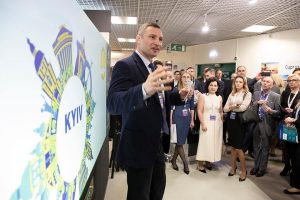
Kyiv Mayor Vitali Klitschko met with a delegation from the European Bank for Reconstruction and Development (EBRD) headed by Odile Renaud-Basso, where the sides discussed further cooperation in the implementation of environmental and infrastructure projects in the Ukrainian capital.
“This year, we plan to complete the repayment of loans under the 2007 loan agreements, which allowed us to purchase 202 new trolleybuses, some 185 buses and 50 metro cars,” Klitschko said on the klichko.org website on Tuesday.
In addition to the urban transport renewal program, the meeting also discussed a project worth EUR 140 million to modernize the heating system of the Ukrainian capital. The EBRD provided a loan for the implementation of the project to the city within the Green Cities program.
Renaud-Basso stressed the interest of the EBRD in cooperation with the municipality of Kyiv.
She said the EBRD officials see the same priority areas of cooperation: roads, bridges, transport and environmental infrastructure. They are ready for closer cooperation, as well as they are ready to continue to provide support and attract investments to contribute to the sustainable development of the city in the face of global challenges.
President of Ukraine Volodymyr Zelensky during a meeting with President of the European Bank for Reconstruction and Development (EBRD) Odile Renaud-Basso invited a financial institution to join the development of infrastructure projects and privatization in Ukraine, according to the website of the head of state.
“It is very important to support infrastructure projects in Ukraine, because high-quality roads, bridges and social infrastructure are important for every Ukrainian. Thanks to infrastructure projects, we created 190,000 jobs at a time when many were losing their jobs due to the COVID-19 pandemic,” Zelensky said.
The head of state also added that “privatization is one of the priorities today” and invited the EBRD to join this direction.
In addition, issues of development of the agricultural sector of Ukraine were discussed at the meeting. “It is advisable to invest in agriculture. Ukraine needs a lot of investment in the modernization of irrigation infrastructure. Its restoration will be a powerful step in the development of agriculture and Ukraine as a player in the international agricultural market,” Zelensky said.
In addition, Zelensky informed Odile Renaud-Basso about the continued implementation of the reform of law enforcement agencies, about the signing of a law in Ukraine on the creation of the Bureau of Economic Security. The interlocutors also discussed the reform of the energy sector, they talked about the implementation of energy efficiency programs, in particular, the introduction of energy-saving technologies in housing.
In addition, the negotiating parties discussed the continuation of the reform of the financial and banking sectors of Ukraine.
“Ukraine and the EBRD have good relations and many important projects in which Ukraine puts its soul, and the EBRD – its faith and money. We consider you one of the strategic financial partners. These relations are very important for us,” Zelensky said.
In turn, the EBRD President welcomed the reforms that are being implemented in various sectors of the Ukrainian economy.
The meeting was attended by Minister of Finance Serhiy Marchenko, Deputy Head of the President’s Office Yulia Svyrydenko, Advisor to the head of the President’s Office Tymofiy Mylovanov, and Head of Ukravtodor Oleksandr Kubrakov.



