
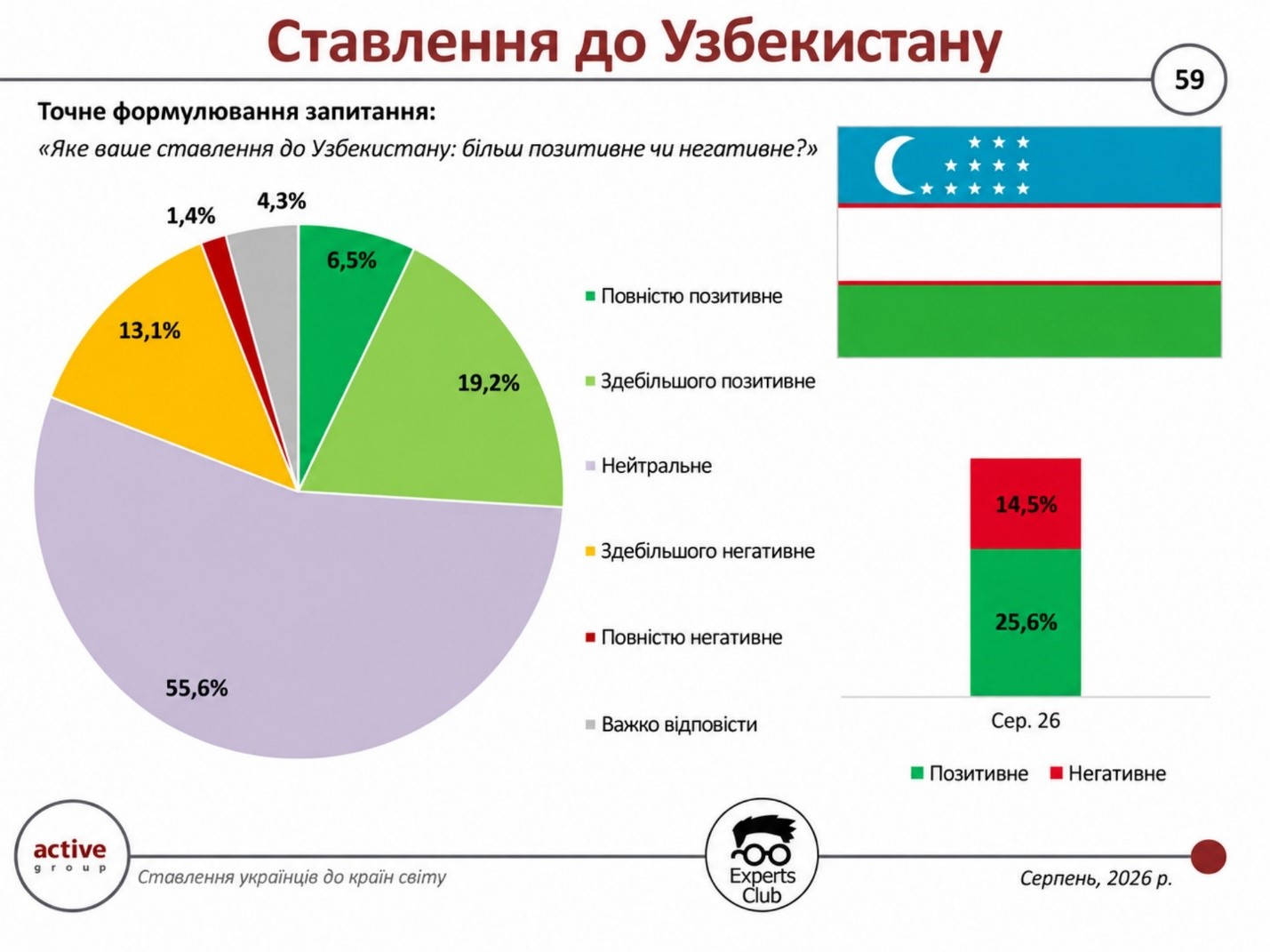
In August 2026, Ukrainians’ attitudes toward Uzbekistan remain predominantly neutral: 55.6% of respondents hold this view. Taking these categories together, 25.7% of those surveyed view the country positively, while 14.5% view it negatively, according to the Experts Club Information and Analytical Center. In the summary report, the positive figure is listed as 25.6%, which is due to the rounding of the raw data.
6.5% of Ukrainians have a completely positive attitude toward Uzbekistan, while 19.2% have a mostly positive attitude. 55.6% of respondents chose a neutral response. 13.1% view the country mostly negatively, 1.4% completely negatively, and another 4.3% were undecided.
When the categories are combined, the balance between positive and negative attitudes is +11.2 percentage points. Positive assessments thus outnumber negative ones by approximately 1.8 times. At the same time, more than half of those surveyed do not express a strong positive or negative stance toward the country.
In the overall regional picture, Uzbekistan has a less pronounced positive image than Georgia and Azerbaijan. In August, positive assessments stood at 57.3% for Georgia and 48.7% for Azerbaijan, while a high proportion of neutral responses remains the key feature of perceptions toward Uzbekistan.
At the same time, compared to the April 2025 survey, attitudes have become more defined. At that time, 63.4% of Ukrainians held a neutral stance toward Uzbekistan, 21.7% had a positive view, 9.3% had a negative view, and 5.6% were undecided. Thus, the positive segment grew by approximately 4 percentage points, the negative segment by 5.2 percentage points, and the share of neutral responses decreased by 7.8 percentage points.
Maksym Urakin, founder of the Experts Club Information and Analytical Center and a candidate of economic sciences, believes that a key factor in how Uzbekistan is perceived remains Ukrainians’ lack of awareness about the country’s current role in Central Asia.
“For a significant portion of Ukrainian society, Uzbekistan remains a rather distant country. People are exposed to far less information about its economy, business, politics, or humanitarian ties than they are about EU countries, the Caucasus, or Ukraine’s immediate neighbors. That is precisely why the neutral group still accounts for more than half of the respondents,” Urakin noted.
At the same time, he said, the decline in the share of neutral responses—from 63.4% in April 2025 to 55.6% in August 2026—is a more significant signal than the individual increase in positive or negative assessments.
“We are seeing the gradual formation of a more defined image of Uzbekistan. Some respondents are shifting from a neutral stance to a specific assessment of the country. At the same time, positive attitudes still significantly outweigh negative ones. This means that there is a sufficiently favorable foundation for the development of economic, educational, cultural, and humanitarian ties, but the image of Uzbekistan in Ukraine still requires a greater informational presence,” Urakin added.
The current results partially confirm this assessment: the neutral group remains the largest, but it has shrunk significantly compared to 2025. The simultaneous increase in both positive and negative responses indicates, above all, the gradual formation of a more defined attitude toward Uzbekistan.
The survey was conducted in August 2026 using an online self-administered questionnaire via the SunFlowerSociology panel among 800 Ukrainian citizens aged 18 and older. The sample is representative by age, gender, and region; the maximum theoretical margin of error for indicators at the 50% confidence level is ±3.5 percentage points.
ACTIVE GROUP, Central Asia, EXPERTS CLUB, international relations, PUBLIC OPINION, SOCIOLOGY, UKRAINE, URAKIN, UZBEKISTAN
Georgia has the highest balance of positive and negative attitudes among Ukrainians among the countries of the Caucasus and Central Asia included in the study—48.5 percentage points. Azerbaijan scored 40.1 percentage points, while Uzbekistan’s score was 11.1 percentage points. These findings come from the third wave of the study “Ukrainians’ Attitudes Toward Countries Around the World,” conducted by Active Group in collaboration with Experts Club, according to the Experts Club Information and Analytical Center.
57.3% of Ukrainians surveyed view Georgia positively, 32.1% neutrally, 8.8% negatively, and another 1.8% were undecided. The balance of positive and negative assessments stands at 48.5 percentage points and has gradually increased over the three waves of the survey: from 45.6 percentage points in August 2025 to 47.5 percentage points in March 2026 and 48.5 percentage points in August of this year. The current figures for positive attitudes and the balance are confirmed by the published survey data.
A positive attitude toward Azerbaijan was expressed by 48.7% of respondents, a neutral one by 39.5%, a negative one by 8.6%, and another 3.1% chose the “difficult to answer” option. The balance stands at 40.1 percentage points. Compared to March 2026, it has risen from 37.8 percentage points, but remains lower than the August 2025 level of 51 percentage points. In terms of the share of positive assessments, Azerbaijan ranks second in this regional group after Georgia.
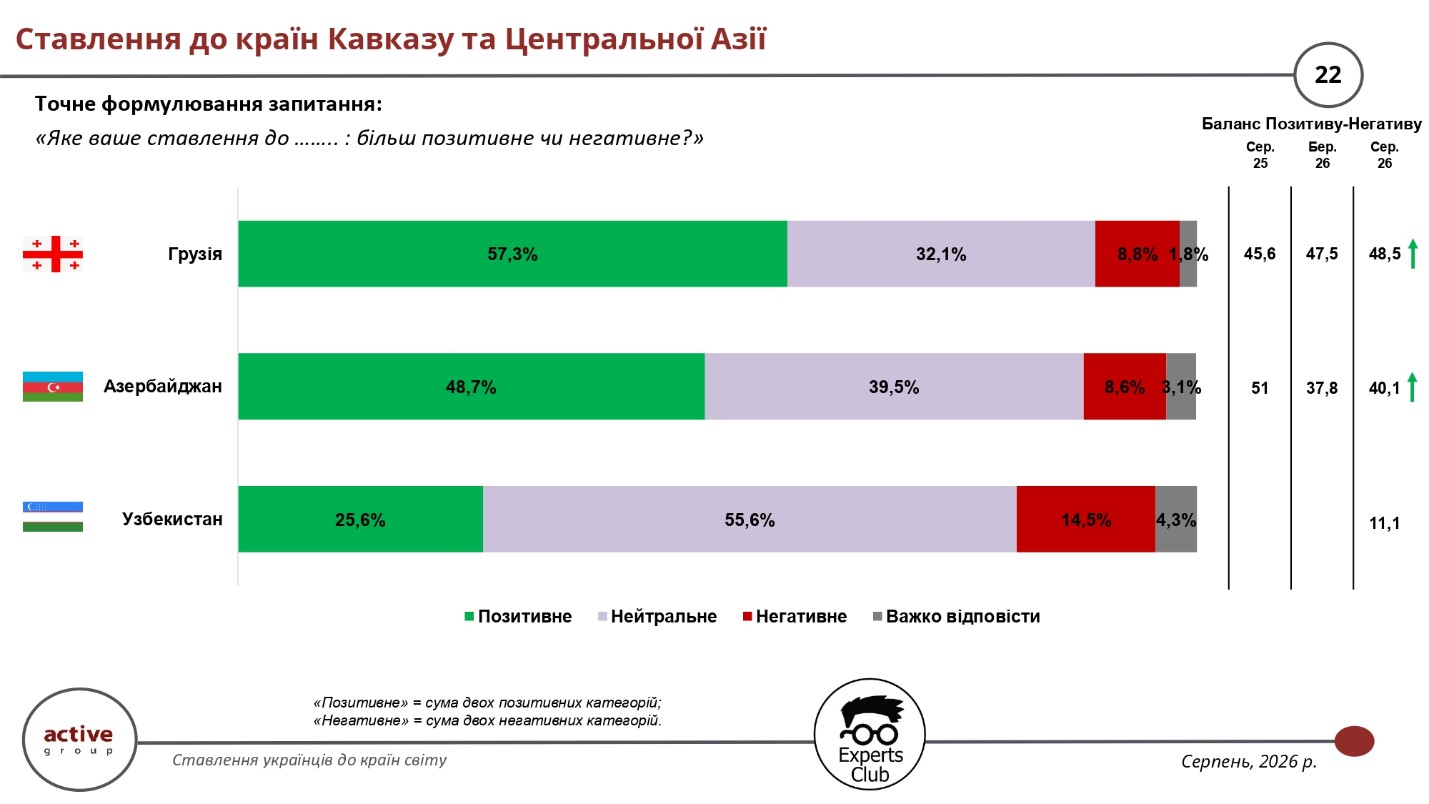
Attitudes toward Uzbekistan are characterized primarily by a high proportion of neutral assessments. 25.6% of respondents view the country positively, 55.6% neutrally, 14.5% negatively, and another 4.3% are undecided. The balance between positive and negative responses is 11.1 percentage points. In the study’s analytical materials, the high proportion of neutral responses is noted as a characteristic feature of perceptions of countries in the region that receive less media attention from the Ukrainian audience.
Thus, the balance remains positive for all three countries surveyed, but the structure of the assessments differs significantly. In the case of Georgia, the overwhelming majority of respondents express a positive attitude; positive assessments also prevail regarding Azerbaijan, while a neutral stance dominates in assessments of Uzbekistan.
Maksym Urakin, founder of the Experts Club Information and Analytical Center, deputy director of the Interfax-Ukraine news agency, and candidate of economic sciences, emphasized the importance of systematic communication between foreign partners and Ukrainian society.
“Second, we must be open to questions and inquiries from the media and the public. We also need to make use of our sociological data,” Urakin noted. According to him, it is important for embassies to regularly inform the Ukrainian audience about specific results of cooperation and to maintain full-fledged communication in the Ukrainian language.
Oleksandr Pozniy, director of the research company Active Group, drew attention to the need to develop the practical component of international economic cooperation.
“We should focus not only on raising general awareness. We need to expand cooperation with countries where we can achieve a positive trade balance,” Pozniy noted. He also highlighted the role of business associations, the Ministry of Economy, and the Ministry of Foreign Affairs in developing bilateral relations.
The survey was conducted in August 2026 using self-administered online questionnaires via the SunFlowerSociology panel. A total of 800 Ukrainian citizens aged 18 and older were surveyed. According to the organizers, the sample is representative in terms of age, gender, and region, and the maximum theoretical margin of error for indicators at the 50% confidence level is ±3.5 percentage points. This is the third wave of the survey, following surveys conducted in August 2025 and March 2026.
ACTIVE GROUP, AZERBAIJAN, Central Asia, EXPERTS CLUB, GEORGIA, international relations, Pozniy, SOCIOLOGY, the Caucasus, UKRAINE, URAKIN, UZBEKISTAN
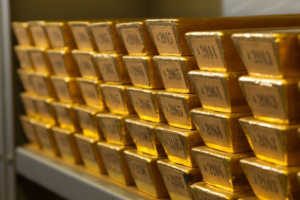
Poland became the largest gold buyer among the world’s central banks in January-August 2026, increasing its reserves by approximately 98 tonnes, according to an Experts Club analysis based on World Gold Council (WGC) data published on October 6.
In August, global central banks continued actively increasing their gold reserves, purchasing another 39 tonnes on a net basis compared with 23 tonnes a month earlier. However, the ranking of cumulative purchases since the beginning of the year differs noticeably from the results of August alone.
According to the WGC, the largest gold buyers in January-August 2026 included:
Poland – about 98 tonnes
China – about 80 tonnes
Uzbekistan – about 50 tonnes
Kazakhstan – about 36 tonnes
Czech Republic – about 14 tonnes
The National Bank of Poland retained first place thanks to the continuation of its large-scale precious metal accumulation programme. In August alone, the Polish central bank purchased another approximately 7.8 tonnes.
As a result, Poland’s gold holdings approached 648 tonnes, while the National Bank’s strategic target is 700 tonnes.
China ranks second. In August, the People’s Bank of China was the largest buyer in the world, increasing its reserves by as much as 20.2 tonnes.
In January-August, China purchased about 80 tonnes of gold, while its official gold reserves reached approximately 2,387 tonnes. Gold accounts for about 9% of the country’s international reserves.
At the same time, China has continued buying the precious metal for 22 consecutive months, making it one of the most consistent buyers among the world’s largest central banks.
Uzbekistan ranks third, having increased its gold reserves by approximately 50 tonnes since the beginning of the year. In August, the country purchased another approximately 7.8 tonnes. The total volume of gold in Uzbekistan’s reserves reached approximately 439 tonnes, with the precious metal accounting for about 90% of the country’s international reserves.
Kazakhstan ranks fourth, with purchases of approximately 36 tonnes over eight months. In August, the National Bank of Kazakhstan added about 7.4 tonnes, bringing its gold holdings to approximately 377 tonnes. Gold accounts for about 79% of the country’s international reserves.
The Czech Republic rounds out the top five largest buyers. The Czech National Bank purchased 14 tonnes since the beginning of the year, including approximately 1.7 tonnes in August. The country’s total gold reserves reached around 86 tonnes.
Notably, the Czech Republic has been increasing its gold holdings for 42 consecutive months, implementing one of the most consistent reserve expansion programmes among European central banks.
At the same time, Turkey and Russia became the largest gold sellers since the beginning of 2026. Turkey reduced its reserves by approximately 82 tonnes, although in August it returned to purchases and bought about 2.9 tonnes. Russia sold about 56 tonnes in January-August, including approximately 6.2 tonnes in August.
The World Gold Council notes that the continued presence of the same countries among active buyers indicates the long-term nature of gold accumulation policies. Monthly changes in purchase volumes largely reflect the implementation schedules of these programmes, market conditions and the liquidity needs of individual countries.
According to the WGC, in January-August 2026 central banks reported net purchases of approximately 170 tonnes of gold. At the same time, officially recorded changes in reserves do not necessarily reflect total public-sector demand, as some central bank transactions become known with a delay or are not disclosed.
The World Gold Council regularly tracks changes in central banks’ official gold reserves based on data from the International Monetary Fund, national regulators and other official sources. The WGC regards central bank demand as one of the key factors in the global gold market.
Central banks, CHINA, CZECH REPUBLIC, EXPERTS CLUB, GOLD, gold reserves, KAZAKHSTAN, POLAND, UZBEKISTAN, WORLD GOLD COUNCIL
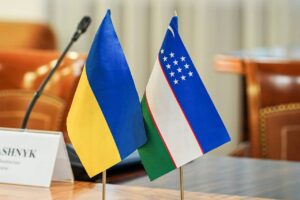
Ukraine and Uzbekistan are introducing a “transport visa-free regime,” which provides for the abolition of permits and related quotas for direct and transit international freight truck transportation between the two countries.
A corresponding protocol between the governments of Ukraine and the Republic of Uzbekistan amending the bilateral Agreement on International Road Transport was signed on September 30, 2026, according to the Ukrainian Embassy in Uzbekistan.
According to the diplomatic mission, the preparation of the document took nearly a year.
The main change will be the simplification of direct and transit freight transport by eliminating the need to obtain permits, as well as quantitative quotas for such transport. This regime, by analogy with other agreements in the field of international road transport, is referred to as “transport visa-free travel.”
For Ukrainian and Uzbek carriers, this will mean the removal of one of the administrative barriers to organizing freight transport between the two countries and transit through their territories.
The embassy expects that the liberalization of road transport will contribute to the restoration of Ukraine’s trade and economic ties with Uzbekistan, which were partially disrupted due to logistical problems following the start of full-scale Russian aggression.
The agreement takes on particular significance amid the restructuring of Ukraine’s foreign trade and the search for alternative transport corridors to Central Asia.
“The removal of bureaucratic barriers should soon facilitate the restoration of full-fledged trade and economic ties between Ukraine and the Republic of Uzbekistan,” the embassy noted.
The diplomatic mission also described the new agreement as one of the steps toward Ukraine’s return to Central Asian markets via new logistics routes.
The protocol, signed on September 30, amends the existing intergovernmental Agreement between Ukraine and Uzbekistan on international road transport. Specifically, it concerns the liberalization of direct and transit freight transport by road. The embassy’s statement does not provide for the abolition of other customs, border, or transportation procedures required for the international transport of goods.
Original source – Embassy of Ukraine in the Republic of Uzbekistan.
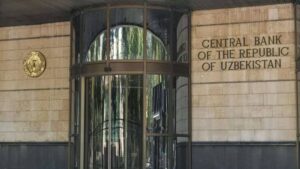
According to Fixygen, the Central Bank of Uzbekistan is exploring the possibility of introducing a wholesale central bank digital currency (CBDC), while also testing stablecoins and intending to continue reducing the state’s share in the banking sector.
Representatives of the regulator made these statements at the Silk Road Finance & Technology Forum 2026, which is taking place in Tashkent from August 24–26. The forum was organized by the Central Bank of Uzbekistan and the Global Finance & Technology Network (GFTN). More than 6,000 representatives from 74 countries are participating.
Nodirbek Achilov, Deputy Chairman and Member of the Board of the Central Bank, stated that the regulator is analyzing international experience with wholesale CBDCs, including both successful and unsuccessful projects.
Unlike a retail digital currency, which could potentially be used by the general public for everyday payments, a wholesale CBDC is intended primarily for settlements between banks and other financial institutions. Among the potential benefits of such an instrument, Achilov cited increased security and efficiency in interbank settlements.
The central bank is also testing a stablecoin system in a special regulatory regime in collaboration with Uzbekistan’s National Agency for Prospective Projects. A decision on further scaling up the project is planned to be made after the completion of research and an assessment of the financial market’s reaction. The topic of stablecoins, central bank digital currencies, and the tokenization of real assets is one of the distinct themes of the forum’s program.
At the same time, the Central Bank plans to continue privatization and reduce the state’s presence in the banking system. Central Bank Governor Timur Ishmetov stated that over the past few years, the state’s share in the sector has decreased from approximately 85% to 60%. “We will continue this trend,” Ishmetov said.
Official Central Bank statistics show that as of June 1, 2026, banks with state participation accounted for about 63% of the banking system’s assets, 66% of the loan portfolio, and 59% of capital. Total assets of commercial banks amounted to 984.4 trillion sum.
The regulator is also preparing to publish a strategy for foreign exchange interventions. According to Ishmetov, the Central Bank’s operations in the foreign exchange market are not aimed at keeping the sum exchange rate at a specific fixed level. Interventions, in particular, are related to gold purchases and the regulation of the money supply.
The Central Bank intends to continue maintaining a flexible, market-oriented exchange rate and to present plans for further liberalization of capital account transactions. “We are ready to be more open and transparent,” Ishmetov noted.
In addition, the Central Bank has prepared a three-year roadmap for reforming banking regulation following the Financial Sector Assessment Program (FSAP) conducted by the IMF and the World Bank. The regulator plans to align requirements with the international Basel III standards and transition banks to reporting under International Financial Reporting Standards (IFRS). The Silk Road Finance & Technology Forum is being held in Uzbekistan for the first time. The organizers cite positioning the country as a regional hub for financial technology in Central Asia as one of the forum’s goals. Specific sessions of the forum are dedicated to digital assets, payment infrastructure, artificial intelligence, cross-border payments, tokenization, and CBDCs.
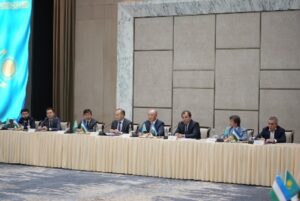
Kazakhstan and Uzbekistan plan to jointly enter new export markets in the Middle East. The agreement was reached during the Kazakhstan-Uzbekistan Business Forum, which took place on August 5 in Tashkent.
As part of the initiative, business delegations from both countries intend to visit Aleppo in late September and Erbil in early October. A trilateral business forum involving companies from Uzbekistan, Kazakhstan, and Syria is planned to be held in Syria. The Uzbek side may be represented by 20–30 companies.
The Syrian market is of particular interest, as demand for construction materials, food products, sunflower oil, and meat products is growing amid the country’s reconstruction.
In Iraq, the supply of confectionery products, porcelain tiles, household chemicals, and polyethylene pellets has been identified as promising areas.
Joint entry into third-country markets will make it possible to:
· expand the export reach of Kazakhstan and Uzbekistan;
· combine the production and export capabilities of the two countries;
· develop cooperation between enterprises;
· utilize shared logistics routes;
· find new foreign partners.
The initiative reflects a new approach to economic partnership between the two countries—shifting from the development of mutual trade to the joint development of third-country markets. Uzbekistan and Kazakhstan also maintain their goal of increasing bilateral trade to $10 billion.



