

Exports of IT services in 2024 will decline by 4-6% compared to 2023 and may amount to $6.3-6.4 billion, Lviv IT Cluster predicts.
“The decline in IT services exports that began in 2023 continues. Under the optimistic scenario, by the end of 2024, it will decrease by 4% compared to 2023. Under the pessimistic scenario, this figure will reach 6%. We should expect $6.3-6.4 billion. Thus, in 2024, the tech industry will not show growth for the second year in a row compared to last year,” follows a study by IT Research Ukraine conducted by the Lviv IT Cluster.
At the same time, despite the challenges of a full-scale war, the technology industry in Ukraine remains one of the key industries and provides significant foreign exchange earnings. The IT sector is the largest exporter of services in Ukraine, accounting for 38% of total exports of services. In total exports, IT ranks second after food exports, the study says.
According to the data, 2118 IT companies operate in Ukraine. Half of them are service companies, including 47% outsourcing and 3% outstaffing. Another 31% of companies are product companies. The rest have a mixed business model.
45.7% of the IT companies surveyed said they do not plan to open new representative offices in the short term, 17.1% plan to open in Ukraine, and 34.3% abroad. Most want to open a representative office in Poland. In addition, 6% of CEOs plan to close their office in Ukraine.
The number of specialists working in the IT industry in 2024 decreased by 1.6% to 302 thousand. Most of them, 238 thousand people, live and work in Ukraine. The number of Ukrainian specialists abroad also decreased to 62-64 thousand people against 65 thousand in 2023, the study says. The average age of a Ukrainian IT specialist is 31.5 years. The majority of respondents, 68%, do not have children.
The median income of IT professionals in Ukraine, according to IT Research Ukraine 2024, decreased by 1.7% compared to 2023 and amounts to $2590. At the same time, the majority of respondents reported that their expenses for rent, food, and other basic needs have increased.
Most 97% of IT companies donate and implement projects that bring Ukraine closer to victory. 67.6% of surveyed companies have mobilized specialists on their staff. IT companies support their employees serving in the Ukrainian Defense Forces by providing them with job security, fixed salaries, or partial compensation.

About 20% of Ukrainian IT specialists work abroad, while in 2023 their number increased to 65 thousand from 50-57 thousand a year earlier, according to the study AI Ecosystem of Ukraine: Talents, Companies, Education, prepared by the non-profit organization AI House and Roosh investment group with the support of the Ministry of Digital Information.
According to the data, the total number of IT specialists in Ukraine increased to 307 thousand in 2023 from 285 thousand in 2022.
According to Eurostat data cited in the study, Ukraine ranks second among Central and Eastern European countries in terms of the number of IT specialists, followed by Poland with 600.7 thousand.
At the same time, the number of AI/ML specialists has increased fivefold over the past 10 years, but as of January 2024, it amounts to slightly more than 1% – 5.2 thousand people.
“The active migration of specialists abroad as a result of the war leads to a shortage of qualified personnel in the domestic market, hindering the development of the industry,” the study says.
The most widespread professions among specialists are Data Scientists and ML Engineers, which together account for 63% of all AI/ML industry professionals. It is noted that these areas offer the highest salaries among IT specialties in the country. The average salary of a junior specialist in Ukraine is $1-1.5 thousand, and a senior specialist – $4.5 thousand.
Over the past 10 years, the number of product AI companies in Ukraine has increased by 3.7 times and reached 183 by 2023, while the number of service AI companies has increased by 46% to 60. Over the past four years, 34 companies specializing in artificial intelligence have opened. It is noted that 55% of the offices of Ukrainian AI companies are located in Kyiv.
At the same time, the country ranks last among the countries of Central and Eastern Europe in terms of the number of venture capital investments attracted over the past three years. The leaders are Poland, Lithuania, and the Czech Republic, which attract 12-16 times more funding than Ukraine, the study says. The probable reasons are the full-scale invasion of Russia and the registration of Ukrainian companies in European countries or the United States.
In 2023, the amount of venture capital investments that 22 Ukrainian companies managed to attract decreased by 31% to $10.8 million compared to 2022, which, according to the authors of the study, repeats the general trend of a decrease in such investments in the world. The war also complicates the process of negotiations between startups and potential investors to raise funding.

The number of IT specialists working in Ukraine in 2023 increased by about 2.7% to 346.2 thousand people, according to the research Digital Tiger: the Power of Ukrainian IT, prepared by the IT Association.
Executive Director of IT Ukraine Association Maria Shevchuk specified that such statistical data were provided at the request of IT-Association and the Ministry of Digital Transformation by the State Statistics Service.
“At the same time, the same IT specialist can be an individual entrepreneur (FOP), a salaried employee employed in the staff of an IT company, and a specialist working under a gig contract. This duplication is not reflected in the statistics figures,” Shevchuk specified.
According to the research data, the biggest growth was observed among specialists working in IT on gig-contract. Their number in 2023 increased by 3.9 times – up to 23.2 thousand. At the same time, the number of specialists registered as entrepreneurs (FOP) decreased to 265 thousand against 272.8 thousand in 2022.
The study points out that there are no new data on the number of employees employed in the staff of IT companies for 2023, but in 2022 their number reached 58.1 thousand people.
In general, for five years from 2018 to 2023, the growth in the number of IT-specialists in Ukraine amounted to 78.4%, stated in the study Digital Tiger: the Power of Ukrainian IT.
The number of taxes paid by the IT industry in Ukraine during the full-scale invasion has decreased – according to the data given in the study as of January 1, 2022, $1.018 billion was paid, January 1, 2023 – $996.7 million, January 1, 2024 – $982.6 million.
The number of M&A deals in IT in 2022 decreased from 19 for $146 million to 11 for $161.2 million in 2023.
IT in Ukraine remains an important partner for foreign companies despite the ongoing war, said Stepan Mitish, vice president of EPAM Ukraine, at the presentation of the study.
“When our clients need to do something impossible, they go to Ukraine, against all odds. With all due respect to other countries and nationalities, but Ukrainians are about creativity, about knowledge and technology, result-oriented, indestructible and productive, which the last two years have proven,” Mitish said.
As an example, he cited US-based MedTech, which specializes in healthcare products. According to him, the company, realizing “the uniqueness of Ukrainian talents,” increased the size of its team from 25 to 200 people during the two years of full-scale invasion. Mitish did not specify the name of the company.

IT and artificial intelligence (AI) can make metallurgy more environmentally friendly and efficient, says Yuriy Ryzhenkov, CEO of Metinvest Mining and Metallurgical Group.
He expressed this opinion at the first B7 Italy 2024 meeting held on 13 March in Verona (Italy), organized by Confindustria, an association of Italian companies designed to facilitate dialogue between the business world and the governments of the G7 countries. The conference was attended by more than 250 guests, including CEOs and business leaders from G7 countries and international companies, as well as the Italian Minister of Entrepreneurship and Made in Italy, Adolfo Urso.
The participants discussed the key factors affecting industrial productivity and competitiveness in a rapidly developing global economy. Metinvest’s CEO was one of the speakers on the main discussion panel. He spoke about the peculiarities of steel production in Ukraine during the war, the company’s vision of a “green” course and the transformation of business processes in the steel industry through new technologies.
In particular, he noted that in recent years, many companies have been working on results and ignored technology. For example, in 2021, Azovstal outperformed all its competitors in terms of process efficiency thanks to AI and analytics.
“Our specialists, using augmented reality, could perform maintenance twice as fast as most of our competitors in neighboring countries. The implemented “space” computer vision system has set new standards for the quality of our products. Finally, the internal data management and communications system allowed us to run the company smoothly in the midst of the fiercest war in Europe since World War II,” Ryzhenkov stated.
He added that Metinvest, despite the war, is a very good example of how to use digital technologies to breakthrough in traditional industries.
Speaking about the “green” course in the industry, the CEO emphasized that almost every politician is interested in these issues, not only in Europe but also in the US, China, and around the world. At the same time, the steel industry is at the top of the agenda of this course as a major player in the implementation of green technologies. But at the same time, metallurgy is a very traditional industry, with technologies developed long ago, and it is impossible to make a major breakthrough now. It is only possible to gradually improve the system, he noted.
“The transition to the green course will not be easy. We do not have enough IT specialists to work on the transformation. Only five to seven years ago, we were looking for metallurgical engineers to teach IT. Now it’s the other way around. We train IT specialists who are taught metallurgy. And these are the people who will be in charge of our company’s green and digital transformation. This is happening right now. We will all be part of this transition, and we had better be ready for this challenge,” the top manager summarized.
“Metinvest is a vertically integrated group of steel and mining companies. The group’s enterprises are located mainly in Donetsk, Luhansk, Zaporizhzhia and Dnipro regions.
The main shareholders of the holding are SCM Group (71.24%) and Smart Holding (23.76%), which jointly manage it.
Metinvest Holding LLC is the management company of Metinvest Group.
AI, IT, METALLURGY, METINVEST
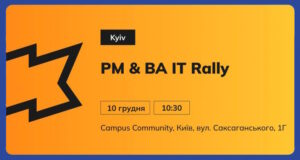
We are pleased to invite you to PM & BA IT Rally in Kyiv.
We have gathered top speakers who will share their practical experience, interesting cases, and insights into project management and business analysis in the IT field.
Speakers:
▪️ Dmytro Sobko, Senior BA at Uklon
▪️ Alyona Lubchak, Co-founder & trainer at E5
▪️ Denys Prylutskyi, Head of PMO at SoftServe
We will have a coffee break where you can talk to the speakers personally. After the speeches of all three IT Rally participants, there will be a panel discussion. Don’t forget to prepare your questions.
There will also be a charity auction where we will raffle off useful and interesting items to support the Mobile Frontline Hospital.
Discount: 10% with the code – Experts
Interfax-Ukraine is a media partner of the event.

The number of employees in the top 50 IT-companies in the period from August 2022 to January 2023 decreased by 5.3% to 92.4 thousand due to relocation in foreign offices of companies and legalization abroad, such research results were published on the DOU website on Monday.
According to him, most companies have up to 25% of their Ukrainian team members abroad.
“As the companies explained, the reduction, with some exceptions, does not mean a reduction in the number of specialists in the company. The IT specialists moved abroad to work in other offices of their own companies, they legalize there and stop paying taxes in Ukraine,” reads the text of the research.
Its authors recall that before the full-scale war, in January 2022, 50 largest IT-companies employed 100.3 thousand people, and in January 2021 – 76.3 thousand people.
It is noted that mostly companies began to actively legalize abroad it is technical specialists. If in the first half of 2022 the number of technical specialists was kept at the same level, in the second half there is a clear negative trend: minus 4.6 thousand specialists. The total number of technical specialists in the top 25 IT companies in January 2023 was 57.9 thousand compared to 62.5 thousand in January 2022.
In the five largest companies (Epam Ukraine, SoftServe, GlobalLogic Ukraine, EVOPLAY, Luxoft) the number of specialists decreased by 3.3 thousand in the second half of 2022, according to the study.
In particular, in company Epam Ukraine which occupies the first step in DOU rating, the number of working specialists decreased on 1260 persons in the first half-year of 2022 and 1225 in the second – to present 11,375 thousand persons (working in Ukraine or continuing to pay taxes in Ukraine even in case of moving abroad). The number of technical specialists of the company decreased by 9% to 10.4 thousand people. It is noted that some of the company’s specialists left Ukraine to escape the war and remain there. Jobs for EPAM in Ukraine today are few, because the need for specialists will be covered mainly through bench – internal specialists of the company, the material says.
The number of employees in Ukraine SoftServe (2nd place) decreased by 164 people in the first half of 2022 and by 1468 people in the second half – to 9.45 thousand people. The company has 22% fewer technicians (7,393). These changes are also explained by relocation: about 2 thousand SoftServe specialists moved abroad after the start of the full-scale invasion. Some of them returned, but many of them still stay abroad and now legalize in other locations of the company. Also, according to the DOU, there is some optimization going on, but not a massive one.



