
German automotive group Mercedes-Benz has decided to suspend further investment in its production facilities in Germany and has begun a detailed analysis of the possibility of closing certain plants due to high production costs and the lack of agreements with trade unions on reducing them, Reuters reported on November 12, citing an internal message from the company’s management to employees.
The management board’s decision was made after several months of unsuccessful negotiations with the works council and the IG Metall trade union on increasing labor productivity and reducing personnel costs.
Michael Schiebe, the Mercedes-Benz management board member responsible for production, said that management had jointly decided to halt all further investments in German facilities until agreements on cost reductions are reached.
According to him, the cost of one working hour at some of the group’s plants in Germany can be five times higher than at production facilities in Eastern European countries.
Mercedes-Benz management warned that, in the absence of agreements to improve competitiveness, production of new car models could be located exclusively outside Germany.
Britta Seeger, a member of the company’s management board, noted that the group seeks to avoid plant closures but, due to the lack of progress in negotiations, is forced to examine this possibility in greater detail.
Schiebe had previously warned that if the current level of costs persists, two German facilities, including an assembly plant and a powertrain production facility, could face closure.
The specific facilities that could be closed have not yet been named, and no final decisions have been made regarding the termination of their operations.
Mercedes-Benz has around 12 production facilities in Germany. Its main passenger car assembly plants are located in Sindelfingen, Rastatt, and Bremen, while engine and component production is concentrated in Stuttgart and other cities. The main point of disagreement between management and employees remains working hours and the wage structure. The group proposes increasing the working week from 35 to 40 hours without a corresponding increase in wages, as well as revising the system of bonuses, additional payments, and compensation.
The IG Metall trade union opposes the deterioration of working conditions and is demanding a 5% wage increase as part of the current industry-wide negotiations.
According to Handelsblatt, Mercedes-Benz management expects to save approximately EUR 800 million annually by reducing personnel costs.
Negotiations on cost reductions are taking place against the backdrop of deteriorating financial performance in Mercedes-Benz’s passenger car business.
According to the group’s financial statements published on October 28, sales of Mercedes-Benz Cars vehicles in the third quarter of 2026 declined by 7.8% compared with the same period of the previous year, to 407,200 units.
The division’s revenue fell by 5.8% to EUR 22.37 billion, while adjusted operating profit (EBIT) dropped by 50.8% to EUR 560 million, compared with EUR 1.14 billion a year earlier.
The adjusted return on sales decreased from 4.8% to 2.5%.
At the same time, the financial results of Mercedes-Benz Group as a whole were better thanks to the performance of its commercial vehicle and financial services divisions.
The group’s total operating profit in the third quarter amounted to EUR 1.77 billion, compared with EUR 750 million a year earlier, while net profit increased to EUR 1.52 billion.
During the first nine months of 2026, investments in fixed assets and research and development expenditures at the Mercedes-Benz Cars division decreased by a combined 11%.
The company also announced the resumption, starting in December 2026, of a voluntary redundancy program for employees of administrative and other indirect departments in Germany.
Mercedes-Benz explains the need for restructuring by intensifying competition from Chinese automakers, declining demand in certain markets, high production costs, and the impact of tariff restrictions.
The difficult situation at Mercedes-Benz is unfolding against the backdrop of restructuring at other major automotive groups and component manufacturers in Germany.
In particular, German automotive components manufacturer Schaeffler announced on November 3 plans to cut 3,460 jobs in Europe, including approximately 2,660 in Germany, and close five production facilities, four of which are located in Germany.
The company expects the restructuring to improve its annual financial result by approximately EUR 300 million starting in 2030.
Meanwhile, Volkswagen is implementing a cost-reduction and production restructuring program in response to intensifying international competition.
According to a study by consulting firm Roland Berger published on October 7, 2026, the German automotive industry could lose at least 200,000 jobs by 2030.
Analysts estimate that employment in the industry, including carmakers and component manufacturers, could fall from approximately 692,000 people in 2025 to 490,000 in 2030.
The researchers note that the average capacity utilization rate of German automotive plants in 2025 was around 60%, whereas profitable operations usually require a rate of at least 75–80%.
Mercedes-Benz Group AG is one of the world’s largest manufacturers of premium-segment automobiles, headquartered in Stuttgart. The group includes the Mercedes-Benz Cars, Mercedes-Benz Vans, and Mercedes-Benz Financial Services divisions. The company produces passenger cars, electric vehicles, and light commercial vehicles, and also provides financial and leasing services.
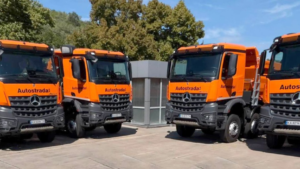
The “Autostrada” Group of Companies purchased 100 new Mercedes-Benz Arocs dump trucks with a total value of 1 billion UAH, according to the group’s founder, Maksym Shkil.
“Autostrada continues to systematically invest in expanding its fleet and its own production capabilities. The company has purchased 100 new Mercedes-Benz Arocs 5 4142 K (8×4) dump trucks. This is one of Autostrada’s largest investments in fleet modernization since the start of the full-scale war—it totals 1 billion hryvnia,” Shkil wrote on Facebook on Tuesday.
According to him, the group has invested over 10 billion hryvnia in vehicles, specialized equipment, and production facilities since the start of the war.
Shkil emphasized that a key component of this particular deal was comprehensive protection for the vehicles against military risks: all vehicles have full insurance coverage, including comprehensive coverage (CASCO), civil liability, and additional insurance against military risks.
The new dump trucks have already been dispatched to Autostrada’s construction sites throughout Ukraine.
Mercedes-Benz Arocs trucks are designed for intensive use and heavy loads. The 421-ks OM 471 engines, 8×4 wheel configuration, and MEILLER Halfpipe bodies provide the necessary performance for operating in challenging road and working conditions.
“Even amid the war, we continue to develop our own technical infrastructure, implement modern technologies, and invest in our team. This approach allows us to control key production processes, reduce dependence on external resources, and ensure on-time delivery, quality, and results at every stage of project implementation,” Shkil emphasized.
The purchase was financed in partnership with OTP Leasing Ukraine, with which Autostrada has been collaborating for 10 years.
The Autostrada Group of Companies is a leader in infrastructure construction in Ukraine. Its areas of activity include road construction, bridge construction, industrial construction, underground construction, and design.
According to data from YouControl, in January–June of this year, Autostrada Group LLC reported 2.4 million UAH in net profit (compared to 91.1 million UAH for the same period in 2025) and 1.92 billion UAH in net revenue (5.13 billion UAH).
As previously reported, a missile strike on “Autostrada’s” production facility in Kyiv in early August destroyed and damaged more than 20 pieces of equipment, a concrete plant, a service center for equipment repairs, production facilities, and a laboratory complex.
Autostrada, dump truck, EQUIPMENT, INVESTMENT, MERCEDES-BENZ, ШКІЛЬ

German automaker Mercedes-Benz Group AG aims to at least halve its carbon footprint per passenger car produced by 2030 compared to 2020 levels.
According to the company’s press release, to achieve this goal, it intends to increase the share of electric vehicles in the line of produced cars, use “green” charging technologies, work on improving battery technologies, and also actively use recycled materials and renewable energy sources in production.
Mercedes-Benz expects to produce exclusively electric vehicles by 2030. The company aims to increase the share of hybrid and electric vehicles to 50% of the total volume of passenger cars produced by 2025.
By 2030, the automaker intends to cover more than 70% of its energy needs from renewable sources, in particular through the use of solar panels and wind turbines at its enterprises.
The company has previously said it plans to achieve carbon neutrality in its operations by 2039.
Mercedes-Benz shares lost 1.3% in Frankfurt trading on Monday. Since the beginning of this year, their value has decreased by 8%.



