
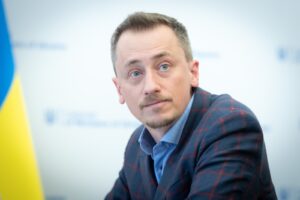
According to the European Business Association, 75% of companies report staff shortages, and the State Employment Service’s (SES) Unified Job Portal has registered over 200,000 open positions, said Minister of Economy, Environment, and Agriculture Oleksiy Sobolev at The Jobs & Skills 4 Ukraine Forum on Thursday.
“We can see how much the labor market has changed, with 75% of businesses facing a labor shortage. The government must address this. That is why we are developing a labor market forecasting system that will serve as the foundation for state funding of education and training, retraining programs, donor investments, educational programs, and employers’ hiring decisions,” the minister emphasized.
According to him, the new employment policy should be based on several key points. First, it involves data on which professions, skills, and qualifications the economy will need not only today but also in five or ten years. Second, if an employer needs certain skills, the government, education providers, and partners must help people acquire those skills. Third, a more inclusive labor market. Fourth, a new level of partnership with the business sector.

The blockade of a road on the Lithuanian-Polish border by farmers on March 1 may violate the European Union principle of free movement of goods and people, Lithuanian Economy and Innovation Minister Aušrine Armonaitė said, LRT writes.
“As far as I understand, the flow of people will not be stopped, but we are still members of the free European Union, where the movement of goods and people should be free. Any impediment to that movement has the potential to disrupt freedom of movement,” the minister said.
She noted that trucks at the border would be directed to additional parking lots for inspection, which could lead to queues.
A nationwide strike of farmers started in Poland on February 9. The main demands of the strikers are to adjust the “green” course of the European Commission, to limit the inflow of Ukrainian agricultural products to the Polish market, as well as to increase the profitability of agricultural production. During the protests, farmers block Ukrainian-Polish border crossings.
Since March 1, Polish farmers have been preparing for two new blockades – at the former Polish-German border crossing in Svec and on the road near the former Lithuanian-Polish border crossing “Kalwaria-Budzisko”. Farmers will check the contents of trucks, especially agricultural goods.
According to Ausris Macijauskas, chairman of the Lithuanian Grain Producers Association, Polish farmers’ suspicions that Ukrainian grain brought from Poland to Lithuania is being returned or processed and re-exported as Lithuanian goods are justified.
Via Baltica is a 970-kilometer section of European route E67 between Tallinn and Warsaw. It provides road links between the Baltic countries. E67 connects Helsinki (Finland) and Prague (Czech Republic).
The Suvalki Gap is a strip of land about 100 kilometers long on the Lithuanian-Polish border, which is wedged between the Russian exclave of Kaliningrad in the west and Belarus in the east.
Maciauskas said earlier that Lithuanian farmers for their part would not contribute to the Polish protest. According to him, the biggest problem of Lithuanian farmers is Russian grain.



