
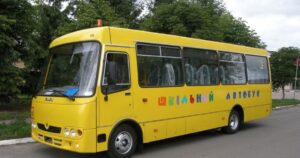
The municipal institution “Center for Financial and Statistical Monitoring, Material and Technical and Information Support of Educational Institutions” of the Mykolaiv Regional Council will purchase 40 Ataman school buses manufactured by the Cherkasy Bus plant by June 1 of this year for UAH 147.83 million, compared to the expected purchase price of UAH 148.36 million.
According to a report in Prozorro, the city council signed the relevant agreement with Isuzu-Ataman Ukraine JSC on December 31 following the results of a tender in which the company was the only participant.
In particular, 39 regular school buses will be purchased for UAH 143.91 million (including VAT), at a price of UAH 3.69 million per bus, and one bus with two seats for schoolchildren with limited mobility will be purchased for UAH 3.92 million.
Full payment is expected within 10 banking days.
Isuzu-Ataman Ukraine will supply buses manufactured in 2025 that meet Euro 5 environmental standards, with 28 seats for schoolchildren and three for accompanying persons and crew members. The degree of localization is 68.8%.
The specialized bus has 21 seats for schoolchildren, including two for children with limited mobility, as well as two seats for accompanying persons. The degree of localization is almost 71%.
According to YouControl, PJSC Isuzu-Ataman Ukraine, which, among other things, trades in Isuzu and Ataman vehicles, received UAH 49.2 million in net profit in January-September 2025, which is 56% more than in the same period in 2024, and its net income increased 2.4 times to UAH 408 million.
As reported, the state budget subsidy for the purchase of school buses next year is UAH 2 billion, compared to UAH 1.6 billion in 2025.
According to the Ministry of Economy, the Mykolaiv region purchased 25 buses last year. The subsidy from the state budget for the region amounted to UAH 23.54 million.
Since 2024, the School Bus program has been implemented thanks to financial cooperation between the EU and Ukraine within the framework of the Ukraine Facility instrument. In particular, school buses must have seats for students with limited mobility.
The required level of localization in 2026 is at least 30%.
According to preliminary data, 720 school buses were implemented in 2025 with state subsidies and co-financing from local communities.
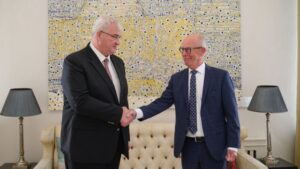
Ukrainian Foreign Minister Andriy Sybiga received Ole Egberg Mikkelsen, Ambassador Extraordinary and Plenipotentiary of the Kingdom of Denmark to Ukraine, who is ending his diplomatic mission in Ukraine after five years of service.
According to the press service of the Ukrainian Foreign Ministry, Sibiga expressed his gratitude to Ole Egberg Mikkelsen for his personal commitment to the Ukrainian-Danish partnership and noted that the ties between Ukraine and Denmark established during his tenure go far beyond official relations.
“Denmark has become a world leader in terms of aid to Ukraine as a percentage of GDP (2.89%) and has provided our country with more than €9.9 billion in support. In addition, Denmark’s unique partnership with Mykolaiv and the Mykolaiv region has become a model of regional cooperation for other international partners. We greatly appreciate this,” Sibiga said.
The minister also noted the recent launch of the long-term humanitarian support program Ukraine Transition Programme and unprecedented military assistance, namely Denmark’s transfer of its entire artillery arsenal, the provision of F-16 fighter jets, and the launch of the Danish model of direct investment in the Ukrainian defense-industrial complex.
The interlocutors discussed the further development of relations between Ukraine and Denmark on the path to a just peace and the restoration of security in Europe.
The Foreign Minister wished Ole Egberg Mikkelsen success in his new endeavors.
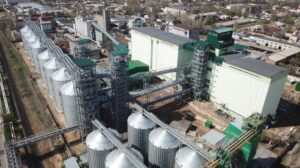
South Korean corporation POSCO International plans to resume full operation of its grain terminal in Mykolaiv region, according to a press release from the Ministry of Economy, Environment, and Agriculture following a meeting between Minister Oleksiy Sobolev and business representatives during a working trip to Odesa.
The ministry specified that the meeting discussed the prospects for developing infrastructure for storing grain and vegetable products (storage facilities and cold rooms).
“The Ukrainian side emphasized the need to develop mechanisms to protect businesses in wartime and reduce the cost of marine insurance. At the same time, the government is working on a program to support the restoration of trade routes in the Mykolaiv region,” the statement said.
The Korean delegation, consisting of POSCO International Corporation Vice President Kim Young-hoon and POSCO International Ukraine Sales Director An Suk-hyun, noted the Ukrainian government’s cooperation with the Economic Development and Cooperation Fund (EDCF). Through the EDCF and KEXIM Bank programs, Korean companies have the opportunity to participate in the transformational reconstruction of Ukraine. This includes POSCO, which has experience in implementing infrastructure projects abroad.
One of the company’s priorities is the construction of an RDF-fueled (Refuse-derived fuel) thermal power plant in Odesa. Consultations with the city administration on environmental and energy efficiency issues have already been held. The project to build a CHP plant in Odesa has been tentatively included in the list of priorities.
“The project in Odesa is very important for our ministry because it combines an investment component with an environmental component. The initiative is aimed at protecting the environment and introducing modern technologies to reduce emissions. In the future, this practice can be extended to other regions of Ukraine. The Agency for Reconstruction is submitting this project to the Unified Project Portfolio of the State, and it is expected to be evaluated by experts and subsequently approved by the Strategic Investment Council,” Sobolev said.
Regarding the implementation of a joint project with JSC Ukrzaliznytsia – the construction of a railway depot – various mechanisms for attracting investment are currently being considered, in particular, public procurement and public-private partnership instruments. The first option opens up more opportunities for Korean companies to participate in Ukraine’s recovery, while the second option allows for the localization and involvement of Ukrainian manufacturers in the project as part of the “Made in Ukraine” state policy aimed at stimulating the development of national production.
GRAIN TERMINAL, MYKOLAIV REGION, ODESA, POSCO International, TPP
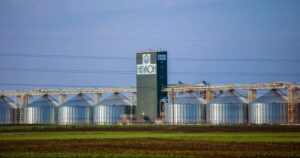
One of the largest grain market operators in Ukraine, JV Nibulon LLC, has modernized two elevator complexes in Mykolaiv region, the grain trader’s press service reported on its Facebook page.
According to the report, a second transshipment line was built at the Vradiyevsky agricultural complex, which doubled the capacity and changed the scheme of acceptance and shipment. Nibulon expects that instead of 50-80 tons per hour, the complex will be able to unload 150-180 tons per hour.
In addition, the second auto-loading point at this branch was re-equipped: the size of the loading pit was significantly increased, a modern shed with roller shutters was built, transport equipment was replaced, and an automatic process control system was installed on the new equipment.
The agro-industrial complex also expanded the area of concrete roads, which gave farmers a complete route from the laboratory through the weighing room to the loaders. The improvements have significantly reduced the time for unloading grain and enabled us to work with several crops simultaneously.
At the Kolosivsky Elevator branch, the company increased the productivity of the process of unloading grain onto trucks by installing two bins with a capacity of 40 tons each. They allow for quick accumulation and shipment of grain. Four pieces of transportation equipment under the first and second truck unloaders were also replaced.
Nibulon JV LLC was established in 1991. Prior to the Russian military invasion, the grain trader had 27 transshipment terminals and crop reception complexes, a capacity for simultaneous storage of 2.25 million tons of agricultural products, a fleet of 83 vessels (including 23 tugs), and owned the Mykolaiv Shipyard.
“Before the war, Nibulon cultivated 82 thousand hectares of land in 12 regions of Ukraine and exported agricultural products to more than 70 countries. In 2021, the grain trader exported the highest ever volume of 5.64 million tons of agricultural products, reaching record volumes of supplies to foreign markets in August – 0.7 million tons, in the fourth quarter – 1.88 million tons, and in the second half of the year – 3.71 million tons.
Nibulon’s losses due to Russia’s full-scale military invasion in 2022 exceeded $416 million.
Currently, the grain trader is operating at 32% of capacity, has created a special unit to clear agricultural land of mines, and was forced to move its headquarters from Mykolaiv to Kyiv.

Cholera-like vibrio, which can cause acute intestinal infections, was found in the water in Mykolaiv region, which was subjected to flooding after the explosion of the Kakhovka hydropower plant by the Russians, reported the Mykolaiv Regional Center for Disease Control and Prevention under the Ministry of Health of Ukraine.
“As of June 18, 2023, according to the results of the research, cholera vibrio in the water has not been isolated, but cholera-like vibrio (which is a marker for the possible presence of cholera vibrio) has been isolated in the following places,” the report says.
In particular, in Ingulets – Snigirevka, Buzhsky estuary – beach “Chaika”, recreational area “Namiv” in Nikolaev, Ingulets – Nikolaev, Dnepro-Bug estuary.
It is noted that according to microbiological indicators – lactose-positive E. coli (at the permissible level of 5000 units) is in Ingulets – 240000000, in Dnepro-Bug estuary – 6200-13000.
“On sanitary and chemical indicators in the city of Ingulets did not meet the standards of dissolved oxygen, dry residue, chlorides, iron and biological oxygen consumption, in the Dnepro-Bug estuary there is an excess of maximum allowable concentrations of ammonia,” – added in the Center.
It is also reported that there are no petroleum products and pesticides in the samples taken for the study.
Also, to prevent acute intestinal infections, the Control Center recommends not drinking water, not swimming in open reservoirs, not consuming river fish (including dried, salted, smoked), personal hygiene rules and treating hands with antiseptics.
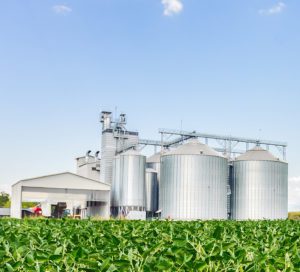
Posco International Corporation Korea-based Company and Ukrainian Orexim Group have officially opened a grain terminal with a total storage capacity of over 140,000 tonnes in Mykolaiv seaport.
As Orexim reported on its website, the grain terminal was built on the base of Mykolaiv Milling Works.
“By the start of work of the new grain terminal Posco plans to increase Ukrainian grain export to 3 million per year. Also, the company has in plans to create their own park of rail wagons for grain transporting,” said the Group.
As reported, in February 2019, Posco Corporation announced that it has signed an agreement with the Orexim Group from Ukraine on the acquisition of 75% of shares in the grain export terminal being built at the Mykolaiv maritime merchandise port.
Orexim Group started its activity in 2004 as a small trading company having transformed over several years of continuing successful activity into a market leader with around 1,000 employees. The group incorporates over 20 enterprises.
The core business is exports of agricultural products, port and logistics services. The company has invested over $100 million in fixed assets.
In August 2016, the group finalized a deal to acquire Mykolaiv Grain Terminal.
In February 2018, the Black Sea Trade and Development Bank (BSTDB) is providing EUR 31 million to Orexim Group to reconstruct and modernize private joint-stock company Mykolaiv Grain Terminal.



