
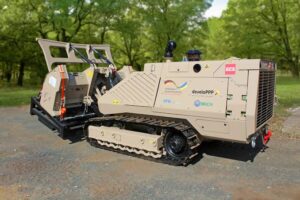
Nibulon Joint Venture LLC has joined the “Agency for Humanitarian Demining of Ukraine’s Waterways” consortium with the aim of helping to build Ukraine’s institutional capacity in this area, the company’s press service reported.
“The joint work will encompass humanitarian demining of Ukrainian waters, the development of technological solutions, scientific research and innovation, the implementation of standards, personnel training, and the execution of international projects,” the statement reads.
Nibulon noted that its participation in the consortium is a continuation of the company’s work in the field of humanitarian demining. With the support of the German organization DEG Impulse gGmbH, the company formed a specialized unit and strengthened its technical capabilities, specifically with GCS-200 mechanized demining machines. In July 2026, Nibulon received the relevant certification, confirming its professional readiness to carry out such work.
The company added that its participation in the Agency for Humanitarian Demining of Ukrainian Waters represents another consolidation of practical experience, infrastructure, and scientific and engineering expertise aimed at building Ukraine’s systemic capacity in underwater demining.
The initiative to create this consortium was launched by the NGO “International Business People’s Club.” The consortium also includes representatives from the Admiral Makarov National University of Shipbuilding and the “West-East” group of companies, which specializes in engineering and technological solutions.
Before the war, “Nibulon” Joint Venture LLC cultivated 82,000 hectares of land across 12 regions of Ukraine and exported agricultural products to more than 70 countries worldwide. In 2021, the grain trader exported 5.64 million metric tons of agricultural products—the highest volume in its history. After the war began, the company was forced to relocate its headquarters from Mykolaiv to Kyiv. Currently, “Nibulon” cultivates 52,000 hectares of land across four clusters. In addition to 23 grain elevator complexes, Nibulon has its own trucking and rail transport capabilities, as well as a fleet built at its own shipyard. During wartime, this fleet continues to provide river transportation services.
The company is also actively developing its own humanitarian demining unit to restore safety on leased lands and assist Ukraine’s agricultural sector. It is a certified mine action operator.
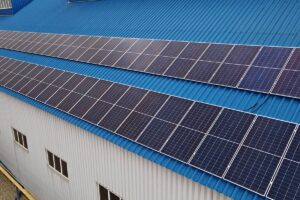
In the summer of 2026, Nibulon Joint Venture LLC installed ground-mounted solar power plants (SPPs) at its Bessarabsk, Zolotonosha, and Denykhiv branches, the company’s press service reported.
As a result, five grain elevator complexes are now equipped with solar power plants, accounting for over 20% of the company’s total capacity. Depending on the elevator’s operating mode, each SPP covers between 25% and 50% of its electricity needs, the statement noted.
The solar power plants at the three branches have a total capacity of up to 350 kW each and are equipped with 546–566 double-sided solar panels with a capacity of up to 620 W. The plants can operate either from the external power grid or in conjunction with diesel generators in the event of a power outage.
The company noted that the development of its own solar power generation is part of its decarbonization strategy. By 2030, Nibulon plans to equip 30% of its grain elevator complexes with solar power plants.
Installing solar power plants reduces the need to purchase electricity on the market and allows surplus electricity to be fed into regional power grids. Additionally, operating solar power plants alongside diesel generators reduces diesel fuel consumption during scheduled or emergency power outages.
Before the war, Nibulon Joint Venture LLC cultivated 82,000 hectares of land across 12 regions of Ukraine and exported agricultural products to more than 70 countries worldwide. In 2021, the grain trader exported 5.64 million metric tons of agricultural products—the highest volume in its history. After the war began, the company was forced to relocate its headquarters from Mykolaiv to Kyiv. Currently, “Nibulon” cultivates 52,000 hectares of land across four clusters. In addition to 23 grain elevator complexes, Nibulon has its own trucking and rail capabilities, as well as a fleet built at its own shipyard. Even during wartime, this fleet continues to provide river transportation services.
The company is also actively developing its own humanitarian demining unit to restore safety on leased lands and assist Ukraine’s agricultural sector. It is a certified mine action operator.
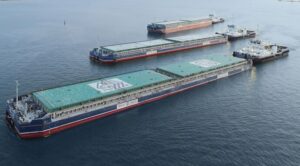
Nibulon Joint Venture LLC proposes introducing a transitional mechanism for assigning and confirming the qualifications of river fleet specialists, which, according to its estimates, will make it possible to increase shipments through the Danube export corridor by 100,000 metric tons per month, the company’s press service reported, citing Logistics Director Serhiy Kalkutin.
“Nibulon” could deploy an additional 12 tugboats on the Danube, but this would require resolving the issue of retraining and processing the necessary paperwork for approximately 30 specialists. And we are not the only ones facing this limitation. “If a workable mechanism is created to attract qualified specialists on an industry-wide scale, the Danube corridor will be able to transport up to an additional 100,000 metric tons of cargo per month,” the press service quoted Kalkutin as saying.
He explained that shipowners have a technically ready fleet but are unable to fully staff their crews or put additional vessels into service due to a shortage of qualified crew members.
As noted in the statement, “Nibulon” proposes introducing a temporary transitional mechanism for certifying and confirming the qualifications of inland waterway fleet specialists and for them to obtain the necessary documents until the full transition to European regulations is complete. This, in particular, will allow specialists with the necessary training and experience to complete the paperwork required to work on the Danube more quickly.
Kalkutin emphasized that additional shipments via the Danube corridor will make it possible to support purchases from agricultural producers, ensure the inflow of foreign exchange earnings, and increase the resilience of Ukraine’s export system.
“Nibulon” proposed that the relevant government agencies, together with industry representatives, develop a transitional solution that would allow for the recruitment of the necessary number of qualified specialists to work on inland waterways while complying with requirements for professional competence and navigation safety.
As reported, according to the Ministry of Agrarian Policy, from August 1 to 18, Ukraine exported 900,000 metric tons of agricultural products, of which about 45% were exported via the Danube region.
Nibulon Joint Venture LLC invested $22.5 million in the modernization and digitization of agricultural production between 2023 and 2025, including securing EUR12.8 million in long-term financing from the Danish Export and Investment Fund (EIFO), the company’s press service reported.
As part of the modernization, the company upgraded its fleet of agricultural machinery, implemented digital solutions for managing production processes, and adopted a new soil cultivation model, which reduced the number of passes by machinery across the field—a practice that leads to soil compaction—and also lowered fuel consumption and production costs.
The company reported that as a result of the modernization, fuel consumption decreased by 10 liters per hectare, the use of crop protection products was reduced by up to 50%, seed usage was reduced by 10–20%, and nitrogen use efficiency (NUE) increased by 30%.
The report notes that the implemented measures led to a 50% increase in gross yield and a 65% increase in agricultural machinery productivity.
According to published data, the agricultural division’s EBITDA in 2025 amounted to $329/ha. At the same time, approximately 40% of the agricultural holding’s land bank is located in southern Ukraine, which has been hardest hit by climate change following the destruction of the Kakhovka Hydroelectric Power Plant. The financial results also include $4.6 million in losses from sunflower crop failures due to drought.
The company also reported that, as part of its efforts to adapt to climate change, it is reviewing its crop rotation structure and testing alternative drought-resistant crops, including sorghum, chickpeas, lentils, and flax.
In addition, during the 2025/26 marketing year, the agricultural holding launched a pilot project for contract farming of corn and sunflowers on an area of approximately 100 hectares, and is also working with seed material for other specialty crops.
It is also noted that the company is developing an irrigation model for the southern regions of Ukraine, which involves irrigating approximately 1,000 hectares of agricultural land.
Currently, Nibulon’s agricultural division cultivates 52,000 hectares of land, comprises 14 branches across four clusters, and operates 41 units of farm equipment.
Prior to the war, Nibulon Joint Venture LLC cultivated 82,000 hectares of land across 12 regions of Ukraine and exported agricultural products to more than 70 countries worldwide. In 2021, the grain trader exported 5.64 million metric tons of agricultural products—the highest volume in its history. After the war began, the company was forced to relocate its headquarters from Mykolaiv to Kyiv. In addition to 23 grain elevator complexes, Nibulon has its own road and rail transport capabilities, as well as a fleet built at its own shipyard. During wartime, this fleet continues to provide river transport services.
The company is also actively developing its own humanitarian demining unit to restore safety on leased lands and assist Ukraine’s agricultural sector. Nibulon is a certified mine action operator.
AGRICULTURAL PRODUCTION, EIFO, INVESTMENT, MODERNIZATION, NIBULON
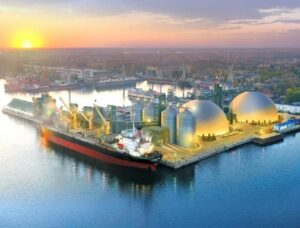
Nibulon Joint Venture LLC exported 3.15 million metric tons of agricultural products in the 2025/2026 marketing year (MY), a 32% increase from the previous season, when exports totaled 2.39 million metric tons, the company’s press service reported.
As noted in the statement, the company’s share of grain exports rose to 7% from 5.1% a year earlier.
The company attributes this growth to expanded cooperation with agricultural producers, updated trading approaches, an expanded export footprint, and a strengthened international trade presence.
According to the company, it currently works with approximately 4,000 agricultural producers and exports Ukrainian agricultural products to 26 countries worldwide.
Before the war, Nibulon Joint Venture LLC cultivated 82,000 hectares of land across 12 regions of Ukraine and exported agricultural products to more than 70 countries worldwide. In 2021, the grain trader exported 5.64 million metric tons of agricultural products—the highest volume in its history. After the war began, the company was forced to relocate its headquarters from Mykolaiv to Kyiv. In addition to 23 grain elevator complexes,
“Nibulon” has its own trucking and rail transport capabilities, as well as a fleet built at its own shipyard. During wartime, this fleet continues to provide river transportation services.
The company is also actively developing its own humanitarian demining unit to restore safety on leased lands and assist Ukraine’s agricultural sector. Nibulon is a certified mine action operator.
agricultural producer, AGRICULTURAL PRODUCTS, EXPORTS, GRAIN, NIBULON
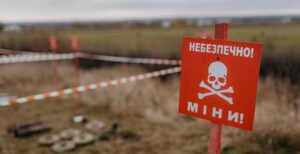
“Nibulon” Joint Venture LLC is preparing to begin work on its second humanitarian demining contract in Kharkiv Oblast, which involves clearing 64 hectares of agricultural land in the Izyum District, the company’s press service reported.
“The terrain is challenging, but we make timely decisions tailored to each specific challenge—to ensure effective work and achieve our main goal: that farmers in the Kharkiv region harvest grain, not the remnants of explosive ordnance,” the press service quoted Vsevolod Petrovsky, head of the “Demining” division, as saying.
According to the report, the work will be carried out under a subcontract on land owned by Landex-Agro LLC.
At the same time, Nibulon is completing its first government contract in the Kharkiv region, which it is carrying out jointly with Ukrainian Demining Services LLC. As part of this project, the company’s specialists have already surveyed more than 30 hectares of land across seven cadastral numbers on the territory of “Agrofirma Yug-M” LLC.
The work has passed an internal inspection and is currently undergoing an external audit conducted by the Mine Action Center of the Ministry of Defense of Ukraine, the statement said.
In addition, the company has completed a non-technical survey of 24 hectares of land in the Dnipropetrovsk region. The results have been validated by the Center for Mine Action in the IMSMA system.
The company noted that the development of its humanitarian demining operations is supported by DEG Impulse gGmbH, which has enabled it to strengthen its technical capabilities, particularly through the use of modern clearance equipment.
The statement noted that “Nibulon” has already completed its first commercial humanitarian demining contract in the Mykolaiv region. Since the start of operations, the company has returned more than 7,500 hectares of agricultural land to productive use and confirmed the certification of five mine action processes. Certification of three additional processes is currently underway.
As previously reported, in May 2025, Nibulon confirmed its certification in demining and expanded the list of mine action processes to eight areas.
Before the war, Nibulon LLC cultivated 82,000 hectares of land across 12 regions of Ukraine and exported agricultural products to more than 70 countries worldwide. In 2021, the grain trader exported 5.64 million metric tons of agricultural products—the highest volume in its history. After the war began, the company was forced to relocate its headquarters from Mykolaiv to Kyiv. In addition to 23 grain elevator complexes, “Nibulon” has its own trucking and rail transport capabilities, as well as a fleet built at its own shipyard. During wartime, this fleet continues to provide river transport services.
The company is also actively developing its own humanitarian demining division to restore safety on leased lands and assist Ukraine’s agricultural sector. Nibulon is a certified mine action operator.
DEG Impulse gGmbH is a nonprofit subsidiary of the German financial institution DEG that implements private-sector support programs funded by the German Federal Ministry for Economic Cooperation and Development (BMZ).



