
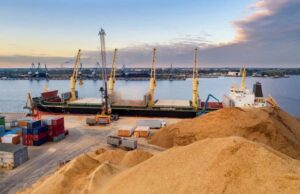
The suspension of the maritime corridor since late July has led to a drop in grain exports from Ukraine: from August 1 to 12, exports totaled 590,000 metric tons, or 30% of demand, Agriculture Minister Taras Vysotsky said at a briefing in Kyiv on Friday.
“From August 1 to 12, we exported 590,000 metric tons. That’s about 30% of the required volume. We expect to be able to reach 50% going forward… taking into account all the relevant impacts on international trade balances,” the minister said.
He clarified that of these 590,000 metric tons, about 40% were exported by rail, about 40% via the Danube region, about 10% by road, and the remaining 10% consisted of several ships that were still able to leave Ukrainian ports in early August.
“If we subtract those, we can say that as of today, 45% is exported by rail, 45% via the Danube region, and about 10% by road,” the minister stated.
At the same time, he emphasized that there is potential to partially increase exports, but even so, without the resumption of operations at the Black Sea ports, exports will amount to no more than 50% of demand.
According to Vysotsky, due to the drought, the Danube route is currently unable to operate at full capacity; reaching its full potential—about 1.5 million metric tons per month—will be possible closer to the end of the year.
The minister also reported that Ukraine currently has sufficient permanent storage facilities for grain, but in November, after the corn harvest, there may be a storage capacity shortfall of 8 to 11 million metric tons, which they hope to cover using temporary storage facilities and silo bags.
According to Vysotsky, a request for $10 million in funding for the temporary storage of 2–2.5 million metric tons has already been sent to international partners. In addition, a similar request to the World Bank for $25 million—covering more than 6 million metric tons of grain—is being finalized.
He noted that it is currently difficult to predict how quickly maritime exports can be resumed.
“We see that every day there are various rumors… gossip about different proposals (regarding a maritime ceasefire)… As always, we must rely first and foremost on ourselves. By ‘ourselves,’ I mean the military… As of today, the only way to enable exports is through military security… This is a very important area; the military is working on it, but so far, they cannot report any progress on their end. Therefore, as of today, exports from the ports of Greater Odesa are suspended. We are focusing on alternative logistics channels,” stated the head of the Ministry of Agrarian Policy.
Regarding the U.S. Department of Agriculture’s downward revision this week of its forecast for grain exports from Ukraine this marketing year by 2.21 million metric tons—to 37.77 million metric tons—Vysotsky noted that, overall, the figures remain within the range of the typical annual balance.
“We do not rule out that this could be the case. We are still only a month and a half into the marketing year. We understand that, provided there is some recovery during a certain period, we can make up the shortfall. Therefore, from our point of view, this balance is currently based on the annual cycle—no more, no less—rather than on an assessment of the current situation,” the minister said.
He noted that this year’s total harvest of grains and oilseeds is expected to exceed 80 million metric tons, of which domestic consumption and adequate carryover stocks will account for up to 20 million metric tons.
“The baseline volume of exports of grains, oilseeds, and processed products could reach up to 60 million metric tons. However, given how logistics are currently developing, we understand that there is a possibility this trend will continue throughout the year, and exports will amount to no more than 30 million metric tons,” Vysotsky said, outlining the worst-case scenario.

The national postal operator, JSC “Ukrposhta,” in partnership with the Ukrainian company “Modern-Expo,” is launching the production and installation of 1,000 new street-side mail kiosks, primarily in Kyiv, Odesa, Lviv, Dnipro, and other major cities across the country, the company’s CEO, Ihor Smilianskyi, announced on the company’s Telegram channel on Thursday.
According to him, these mail kiosks will be equipped with mailboxes that will allow users to both receive packages and send letters.
According to a press release from “Ukrposhta,” the company is inviting homeowners’ associations, property management companies, and representatives of residential complexes to collaborate.
It is anticipated that representatives of homeowners’ associations, property management companies, or residential complexes can submit an application on the national postal operator’s website to have the mail kiosks installed at the appropriate locations.
Ukrposhta explains that the company will prioritize residential complexes in major cities where there is no nearby brick-and-mortar post office, and where it is possible to place a parcel locker near the building’s entrance or in an open area of the residential complex in a location accessible to residents.
Other criteria include the availability of a solid, level surface; the ability to connect to a 220-volt power supply; and reliable mobile network coverage in the relevant area.
It is noted that coffee shops, stores, pharmacies, gas stations, and other businesses are also invited to collaborate.
“We will definitely contact you to inspect the location, agree on the installation site and terms of cooperation. And if everything is in order—we’ll sign a contract and install the parcel locker,” added Smiliansky.
Among other things, he also noted that the company will continue to purchase and install parcel lockers and expand its network through its partners’ parcel lockers.
Separately, the national postal operator announced that the cost of using parcel lockers remains unchanged—starting at 45 UAH. A customer’s package will be stored there for seven calendar days.
Ukrposhta also took the opportunity to reiterate its plans to install 1,000 parcel lockers nationwide, as well as 600 express pickup lockers directly in post offices.
As previously reported, Ukrposhta posted a net profit of 296.7 million UAH for the second quarter of 2026, compared to a net loss of 108 million UAH in the same period of 2025.
According to the report, Ukrposhta operates 7,200 customer service locations, including 2,000 mobile postal branches that serve 21,300 settlements.
DELIVERY, homeowners’ association, LOGISTICS, parcel locker, UKRPOSHTA

Moldova is preparing proposals regarding the possible transfer of 20 locomotives to Ukraine; the parties are also working on opening a new joint border crossing and ensuring the unimpeded transit of Ukrainian cargo, said Mykola Kalashnyk, Ukraine’s Minister of Recovery, Infrastructure, and Transport.
“Our priority is unimpeded traffic from Odesa to the Danube region,” Kalashnik wrote following a working meeting in the Odesa region with Moldova’s Deputy Prime Minister and Minister of Infrastructure and Regional Development, Vladimir Bolea.
According to him, to ensure transit, it is necessary to guarantee free and safe passage along a 7-kilometer section of the M-15 highway near Palanka. The parties are also preparing to open a new joint border crossing point.
In the field of rail transport, Moldova is preparing proposals regarding the possibility of providing Ukraine with 20 locomotives. The parties are also working to ensure competitive freight rates and additional routes for Ukrainian cargo through Moldova to the Romanian port of Constanța.
Kalashnik noted that the agreements are expected to result in an increase in the number of routes, faster border crossings, and strengthened logistics links between Ukraine, Moldova, and the European Union.

On the night of August 5, a Russian attack destroyed the high-tech, automated, Class A DENKA LOGISTICS logistics complex in the village of Chaiky, Kyiv Oblast, according to a press release from the MTI Group.
There were no fatalities or injuries among the employees. The company noted that the extent of the damage is very significant.
DENKA LOGISTICS was the main logistics hub of the MTI Group, as well as one of the largest and most modern logistics hubs in Ukraine. The complex had been operating continuously since 2009 and featured a high level of automation in its warehouse processes.
Every day, thousands of pairs of shoes, items of clothing, gadgets, electronics, and home appliances were shipped from the warehouse to stores and directly to customers. The complex provided logistics services for retail chains and other businesses within the MTI Group.
“We are continuing to operate. We are already assessing the consequences of the attack and reorganizing all processes. We are doing everything possible to ensure that customers are affected as little as possible by this disruption,” the group said in a statement.

MTI Group intends to restore the damaged facilities. The company has promised to keep customers and partners informed about changes in logistics operations and further steps toward restoring the complex.
MTI’s official website notes that the DENKA LOGISTICS complex was equipped with an automated warehouse logistics management system and had approximately 20,000 square meters of specialized facilities. The main categories of goods handled at its facilities were clothing and footwear, cosmetics, office equipment, and household appliances.
MTI Group operates in Ukraine, Kazakhstan, and Kyrgyzstan. The group includes businesses in the fields of retail, information and communication technologies, cybersecurity, services, and logistics.
In Ukraine, the group comprises eight businesses, including INTERTOP, AMADEO (the official distributor of Pandora), PROTORIA (which operates the Samsung Experience Store chain), as well as MTI, OCTOPUS CYBER SERVICES, MTI-SERVICE, TECHNOGARD, and DENKA LOGISTICS.
According to MTI Group, its Ukrainian businesses operate 238 stores and employ approximately 2,700 people. The total area of stores and offices is 39,700 square meters, while warehouse space totals 28,400 square meters. The group collaborates with over 1,400 partners. In 2025, its businesses paid 3.6 billion UAH in taxes to Ukraine’s state budget.

The Russian marketplace Wildberries plans to commission two large logistics complexes in Kazakhstan with a total area of over 260,000 square meters in the first quarter of 2027, according to Kazakhstan’s Minister of Trade and Integration Arman Shakkaliyev.
“In the first quarter of next year, the company is carrying out construction and installation work on a facility of about 160,000 square meters in Almaty. And in Astana, there will be a facility of about 100,000 square meters,” the minister said at a briefing at the Kazakh government on August 4.
According to him, these projects are part of the previously announced development program for Wildberries’ Kazakhstani division. Currently, the company leases approximately 46,000 square meters of warehouse space in the country.
Shakkaliyev also noted that Wildberries has not submitted any new requests to the Kazakhstani authorities regarding the search for or opening of additional warehouse facilities.
However, official data on the distribution of space among cities contradicts the minister’s statements. A statement published by the Kazakh government indicates that the Wildberries logistics hub currently under construction in Astana will have an area of 160,000 square meters, not 100,000 square meters.
Investments in the Astana complex are estimated at 47.7 billion tenge. The project is expected to create approximately 6,000 jobs, and construction is also scheduled for completion in the first quarter of 2027.
Representatives of the merged company RWB had previously reported that a 160,000-square-meter facility is under construction in Astana, and a complex covering more than 100,000 square meters is being built near Almaty. Thus, the total area of the two centers will indeed exceed 260,000 square meters, although the final distribution of space between the cities still needs to be clarified.
The cost of the Wildberries logistics center in Almaty was previously estimated by the Kazakhstani authorities at 43.2 billion tenge. The exact completion date for this facility was not specified in the relevant announcement.
The new centers are expected to expand the marketplace’s capacity for receiving, storing, sorting, and delivering goods within Kazakhstan. Expanding the local warehouse network may also reduce delivery times and increase the number of Kazakhstani entrepreneurs operating through the platform.
In 2025, the volume of retail e-commerce in Kazakhstan, including marketplaces, reached 3.769 trillion tenge. Sales through marketplaces accounted for 3.238 trillion tenge, or 86% of the total e-commerce market.
Wildberries is one of Kazakhstan’s largest e-commerce platforms. Previously, the Ministry of Trade reported on plans by Wildberries and Ozon to build three fulfillment centers in Astana and Almaty with a total area of 291,000 square meters and a combined investment of 101.3 billion tenge.

At the end of July, Ukraine’s Danube port cluster sharply increased its intake of grain carriers amid a slowdown in operations at the Greater Odessa ports; however, a critical drop in water levels on the Danube could limit the capacity of this alternative export route.
According to the brokerage firm Spike Brokers, the number of grain railcars heading to the Danube ports increased nearly sevenfold over the week—from 167 to 1,141 thousand railcars. The average daily unloading rate rose by 17 railcars to 51 railcars per day.
At the same time, the number of grain railcars heading toward the ports of Greater Odessa fell by approximately 70%—to a record low of 1,356 railcars, compared to 4,525 railcars a week earlier. Average daily unloading decreased by 160 railcars to 690, while loading decreased by 203 railcars to 580 railcars per day.
In July, 1.38 million metric tons of grain were transported by rail to Ukrainian seaports, which is 37% less than in June. Additional constraints included overcrowding at certain port terminals and delays in transshipping grain from railcars to ships.
Thus, the increase in railcar deliveries to the Danube currently appears to be an immediate market response to the slowdown in operations in the Greater Odessa area. However, the capacity of the Danube route is also under pressure due to the rapid shallowing of the river.
At the end of July, the water flow in the Danube at the entrance to Romania dropped to 1,650 cubic meters per second, compared to an average July level of about 4,750 cubic meters. By August 4, according to forecasts, the figure could drop to 1,500 cubic meters per second, approaching the historic low of 1,400 cubic meters set in 1985.
Back in July, the Romanian Lower Danube Administration recorded a sharp drop in water levels across virtually the entire navigable stretch from Băziaș to Sulina. Near Corabia, several barges ran aground, and actual depths in certain critical sections decreased to 1.5–1.7 meters. Dredging operations are being carried out to maintain depths of at least 1.8–2 meters.
The main risk for Ukraine lies not necessarily in a complete shutdown of the Danube ports, but in a reduction in the permissible draft of vessels. Barges and river-sea hybrid vessels will be forced to carry less grain, which will increase the number of voyages, transportation costs, and fleet turnaround time.
Even if the terminals in Reni and Izmail retain the capacity to receive railcars, the slowdown in loading grain onto vessels could lead to a buildup of rolling stock at stations near the ports. The disparity is already evident: 1,141 railcars are heading toward the Danube ports, while the average daily unloading rate is only 51 railcars.
If this ratio persists, the terminals may once again face overcrowding, after which Ukrzaliznytsia will have to impose restrictions on the shipment of certain cargoes or implement temporary measures.
The second risk is related to the increase in queues on the Romanian sections of the Danube and the Sulina Canal. The ports of Reni and Izmail depend not only on the water depths directly at the Ukrainian berths but also on the condition of the entire Lower Danube route. As the Danube Commission notes, a single shallow section can become a “weak link” and restrict traffic along the entire international corridor.
Silting also complicates the transport of Ukrainian grain by barge to Constanta, Romania. A reduction in the load capacity of a single barge means that more vessels must be deployed to transport the same volume of cargo. This increases freight rates, transshipment costs, and the risk of fines for vessel downtime.
The third risk is the simultaneous decline in the reliability of the two main maritime routes. The ports of Greater Odessa are currently operating more slowly due to terminal congestion and delays in loading ships, while the Danube—which is supposed to serve as a backup route—faces a natural limitation on its throughput capacity.
This factor becomes particularly critical during the arrival of the new grain harvest. Rising logistics costs could lower purchase prices within Ukraine, delay the fulfillment of export contracts, and widen the price gap between Ukrainian ports and the global market.
On June 24, the Ukrainian Sea Ports Authority began operational dredging in the waters of the Port of Izmail. The work is intended to restore the design depths near the berths and allow for the maximum possible draft and cargo capacity of vessels. It was planned to be completed within two months.
However, dredging within the Ukrainian port alone cannot fully compensate for the drop in water levels in the Romanian and transboundary sections of the Danube. To maintain stable traffic flow, Ukraine and Romania will need to work in sync, promptly mark the fairway, conduct regular depth soundings, dredge critical sections, and regulate vessel queues.
The Ministry of Infrastructure had previously identified dredging as one of the main “bottlenecks” in Danube logistics and discussed with the European Commission and Romania the coordination of traffic, the use of the PRIMUS digital system, and measures to address a potential reduction in the capacity of the Odessa-Danube route.
The Danube ports remain a strategic reserve for Ukraine’s foreign trade.
After the start of the full-scale war, their throughput capacity was increased to 35 million metric tons per year. However, actual transshipment volumes fell from 17.4 million metric tons in 2024 to 8.9 million metric tons in 2025, and authorities had previously forecast approximately 5 million metric tons for 2026.
The current increase in grain ship traffic indicates that businesses are ready to quickly return to the Danube route should problems arise in the Greater Odessa area. However, record-low water levels in the river may prevent the ports from fully accommodating this additional traffic, potentially turning the rerouting of cargo by rail into a new logistical bottleneck.



