
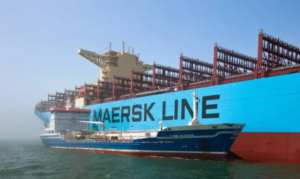
The international transportation and logistics group A.P. Moller—Maersk has temporarily suspended maritime container shipping through the terminal of Chornomorsk Fish Port LLC in the Odesa region.
The decision was made amid a deteriorating security situation and intensified Russian attacks on Ukrainian port infrastructure. However, this does not mean a complete suspension of Maersk’s operations in Ukraine.
“Due to the current situation affecting our operations, the feeder operator is unable to continue providing services to Ukraine via the Black Sea Fishing Port,” Maersk’s Ukrainian division reported.
The service has been suspended until further notice. The company did not explicitly cite the Russian attacks as the reason for this decision; however, the announcement came after a series of strikes on ports and civilian vessels in the Odesa region.
The vessel MEDKON MIRA V.629S, which was scheduled to deliver imported containers to Chornomorsk, will be redirected to the Romanian port of Constanta for unloading.
It is also planned to reroute shipments destined for Chornomorsk that are already in Port Said, Egypt, or en route there, to Constanta. Customers for whom unloading in Romania is not suitable are advised to submit a request to change the destination.
“Chornomorsk Fish Port” is not a term referring to a fishing harbor in the everyday sense, but rather the official name of a separate enterprise and a multifunctional cargo terminal in the village of Burlachya Balka near Chornomorsk.
The company was previously known as “Illichivsk Sea Fishing Port,” and in 2018 it adopted its current legal name—LLC “Black Sea Fishing Port.”
Despite its historical name, the enterprise operates a full-fledged container terminal. It has deep-water berths, Liebherr container handlers, mobile cranes, storage yards, and truck and rail weighing facilities.
The Black Sea Fishing Port is an independent operator and should not be confused with the state-owned seaport of Chornomorsk. The main deep-water port of Chornomorsk and other ports in the Greater Odesa region continue to operate, according to Ukrainian authorities.
The company has suspended only maritime shipments through this specific terminal. Maersk continues to offer cargo delivery to Ukraine via land and multimodal routes, including through Romania and Poland.
Rerouting containers through Constanța may increase transit times and shipping costs. After unloading in Romania, cargo will need to be transported to Ukraine by road or rail.
For Ukrainian importers, this means additional costs for land logistics, changes to documentation, and a possible delay in receiving goods.
At the same time, this decision enhances Constanta’s role as a regional transshipment hub for Ukrainian cargo.
Prior to Maersk, Kernel, a major Ukrainian producer and exporter of agricultural products, had suspended operations at one of its facilities in Chornomorsk following a series of attacks.
However, Ukrainian authorities have not imposed a general ban on ships calling at ports in the Greater Odesa area. Decisions to change routes are made by individual carriers and shipowners with the safety of crews, vessels, and cargo in mind.
A.P. Moller — Maersk is a Danish transportation and logistics group founded in 1904. The company provides maritime container shipping services and manages port terminals, warehouses, and land-based logistics infrastructure.
Maersk operates in approximately 130 countries, serves over 100,000 customers, and has a fleet of more than 700 container ships and a network of 67 terminals in 42 countries. The group employs more than 100,000 people. Thanks to its scale, Maersk is one of the key players in global container trade, and changes to its routes can significantly affect the timing, cost, and availability of international shipments.

Nova Poshta, Ukraine’s leading express delivery service and part of the Nova Group, increased its revenue by 32% in the first half of 2026 compared to the same period in 2025—reaching 32.5 billion UAH—while growth in the first half of last year stood at 23%.
According to a press release issued by the group on Tuesday, over the first six months of this year, it increased the volume of processed shipments by 11.5% compared to the same period in 2025: the volume of delivered packages and cargo totaled 254.4 million, including 17.9 million international shipments.
“In the first six months of the year, Nova Poshta expanded its network by 5,242 new service points: 1,362 branches were opened and 3,880 new parcel lockers were installed,” the press release states.
Last year, based on the results of the first half of 2025, Nova reported 238 million parcels and shipments delivered, including 5.9 million international ones, the opening of 708 branches, and more than 4,000 parcel lockers.
The company noted that this year its network has expanded throughout Ukraine, including in frontline territories, where 748 new service points were opened.
“Currently (as of July 13, 2026), the Nova Poshta network comprises 54,700 service points: 16,765 branches and 37,935 parcel lockers throughout Ukraine,” the press release states.
According to the release, the company is also continuing to expand its network of self-service branches, where customers can pick up packages without waiting in line or interacting with an operator. Currently, there are four such branches operating in Ukraine: in Kyiv, Irpin, and Vinnytsia.
It is also noted that Nova Post has continued to scale up and expand: during the first half of the year, 239 new service points were opened in Europe, bringing the total number of Nova Post’s own service points abroad to more than 950. Moldova—with 112 new service points—and Poland—with 80—led the way in terms of expansion in the first half of the year. Additionally, five Nova Post partner pickup points opened in New York in June.
Furthermore, the group noted that amid a full-scale war, it continues not only to develop its infrastructure but also to restore it after damage: since the start of the full-scale invasion, the estimated cost of restoring the group’s property damaged by enemy attacks or as a result of hostilities has exceeded 2.1 billion hryvnias. Throughout the entire period of the full-scale war, Nova Poshta has paid 194 million hryvnias in compensation for damaged or destroyed shipments.
It is also noted that despite enemy attacks, Nova continues to invest in development in Ukraine: in the first six months of 2026, capital investments exceeded 1.5 billion UAH, while last year the group reported 1.9 billion UAH in capital investments for the first half of the year. These funds were allocated to network expansion, enhanced security, fleet modernization, energy independence initiatives, and digital solutions that improve the customer experience.
According to the press release, over the first six months of this year, Nova Group companies paid 9.8 billion UAH in taxes and fees to the Ukrainian budget—a 25% increase compared to the first half of 2025—and donated 950 million UAH to charity, with total charitable contributions exceeding 7.5 billion UAH since the start of the full-scale invasion.
The group specified that as part of the “Nova Poshta Humanitarian” program, over 1.1 million humanitarian shipments were delivered in the first six months of this year—that is, 27,400 metric tons of aid, equivalent to 1,370 trucks, and since the start of the full-scale invasion, this figure has exceeded 7 million shipments.
As previously reported, in 2025, “Nova Poshta” increased its revenue by 21.6% compared to 2024—to 54.2 billion UAH—while net profit rose by 4.4%—to 2.6 billion UAH.
The number of parcels and shipments delivered last year increased by 7.4%—from 486 million to 522 million—including international shipments, which rose by 52.6%, from 19 million to 29 million.
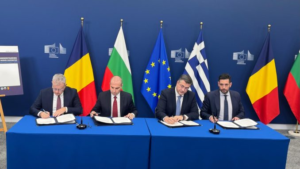
Greece, Bulgaria, and Romania are promoting the construction of the “Black Sea–Aegean Sea” multimodal transport corridor, which is intended to connect the ports, railways, highways, and logistics hubs of the three countries with access to the Ukrainian and Moldovan borders.
The project will become part of the EU’s Trans-European Transport Network (TEN-T). The European Commission notes that the broader “Baltic Sea–Black Sea–Aegean Sea” corridor spans 11 EU countries, as well as Ukraine and Moldova, connecting the Baltic, Black, and Aegean Seas.
The new section between Greece, Bulgaria, and Romania will consist of three main branches. The western branch is planned to run along the route Athens–Thessaloniki–Promachonas–Kulata–Sofia–Vidin/Calafat–Craiova–Bucharest. The central branch will connect Thessaloniki and Alexandroupolis with the Bulgarian cities of Svilengrad and Ruse, then continue through Giurgiu and Bucharest to
Siret on the Romanian border with Ukraine, as well as to Ungheni on the border with Moldova. The Eastern Branch will connect Alexandroupolis with the Bulgarian ports of Burgas and Varna, and then on to Constanța in Romania.
To coordinate the project, the three countries are establishing the Black Sea–Aegean Sea Corridor Platform (BACP). The European Commission reported that Greece, Bulgaria, and Romania signed a memorandum on the development of transport infrastructure on December 3, 2025, in Brussels. The document provides for coordination at the political and technical levels, the exchange of data on national investment plans, and the joint promotion of priority TEN-T projects.
European Commissioner for Transport Apostolos Tzitzikostas called the project a step toward strengthening the strategic north-south corridor in Southeast Europe. According to him, closer cooperation between Greece, Bulgaria, and Romania should strengthen ties for citizens and businesses, as well as enhance Europe’s security, competitiveness, and resilience in the Aegean, Black Sea, and Danube regions.
The project’s significance for the region goes beyond mere transportation modernization. The corridor could provide Ukraine with an additional southern logistics route to ports in the Aegean Sea, Bulgaria, and Romania, as well as strengthen the role of Constanța, Burgas, Varna, Alexandroupoli, and Thessaloniki as hubs for trade, agricultural exports, industrial cargo, and container transport.
For the Balkans, this also represents an opportunity to reduce dependence on overburdened or vulnerable routes. Since the outbreak of full-scale war against Ukraine, the importance of alternative routes via the Danube, the Black Sea, Romania, Bulgaria, and Greece has risen sharply. The central branch to Siret could effectively become an extension of Ukrainian logistics routes to southern Europe.
The project is also important for the military and crisis mobility of the EU and NATO, but its civilian economic value is no less significant. This involves faster transport between the three seas, better connections between ports and railways, reduced logistics costs, and the creation of a sustainable infrastructure for trade between Ukraine, Moldova, the Balkans, Central Europe, and the Mediterranean.
For Ukraine, this represents a potential new route to the Mediterranean; for Romania, Bulgaria, and Greece, it means strengthening their roles as transit countries; and for the entire region, it is a step toward more sustainable logistics between the Baltic Sea, the Black Sea, the Danube, and the Aegean Sea.
Aegean Sea, BACP, BLACK SEA, BULGARIA, GREECE, INFRASTRUCTURE, LOGISTICS, ROMANIA, TEN-T, UKRAINE
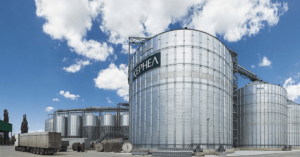
The Kernel agricultural holding’s elevator network, in fiscal year 2026 (FY, July 2025–June 2026) accepted more than 1 million metric tons of grain from third-party agricultural producers for the first time following the implementation of a new business model, under which the company opened its elevators for commercial storage and logistics services, the holding’s press service reported.
“Thanks to a shift in our approach to partnerships and our willingness to share our infrastructure, we were able to attract record volumes of grain,” the press service quoted Serhiy Shcherban, head of Kernel’s storage department, as saying.
According to him, competing in this market requires not just available storage space, but a guarantee of prompt acceptance, legally sound terms, and predictable logistics.
According to Kernel’s report for the first nine months of 2026 FR, the volume of grain and oilseeds accepted into the elevator network increased by 50% compared to the same period in the 2025 fiscal year—reaching 4.02 million metric tons. This includes 2.29 million metric tons accepted in January–March of this year, compared to just 0.09 million metric tons in January–March of last year.
According to the 2025F report, Kernel owns Ukraine’s largest private network of grain storage facilities, with a one-time storage capacity of 2.2 million metric tons.
The company explained that previously, the elevator network primarily served the holding’s own needs, but now it also works with independent agricultural producers. To this end, the agricultural holding revised its pricing policy, expanded its range of services, and introduced digital monitoring of grain movement—from electronic queuing to receipt and shipment.
In addition, Shcherban assured that during the current season, the company will pass on to third-party clients only the increase in electricity costs, while Kernel will cover all other additional operating expenses itself.
The Kernel agricultural holding is the world’s largest producer and exporter of sunflower oil, Ukraine’s largest grain exporter, the operator of an extensive network of logistics assets, and a leading producer of grains and oilseeds in Ukraine. It is one of the largest producers and sellers of bottled oil in Ukraine. It is engaged in the cultivation and sale of agricultural products.
According to results for the first nine months of fiscal year 2026 (July 2025–March 2026), Kernel’s net profit decreased by 5% to $208 million, while its revenue increased by 0.4% to $3.092 billion, and EBITDA rose by 1% to $403 million.
agricultural producer, GRAIN, GRAIN ELEVATOR, KERNEL, LOGISTICS

Nova Post announced the opening of a new 3,800-square-meter logistics hub near Chisinau (Moldova) with a throughput capacity of up to 10,000 packages per hour, having invested EUR800,000 in the facility.
According to the company’s press release on Tuesday, the new terminal operates 24 hours a day, seven days a week, and handles all processes—from sorting shipments to customs clearance.
Among other things, Cargo Branch No. 25 operates on the hub’s premises, handling shipments weighing over 30 kg.
It is noted that the terminal handles all types of shipments—from documents and parcels to oversized cargo.
Currently, an average of 35,000 parcels pass through the terminal daily, and the most recent record was 80,000 shipments in a single day.
“Shipment volumes in Moldova are steadily growing, and consolidating all processes in one location has enabled us to meet this demand much more efficiently,” said Serhii Shapran, CEO of Nova Post in Moldova, as quoted in the press release.
According to him, thanks to the opening of the new terminal, the company has reduced the average delivery time by two hours. Consequently, shipments to intercity destinations are dispatched twice a day, and to local branches every 2.5 hours.
The company added that the first fulfillment hub has been opened at the terminal, and a Ukrainian brand became one of its first clients.
Nova Post emphasized that the company plans to further develop its logistics infrastructure in Moldova, specifically by launching a new sorting center in Bălți.

The TAS Group is considering investments in logistics and port infrastructure, but is taking a cautious approach to this sector for now, according to the group’s founder, Serhiy Tihipko.
He said he personally visited Chornomorsk to explore investment opportunities.
“I can say that I’m not particularly fond of this sector: in my view, it’s overvalued; everyone has gotten used to the abnormally high rates that were in place at the start of the war. That won’t happen again,” said Tigipko.
In his assessment, some assets in logistics and ports may be overvalued due to the high rates that emerged at the start of the full-scale war amid a capacity shortage and the restructuring of export routes.
At the same time, TAS’s interest in logistics seems logical given the group’s presence in the agricultural sector, industry, and other sectors where transportation, storage, export infrastructure, and access to ports are crucial.
Tigipko emphasized that the group is constantly analyzing new projects and waiting for suitable opportunities for deals.
“We’re sitting and waiting for a good, big catch,” he noted.



