
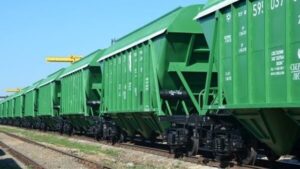
According to the Serbian business media outlet Parametar, a serious train accident occurred in Croatia on October 10 on the approach to the Meja station near Rijeka. Freight train No. 82318, operated by Transagent and carrying a grain cargo toward Rijeka, derailed.
According to official data from HŽ Infrastruktura, the accident occurred around 9:25 a.m. on the incoming track at Meja Station. Eleven cars derailed and ended up in a deep ravine. The locomotive and two other cars remained at the station. There were no injuries, but significant property damage was caused to the railway infrastructure, and the Plase–Meja section is closed to traffic.
The Croatian Agency for the Investigation of Incidents in Air, Maritime, and Rail Transport (AIN) has launched an investigation into the circumstances of the accident. The agency confirmed that a report of a serious incident was received on October 10 at approximately 9:25 a.m. and concerned the derailment of several cars of train No. 82318 on line M202.
According to the Croatian publication Novi list, 11 cars were loaded with grain, presumably of Ukrainian origin. However, an official statement from HŽ Infrastruktura confirms only the transport of grain and does not specify the country of origin of the cargo.
A preliminary theory under consideration is that the locomotive’s brakes failed.
The train belonged to the carrier Transagent Rail, part of the Transagent logistics group based in Rijeka. The company specializes in rail and multimodal freight transportation in Central and Southeastern Europe.
The investigation into this accident is ongoing. The exact causes of the derailment are to be determined by AIN experts.
Source: HŽ Infrastruktura, Croatian Agency for the Investigation of Accidents in Air, Maritime, and Rail Transport (AIN), Novi list.
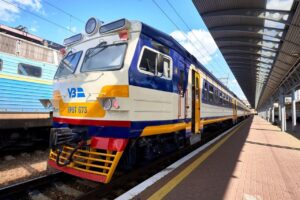
JSC “Ukrzaliznytsia” has launched 18 additional Kyiv City Express shuttle trips between the capital’s left and right banks, the company’s press service reported.
“From October 5 to 9, we are scheduling 18 additional Kyiv City Express shuttle trips on the Vydubychi–Darnitsa–Vydubychi route so that you can quickly and without traffic jams get to work, run errands, or return home amid the difficult traffic conditions on Kyiv’s bridges,” the Telegram message states.
As noted, the 18 shuttle trips will run during the morning and evening rush hours: from 6:00 a.m. to 9:00 a.m. and from 4:00 p.m. to 9:00 p.m. At the Vydubychi station, boarding and alighting will take place on three tracks. At the Darnytsia station, boarding and alighting will take place on one or two tracks (please listen carefully to station announcements). Additional trips will stop at the Bereznyaky station.
“In addition to the KSE shuttle trains, for trips between the right and left banks, you can use scheduled commuter and regional trains running to and from Nizhyn, Hrebinka, Konotop, and Slavutych. They make mandatory stops at the Vydubychi and Darnytsia stations, and commuter trains will also stop at the Bereznyaky station,” added Ukrzaliznytsia.
It is explained that thanks to the combination of additional shuttle services and scheduled trains with Kyiv City Express (KSE) trains, up to six trips will run between the two banks during peak hours, so passengers won’t have to wait long for the next train.
The company noted that tickets are available with just a few clicks in the UZ app.
KYIV, KYIV CITY EXPRESS, RAILROAD, TRANSPORTATION, UKRZALIZNYTSIA

“Ukrzaliznytsia” has added six new passenger cars, manufactured at a Ukrainian plant, to its train fleet, according to a company announcement on Telegram on Saturday.
“As is customary, the new cars are equipped with powerful batteries to ensure maximum autonomy when needed. In the event of a power outage, the batteries will keep the restrooms, lighting, air conditioning, and other systems running. So even if the car continues to travel under a diesel locomotive, all amenities will remain operational for as long as possible,” Ukrzaliznytsia noted.
It did not specify exactly which cars were being referred to, but the illustration shows a compartment car.
“Every new car, in the face of enemy attacks on rolling stock, is an opportunity to keep moving,” the company emphasized.
As previously reported, as part of a state funding program, Ukrzaliznytsia has contracted for 368 passenger cars since 2021. The main supplier is PJSC “Kryukiv Railway Car Building Works” (KVZ).
In late August of this year, Ukrzaliznytsia signed a contract with KVZ for the delivery of 10 new-generation passenger cars by the end of 2029, with a total value of 1.091 billion UAH including VAT, thereby bringing the total number of cars ordered in 2026 to 102.
In late May of this year, Ukrzaliznytsia reported that approximately 1,450 passenger cars are in service, of which 933 are air-conditioned sleeper cars and 100 are high-speed train cars.
CAR, MANUFACTURING, RAILROAD, TRANSPORTATION, UKRZALIZNYTSIA

The Lviv region is preparing to sign an agreement to develop a feasibility study for the construction of the Warsaw–Rava-Ruska–Bryukhovychi–Lviv European-standard railway line.
According to “Interfax-Ukraine”, this was announced by Maksym Kozytskyi, head of the Lviv Regional Military Administration, during the forum “Regional Dialogues with Business on European Integration” in Lviv on September 24.
According to him, the new line is intended to provide a European-standard rail connection between Lviv and Warsaw. Options are being considered for the line to terminate either at Lviv’s main railway station or at the Sknylivsky station.
“An agreement on the development of a feasibility study is set to be signed soon. This feasibility study will be submitted to the railway authority, prepared in accordance with their technical specifications, and will cover a narrow-gauge connection between Lviv and Warsaw,” Kozytskyi noted.
Funding for the development of the feasibility study is planned to come from regional and local budgets.
Separately, the head of the Lviv Regional State Administration highlighted the extension of the European-gauge track to Uzhhorod as a promising project. In his view, this could partially relieve traffic at the road border crossings on the western border and create additional opportunities for the development of the Carpathian region.
Among other railway projects, Kozytskyi mentioned the already completed Nyzhankovychi–Khyriv–Smilnytsia line. According to him, the Ukrainian side has completed the necessary work, and the further launch of the route depends on agreements with the Polish side.
He also highlighted the need to expand certain sections of the Kyiv–Chop highway. The development of rail and road infrastructure, according to Kozytskyi, should strengthen the role of the Lviv region as one of Ukraine’s key logistics hubs.
The Warsaw–Lviv standard-gauge railway project is of particular importance for integrating Ukraine’s transportation system into the European network, as the standard track gauge in most EU countries is 1,435 mm, while Ukraine traditionally uses a 1,520 mm gauge.

JSC “Ukrzaliznytsia” (UZ) transported 8.14 million passengers over the three summer months, compared to 8.07 million during the same period last year and 7.94 million in the summer of 2024, according to a company announcement on its Telegram channel on Thursday.
According to UZ, 628,400 children and 90,000 military personnel visiting their families traveled by train between June and August this year. A total of 22,000 people with disabilities, including veterans, traveled in accessible railcars. A total of 357,000 passengers purchased tickets through the auto-renewal system.
“This result once again demonstrates a more efficient use of the rolling stock: additional ‘rotational’ trains and minimal downtime for cars, especially in frontline regions,” Ukrzaliznytsia noted.
It is noted that over the summer, “UZ” put 20 new railcars into service, while losing seven during this period.
According to Ukrzaliznytsia, there were four and a half passenger requests per seat in June–August. The top five most popular routes based on the number of ticket searches in the company’s app were Lviv–Kyiv, Przemyśl–Kyiv, Kyiv–Kharkiv, Kholm–Kyiv, and Kyiv–Dnipro.
Among other things, passengers exchanged more than 300 million “hugs” for discounts in the “Rail Friends” loyalty program during the summer and also earned about 500,000 rewards.
For its part, the Ministry of Recovery, Transport, and Infrastructure reported that the railway is entering the fall season with a schedule that has been updated and adapted to the current needs of Ukrainians, while also taking the security situation into account.
“This year’s summer season has been yet another challenge for the Ukrainian railway. Russia is attempting to disrupt domestic logistics. At the same time, railway workers continue to optimize operations in accordance with the security situation, quickly adjust logistics, and make the most of the available rolling stock,” the ministry emphasized.
As reported, citing data from “Ukrzaliznytsia,” since the start of the war, the enemy has carried out 6,100 attacks on its infrastructure, more than 1,500 of which occurred between January 1 and August 20, 2026.
PASSENGER TRAFFIC, railcar, RAILROAD, TRANSPORTATION, UKRZALIZNYTSIA

Railway grain shipments to the ports of Greater Odesa during the first five days of August fell by 84.3% compared to the same period in July—to 40.8 thousand metric tons, according to the brokerage firm Spike Brokers.
According to its data, the total volume of agricultural exports from Ukraine for August 1–6 amounted to 312,900 metric tons, compared to 784,500 metric tons for the same period in July, a decrease of 60.1%. At the same time, export revenue decreased by 38.4%—to $201.5 million from $326.9 million.
The sharpest decline was seen in grains: wheat exports for the first six days of August totaled 93.2 thousand metric tons, compared to 294.9 thousand metric tons in early July, while corn exports totaled 33.5 thousand metric tons, compared to 293.7 thousand metric tons, respectively.
At the same time, a seasonal flow of rapeseed totaling 27,900 metric tons appeared in the structure of August exports, while shipments of soybean meal rose to 25,700 metric tons from 18,600 metric tons during the corresponding period in July. Sunflower oil exports fell to 30.7 thousand metric tons from 52.1 thousand metric tons.
During the first five days of August, a total of 182 thousand metric tons of grain and milled products were transported by rail, which is 44.1% less than during the same period in July.
“Data from Ukrainian Railways (UZ) for the first five days of the month show a sharp decline in rail grain shipments to seaports, while land-based rail crossings and road exports are operating at a relatively higher level,” the report states.
As for overland logistics channels, from August 1–6, 59,600 metric tons of agricultural products were exported through road border crossings, compared to 53,600 metric tons during the same period in July (an increase of 11.3%).
According to Spike Brokers, the average daily throughput of grain and meal shipments through border crossings during the first five days of August was 142 railcars, compared to 139 railcars in July.
Volumes increased the most on the Romanian route—to 31.2 railcars per day, or 29.3 railcars more than in July. Poland increased its shipments to 27.4 railcars per day (+13.8). In contrast, Hungary reduced this figure to 23 railcars per day (-15.9), and Slovakia to 14.2 railcars per day (-2.7). The backlog of grain railcars heading toward the border rose from 369 to 521 railcars, or by 41.2%.
“In contrast to the slower overall pace of agricultural exports, the road transport channel began August with greater activity than in July. However, its absolute capacity remains insufficient to compensate for the reduction in large-tonnage grain flows through seaports,” the report states.
An increase in activity was also recorded on the Danube route: the number of grain cars in transit rose to 1,296 (+155), and the average daily unloading rate increased to 157 cars (+106).



