

Centravis Production Ukraine, a leading manufacturer of seamless stainless steel pipes and a subsidiary of the Centravis holding company, has been forced to change its product supply routes due to the situation in the Middle East.
According to Centravis Sales Director Artem Atanasov, the company continues to closely monitor the development of the geopolitical situation in the Middle East and its potential impact on regional logistics and supply chains.
“Over the past weekend, the situation has changed, and new developments have affected previously available logistics options,” Atanasov stated.
According to him, as of March 16, several shipping lines have temporarily suspended new bookings to and from a number of destinations in the Persian Gulf region, including the UAE, Iraq, Kuwait, Qatar, Saudi Arabia (Dammam & Al Jubail), Oman (Sohar), and Bahrain.
The sales director of Centravis noted that the situation remains fluid. Shipping lines are currently working on possible solutions to ensure transportation and minimize operational risks.
Centravis was founded in 2000 and ranks among the top ten largest manufacturers of seamless stainless steel pipes in the world. Its main production facilities are located in Nikopol (Dnipropetrovsk region). In 2023, the company opened a branch in Uzhhorod.
Centravis Ltd. was established on the basis of CJSC “Nikopol Stainless Steel Pipe Plant” and the service and trading companies LLC “Production and Commercial Enterprise ”YUVIS.” Its shareholders are members of the Atanasov family. Centravis Ltd. owns 100% of the shares in Centravis Production Ukraine PJSC.

Kernel, one of Ukraine’s largest agricultural holdings, invested $25 million in logistics sustainability and infrastructure in July–December 2025 (the first half of fiscal year 2026), the company said in its financial report.
“Net cash used in investing activities amounted to $145 million during October-December 2025. The outflow of funds mainly consisted of $120 million invested in financial assets as part of the group’s liquidity management strategy, and $25 million in capital expenditures, mainly related to the reconstruction of the transshipment terminal in Chornomorsk, agricultural machinery, backup power equipment, and grain transport cars,” the document says.
According to the report, the group’s total capital investments for the entire reporting half-year amounted to $55 million. In addition to infrastructure projects, $25 million was invested in agribusiness, in particular in upgrading the fleet of precision farming equipment, and about $5 million was spent on other capital expenditures. Thus, the company continues to implement projects to modernize the logistics chain and ensure the autonomy of production capacities.
As reported, the cost of sales in the second quarter increased by 28% compared to the previous quarter. The holding explained this dynamic by a 55% increase in the cost of delivery and handling of cargo, which was a result of higher insurance premiums due to increased Russian attacks on civilian vessels in the Black Sea port area during the reporting period.
Kernel is the world’s largest producer and exporter of sunflower oil, the largest exporter of grain from Ukraine, an operator of an extensive network of logistics assets, and a leading producer of grain and oilseeds in Ukraine. It is one of the largest producers and sellers of bottled oil in Ukraine. It is also engaged in the cultivation and sale of agricultural products.
Kernel’s net profit in the first half of fiscal year 2026 (FY, July–December 2025) decreased by 33% compared to the same period last year, to $119 million. The agricultural holding’s consolidated revenue for the reporting period amounted to $1.924 billion, which is 1% less than in the first half of FY 2025. EBITDA decreased by 14% to $247 million.

Ukraine’s export logistics entered 2026 in a new configuration, where Ukrzaliznytsia’s transition to a fixed tariff for grain car rental reduced cost volatility, according to the information and analytical agency UkrAgroConsult.
According to analysts, the main cargo flows are currently concentrated in the direction of the ports of Greater Odessa, where terminal utilization has stabilized at 50%. In early February, the number of grain cars heading for ports exceeded 9,000 units, which is associated with the active fulfillment of contracts and the need for working capital for farmers before spring field work.
“The dynamics of grain car traffic demonstrates continued pressure on infrastructure capacity. This situation indicates a resumption of activity by exporters, but at the same time leaves minimal margin for the logistics system,” experts noted.
The agency noted a shift in the competitive balance between modes of transport: railways retain a key role in mass shipments, while road transport is increasing its share due to faster turnover.
“This model of coexistence will become a long-term reality for Ukrainian exports,” UkrAgroConsult predicts.
EXPORTS, GRAIN, LOGISTICS, RAILWAYS, ROAD TRANSPORT, TARIFFS, УЗ

Logistical constraints related to the war are leading to a redistribution of corn imports to the European Union in favor of alternative suppliers, with Ukraine’s share in the 2025/26 season declining significantly, according to a review by S&P Global Commodity Insights (Platts).
According to S&P Global Market Intelligence Global Trade Analytics Suite (GTAS), corn imports to the EU in the 2024/25 marketing year amounted to 18.79 million tons, compared to 19.83 million tons in 2023/24, and GTAS forecasts an increase in imports to 21 million tons in 2025/26.
S&P notes that, on average over five years, Ukraine remained the dominant supplier of corn to the EU, supplying about 9.7 million tons per year (53.5% of imports), but in the 2025/26 marketing year (July-June), the structure of supplies changed: Brazil’s share grew to 40%, the US’s share rose to 28.3%, while Ukraine’s share fell to 22.4%.
Market participants reported delays in receiving contracted Ukrainian corn, which led buyers to switch more actively to Brazil and the US. Market participants cited the EU-Mercosur trade agenda as an additional factor in choosing the origin of products.
Spain, the Netherlands, and Italy remain among the largest corn importers in the EU. According to the European Commission, Spain imported 7.2 million tons in 2024/25 MY (7.6 million tons in 2023/24), the Netherlands imported 3.3 million tons (2.6 million tons), and Italy imported 2.8 million tons (2.1 million tons).
At the same time, Spain, as a price-sensitive market, has recently switched to more competitively priced American corn, while Ukrainian corn was relatively expensive amid high demand from Turkey, the review says.
Platts price benchmarks for February 3: feed corn ex-works Tarragona (Spain) – €213/t with loading between February 3 and March 5, Ukrainian corn – $223/t FOB POC (Odessa-Pivdenny-Chernomorsk ports) with loading between March 3 and 17, Brazilian corn – $210.81/t FOB Santos with loading in August.
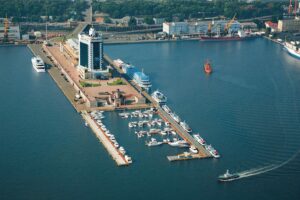
The difficult situation in the ports of Odessa and logistics problems are limiting activity in the oilseed sector in Ukraine, according to the information and analytical agency APK-Inform.
“Russian army missile attacks on Ukrainian ports, damage to terminals, warehouses, and other infrastructure will cause a reduction in shipments in the coming months and may destabilize the situation on the global agricultural market,” analysts explained.
They noted that last week, price growth on the Ukrainian soybean export market stalled, which was due to both missile attacks on ports and pressure from the global market, despite the fact that demand for Ukrainian soybeans remained quite high and export rates grew in the first half of December.
Experts added that demand prices for GM soybeans in Ukrainian ports remained at their highest levels since August 2024 – $420-425 per ton (CPT port).
“The European Union has finally postponed the implementation of the EUDR regulation for another year, which will allow companies to increase supplies of soybeans and soybean meal in this direction,” APK-Inform predicts.

According to Serbian Economist, Serbia’s commercial real estate market will develop around Belgrade and expressway and railway corridors over the next decade, with the most dynamic growth expected in the office and industrial-logistics segments, according to the analytical report “Serbia real estate & construction outlook 2025–2035.”
According to the document, by 2035, Belgrade’s high-quality office stock could increase to 1–1.2 million square meters. The main demand will be provided by IT companies, engineering centers, the financial sector, and international service centers, while in Novi Sad and Niš, more compact clusters of office space focused on technology and research are forming.
The report identifies industrial and logistics real estate as the fastest-growing segment. Experts predict that by 2035, the total volume of modern warehouse space in Serbia could double or triple, with key logistics hubs forming in the Belgrade–Pancevo–Simanovci, Novi Sad–Ruma–Inđija, Kragujevac–Kraljevo, and Niš–Leskovac, as well as along international corridors X and XI.
Individual industry reviews confirm the stability of the industrial segment: according to consulting company iO Partners, in the first quarter of 2025, there were more than 1.2 million square meters of Class A warehouse space on the Serbian market, with vacancy rates remaining at around 6.5% and base rental rates at €5 per sq m per month, indicating a balanced supply and demand structure.
The report identifies potential delays in infrastructure projects, high financing costs, and political cycles that could affect the timing of major development programs as risks for commercial real estate. As strategic recommendations, investors are advised to focus on energy-efficient offices and industrial parks linked to international transport corridors, while the authorities are advised to accelerate the harmonisation of building standards with EU requirements and the digitisation of procedures for commercial projects.



