

“Nibulon” Joint Venture LLC is preparing to begin work on its second humanitarian demining contract in Kharkiv Oblast, which involves clearing 64 hectares of agricultural land in the Izyum District, the company’s press service reported.
“The terrain is challenging, but we make timely decisions tailored to each specific challenge—to ensure effective work and achieve our main goal: that farmers in the Kharkiv region harvest grain, not the remnants of explosive ordnance,” the press service quoted Vsevolod Petrovsky, head of the “Demining” division, as saying.
According to the report, the work will be carried out under a subcontract on land owned by Landex-Agro LLC.
At the same time, Nibulon is completing its first government contract in the Kharkiv region, which it is carrying out jointly with Ukrainian Demining Services LLC. As part of this project, the company’s specialists have already surveyed more than 30 hectares of land across seven cadastral numbers on the territory of “Agrofirma Yug-M” LLC.
The work has passed an internal inspection and is currently undergoing an external audit conducted by the Mine Action Center of the Ministry of Defense of Ukraine, the statement said.
In addition, the company has completed a non-technical survey of 24 hectares of land in the Dnipropetrovsk region. The results have been validated by the Center for Mine Action in the IMSMA system.
The company noted that the development of its humanitarian demining operations is supported by DEG Impulse gGmbH, which has enabled it to strengthen its technical capabilities, particularly through the use of modern clearance equipment.
The statement noted that “Nibulon” has already completed its first commercial humanitarian demining contract in the Mykolaiv region. Since the start of operations, the company has returned more than 7,500 hectares of agricultural land to productive use and confirmed the certification of five mine action processes. Certification of three additional processes is currently underway.
As previously reported, in May 2025, Nibulon confirmed its certification in demining and expanded the list of mine action processes to eight areas.
Before the war, Nibulon LLC cultivated 82,000 hectares of land across 12 regions of Ukraine and exported agricultural products to more than 70 countries worldwide. In 2021, the grain trader exported 5.64 million metric tons of agricultural products—the highest volume in its history. After the war began, the company was forced to relocate its headquarters from Mykolaiv to Kyiv. In addition to 23 grain elevator complexes, “Nibulon” has its own trucking and rail transport capabilities, as well as a fleet built at its own shipyard. During wartime, this fleet continues to provide river transport services.
The company is also actively developing its own humanitarian demining division to restore safety on leased lands and assist Ukraine’s agricultural sector. Nibulon is a certified mine action operator.
DEG Impulse gGmbH is a nonprofit subsidiary of the German financial institution DEG that implements private-sector support programs funded by the German Federal Ministry for Economic Cooperation and Development (BMZ).

Nibulon Joint Venture LLC (Mykolaiv), one of Ukraine’s leading grain market operators, has sown about 20% of the planned acreage in each of its production clusters as part of the current spring planting campaign, the company’s press service reported.
According to the report, the agricultural holding is implementing an adaptive management model that involves moving away from standardized solutions in favor of regional planning based on weather and soil conditions. In particular, the start of work in the Cherkasy and Kamianets-Podilskyi clusters has been postponed until the soil warms up sufficiently.
Corn remains Nibulon’s key crop for the 2026 season, with approximately 28,500 hectares allocated for it. The company plans to complete corn planting within each division within 10–12 days. Soybeans will occupy nearly 3,000 hectares, with plantings concentrated primarily in the central and western regions.
The most significant changes have occurred in the crop structure of the Mykolaiv cluster. Due to the prolonged lack of rainfall and high climatic risks in the south, the company has completely abandoned spring crops in this region, relying exclusively on winter crops with a short growing season. This will allow for more efficient use of winter moisture and reduce dependence on spring and summer rainfall.
Before the war, Nibulon cultivated 82,000 hectares of land across 12 regions of Ukraine and exported agricultural products to over 70 countries worldwide. In 2021, the grain trader exported a record 5.64 million tons of agricultural products. After the war began, the company was forced to relocate its headquarters from Mykolaiv to Kyiv. In addition to 23 grain storage complexes, Nibulon has its own road and rail transport capabilities, as well as a fleet built at its own shipyard. During wartime, this fleet continues to carry out river transport operations.
The company is also actively developing its own humanitarian demining unit to restore safety on leased lands and assist Ukraine’s agricultural sector. Nibulon is a certified mine action operator.
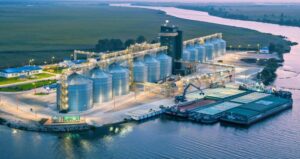
One of Ukraine’s largest grain market operators, Nibulon Joint Venture LLC (Mykolaiv), has expanded the scope of its river fleet cargo transportation on the Danube and opened a new logistics route involving Moldovan ports, the company announced on its Facebook page.
“After entering the markets of the Middle and Upper Danube in 2025, Nibulon opened a new route involving Moldovan ports. The first operation involved the implementation of a comprehensive logistics scheme: a voyage was completed along the route Izmail (Ukraine) – Galați (Romania), transporting 3,600 tons of metallurgical slag,” the statement noted.
According to the company, after unloading, the vessel proceeded to the port of Giurgiulești (Moldova), where it loaded 5,000 tons of rapeseed for further transport to Constanța, Romania. The total volume of cargo transported on the voyage exceeded 8,600 tons.
In addition, Nibulon implemented a two-way logistics scheme involving the delivery of grain from Izmail to Bulgarian ports, with a return load of mineral fertilizers in Serbia for transport to Moldova.
“This format allows us to minimize empty voyages and increase the efficiency of fleet utilization,” the company emphasized.
In total, by the end of 2025, Nibulon had transported over 110,000 tons of cargo via river transport. Its own fleet enables the agricultural holding to transport various types of goods, including agricultural products, fertilizers, slag, and metal, and to adapt routes to market needs.
Before the war, Nibulon cultivated 82,000 hectares of land across 12 regions of Ukraine and exported agricultural products to over 70 countries worldwide. In 2021, the grain trader exported a record 5.64 million tons of agricultural products. After the war began, the company was forced to relocate its headquarters from Mykolaiv to Kyiv. In addition to 23 grain storage complexes, Nibulon has its own road and rail transport capabilities, as well as a fleet built at its own shipyard. During wartime, this fleet continues to carry out river transport operations.
Nibulon is actively developing its own humanitarian demining unit to restore safety on leased lands and assist Ukraine’s agricultural sector. The company is a certified operator of mine action activities.

One of Ukraine’s largest grain market operators, Nibulon, has launched a new phase of its humanitarian demining initiative and signed an agreement with German organization DEG Impulse gGmbH for €7.8 million in funding, the company announced on Facebook.
According to the report, the funds under the develoPPP program will be used for maritime and inland water demining in southern Ukraine. The project involves the construction of a 90-meter marine platform equipped with modern unmanned underwater systems (ROV, AUV, and UUS) for clearing waterways at Nibulon’s own shipyard.
According to the company’s estimates, the implementation of the project will make it possible to clear more than 10 square kilometers of water areas in the Mykolaiv and Kherson regions and additionally clean up more than 13,600 hectares of agricultural land. This will allow more than 200 farms to resume safe operations and ensure an annual production of more than 70,000 tons of grain.
In addition, the initiative includes the creation of a technical service center, the deployment of a mobile rapid response infrastructure, and the training of more than 60 specialists (sappers, operators, and divers). The project’s coastal base will be certified according to IMAS international standards.
“This new stage not only strengthens our technical capabilities, but also demonstrates how Ukrainian business can take the lead in overcoming the consequences of war,” emphasized Oleksandra Dolzhenkova, Nibulon’s director of government relations.
As reported, Nibulon is actively developing its own humanitarian demining unit to restore security on leased land and assist Ukraine’s agricultural sector. The company is a certified mine action operator. In February 2026, Vsevolod Petrovsky, an expert on international missions in Somalia and Libya, headed Nibulon’s demining division.
Before the war, Nibulon cultivated 82,000 hectares of land in 12 regions of Ukraine and exported agricultural products to more than 70 countries around the world. In 2021, the grain trader exported a record 5.64 million tons of agricultural products. After the war began, the company was forced to move its central office from Mykolaiv to Kyiv. In addition to 23 elevator complexes, Nibulon has its own road and rail transport facilities, as well as a fleet built at its own shipyard. Even during wartime, this fleet continues to operate river transport on the Dnipro, Danube, and Southern Bug rivers.
One of Ukraine’s largest grain market operators, Nibulon LLC, recouped approximately $1 million in investments in a digital twin of elevators developed on the basis of the IT-Enterprise ERP system in less than a year by reducing the number of employees and grain losses.
“In conditions of staff shortages, the system allows us to reduce our dependence on manual labor… Previously, 80-100 people worked at one elevator, today there are about 20-30,” according to a joint press release issued by the companies on Monday.
It is noted that the implementation of the new system from IT-Enterprise has improved accounting accuracy and reduced grain losses by 1%.
“We have improved quantitative and qualitative accounting and automated every step of the process: the movement of grain from the moment it arrives at the elevator to shipment to the end consumer, including control of grain quality indicators and resources spent on its processing,” the release quotes Nibulon IT Director Mykola Ryasko as saying.
In addition, it was possible to ensure transparent access to grain quality parameters determined as a result of laboratory tests. In particular, the data is now available in a mobile application along with other operational information.
The agricultural holding specified that it integrated the digital twin of 23 elevators in 2024. “A digital twin is a digital copy of production that is updated in real time based on data from sensors and other sources. This allows you to effectively simulate elevator operating modes and manage all processes from anywhere in the world,” commented Oleg Shcherbatenko, CEO and founder of IT-Enterprise, on the project.
As previously reported by Andriy Vadatursky, owner and CEO of Nibulon, in 2024 the company invested $2 million in the digitization of production processes, which was directed towards the creation of a digital copy of the elevator and a mobile application. According to him, the software has been installed on all of the grain trader’s elevators and connected to a common network.
Before the war, Nibulon cultivated 82,000 hectares of land in 12 regions of Ukraine and exported agricultural products to more than 70 countries around the world. In 2021, the grain trader exported a record 5.64 million tons of agricultural products. After the war began, the company was forced to move its central office from Mykolaiv to Kyiv.
This year, Nibulon plans to increase grain exports to 4 million tons from 2.5 million tons last year, while its land bank has shrunk to 1,000 hectares and its workforce has fallen from 6,000 to less than 2,000.
One of the largest operators in the Ukrainian grain market, Nibulon LLC, invested $2 million in the digitization of production processes in 2024, which was directed toward the creation of a digital copy of the elevator and a mobile application, according to the company’s owner and CEO Andriy Vadatursky.
“We have about 100 people (working in the field of digitalization – IF-U). We recruited many of them from the market and provided them with work. We have detailed plans for the implementation of projects for three years. We know the detailed plan for the month, for the year, and we know the prospects for three years. We also plan to provide services specifically for the projects we are doing for Nibulon. We believe that if it is necessary for Nibulon, then it will also be necessary for the market,” he said at the Forbes Agro conference in Kyiv last Friday.
Among the main projects in which funds were invested, Vadatursky named a digital copy of the elevator, in particular, the purchase and installation of modern equipment that determines the quality of grain. The software is installed at all of the grain trader’s elevators and is connected to a common network. Thanks to this, responsibility at the elevators has been strengthened, the quality of raw materials is clearly determined, the influence of the human factor has been minimized, and reporting has been streamlined.
In addition, Nibulon has developed a mobile application—a company account where you can receive news, prices, information about the location of transport, the quality of grain in it, funds received, discounts, bonuses, etc.
According to Vadatursky, this application will be refined and transformed into an information platform in the near future.
Before the war, Nibulon cultivated 82,000 hectares of land in 12 regions of Ukraine and exported agricultural products to more than 70 countries around the world. In 2021, the grain trader exported a record 5.64 million tons of agricultural products and delivered record volumes to foreign markets in August (0.7 million tons), in the fourth quarter (1.88 million tons), and in the second half of the year (3.71 million tons).
After the war began, the company was forced to move its headquarters from Mykolaiv to Kyiv.



