
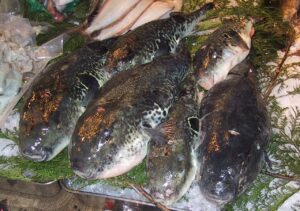
According to Serbian Economist, the silver-striped pufferfish Lagocephalus sceleratus, known as the fugu and considered one of the most dangerous invasive species in the Mediterranean, is being spotted with increasing frequency in the waters of Montenegro, reports the Institute of Marine Biology at the University of Montenegro.
Alexander Joksimović, a scientific advisor at the Institute of Marine Biology, stated that these are no longer isolated findings. According to him, this species has been present off the coast of Montenegro for nearly ten years and has already established a stable population in the Adriatic Sea.
Recently, a pufferfish was found again off the coast of Budva: the fish got caught in a fishing net. Experts are warning fishermen and tourists that this fish is not safe to eat and that they should not attempt to clean or prepare it themselves.
The main danger is associated with tetrodotoxin—a potent neurotoxin that may be present in the organs, skin, and tissues of this fish. Studies on the species Lagocephalus sceleratus in the Adriatic confirm the presence of tetrodotoxin, and this toxin is dangerous to humans if the fish is consumed.
Experts emphasize that heat treatment does not make this fish safe. Therefore, the main practical advice for fishermen and vacationers is not to consume any fish they find, not to sell it, and to report any findings to the relevant authorities or the Institute of Marine Biology.
The spread of pufferfish in the Adriatic is linked to warming sea temperatures and changes in the Mediterranean ecosystem. The species originates from the Indo-Pacific region and is spreading into the Mediterranean as an invasive species, including via the Suez Canal. In 2025, scientists also reported finding this fish off the coast of Croatia, marking one of the northernmost confirmations of its presence in the Mediterranean.
For Montenegro, the emergence of a stable pufferfish population has not only ecological but also economic significance. The fish can harm local fisheries, get caught in nets, damage the catch, and pose additional risks to coastal tourist regions. Budva, the Bay of Kotor, Bar, and other areas where fishing and tourism are closely linked to the marine ecosystem may be particularly vulnerable.



