
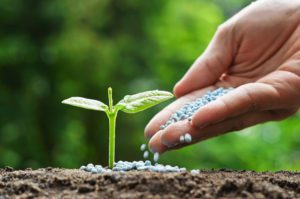
The Ukrainian Chemists Union considers it necessary to introduce quotas for imports of fertilizers, which will make it impossible for Russian manufacturers to bypass trade restrictions and load Ukrainian plants at full capacity.
“We propose the introduction of quotas for complex and nitrogen fertilizers for all countries in order to preserve the historical balance of imports. Each country will supply its products to the extent it has historically supplied, this will make impossible for Russian manufacturers to bypass trade restrictions and load the plants at full capacity,” Ihor Holchenko, the vice president of the union and the director for regulatory policy of Group DF, told Interfax-Ukraine.
According to him, this protective mechanism is applied in the countries where there is a threat of damage from growing imports. The introduction of quotas will be preceded by an investigation by the Ministry of Economic Development and Trade. According to Holchenko, quoting will give a clear picture of how much to produce, while regulators will monitor abuse.
The expert said there is no shortage of nitrogen and complex fertilizers in the Ukrainian market: the country provides itself with nitrogen fertilizers, and it can cover 800,000 tonnes that were supplied from the Russian Federation by increasing domestic production.
As for nitrogen fertilizers, Ukrainian enterprises are not loaded at full capacity, as well as for complex ones, where the load is up to 12%. Complex fertilizers in Ukraine are produced by Sumykhimprom and Dniprovsky Plant of Mineral Fertilizers. Ukraine can produce 700,000 tonnes of complex fertilizers, but in 2018 it produced only about 40,000 tonnes.
Ukraine in 2018 used 11 out of the 40 quotas for duty-free exports under the free trade area (FTA) agreement with the European Union, while export quotas for processed products from oil, sugar syrups, and an additional quota for exports of mushrooms were not used at all, according to the Ministry of Economic Development and Trade.
Ukraine has not yet received permission to export red meat, therefore its companies also did not use the quota for pork, lamb, and beef. The remaining quotas were used partially, the ministry said.
In 2018, the country fully used quotas for exports of corn, honey, corn flour and granules, grape and apple juice, processed tomatoes, processed malt and starch, soft wheat, wheat flour and granules, barley grits and starch flour, and the major quota for exports of poultry and semi-finished products from it.
In 2018, the main quota for exports of mushrooms was used by 0.03%, the quota for exports of cigarettes by 0.01%, food products by 0.9%, processed products from dairy cream by 4.2%, ethanol by 10.4%, processed products from sugar by 13.9%, milk, yoghurt and cream by 15%, barley by 16.6%, dairy products by 22.1%, milk powder by 24.1%, and oats by 36.5%.
In addition, Ukraine has used the basic quota for exports of eggs by 74.6%, and an additional one by 48.3%.
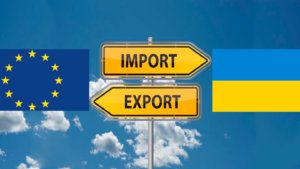
Ukraine as of November 26, 2018 fully used 10 quotas for duty free exports of food under a Free Trade Area (FTA) agreement with the European Union (EU), particular, quotas for honey, cereals, malt and wheat gluten, preserved tomatoes, grape and apple juices, wheat and corn, butter and poultry.
According to a posting on the website of the Ukrainian Agribusiness Club (UCAB), Ukraine also almost fully used quotas for starch (95%) and garlic (96%).
The UCAB reminded that from October 1, 2018 the second year of additional quotas for five groups of goods began, and two groups have been already closed (honey and preserved tomatoes).
“Before the end of the year, additional quotas for grain will be in effect, of which the volume for wheat and corn has already been used, and only 23% is used for barley,” the UCAB said.
As reported, in January-October 2018, exports of agricultural products from Ukraine amounted to $14.8 billion, which is $165 million more than a year earlier.
In addition to quotas for Ukraine, quotas on duty free import of goods from EU countries to Ukraine are still in effect. These include quotas for the following groups of goods – sugar, poultry meat (primary and secondary quotas) and pork (primary and secondary quotas).
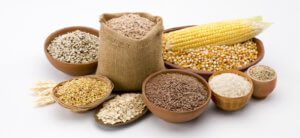
Ukraine as of April 17, 2018 fully used six quotas for duty free exports of goods under the agreement on the Deep and Comprehensive Free Trade Area with the EU (DCFTA), in particular for honey, malt and wheat gluten, preserved tomatoes, grape and apple juices, as well as wheat and corn. According to a report on the website of the Ukrainian Agribusiness Club (UCAB), Ukraine also used the second quarterly quota for export of poultry and the six month quota for butter. The quotas for cereals and flour have been used by 95%.
“This year there was a revival in the pace of using the quotas: as of the same date in 2017, the volume of wheat had not yet been used, and the quota for malt and wheat gluten had not been used in the past year. The fact that along with six key quotas four more are closed indicates the intensification of trade relations with the EU,” an analyst of the foreign trade in agricultural products of the UCAB, Daria Hrytsenko, said.
According to the results in January-February of this year, agri-food exports from Ukraine to the EU increased 28.1%, or $224.7 million compared to the same period last year, and reached $1.025 billion, according to the Ministry of Agrarian Policy and Food.



