
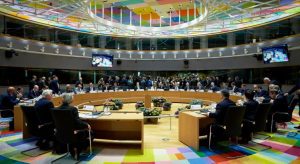
The EU Council decided to extend for another year, until March 6, 2022, sanctions in the form of freezing assets for seven persons identified as responsible for the misappropriation of Ukrainian state funds.
The corresponding decision was published on Thursday. “The Council today decided to prolong for one more year, until March 6, 2022, the existing asset freezes directed against seven individuals identified as responsible for the misappropriation of Ukrainian state funds or for the abuse of office causing a loss to Ukrainian public funds. The restrictive measures against one person were prolonged until September 6, 2021, and those against two persons were not extended,” the statement said.
The EU Council noted that this decision was taken on the basis of the annual review of the measures, with the subsequent publication in the Official Journal on March 5, 2021.
The names of those, in respect of which the sanctions were not extended, were not indicated. Initially, there were 18 people in the sanction list.
President of Ukraine Volodymyr Zelensky has introduced into action the decisions of the National Security and Defense Council of Ukraine, by which Ukraine joined the sanctions imposed by the UN Security Council against the Republic of Mali and the Republic of Yemen.
The decision provides for the application of sanctions against individuals. The Cabinet of Ministers and the Security Service of Ukraine are instructed to ensure the implementation and monitoring of the effectiveness of the sanctions, the Ministry of Foreign Affairs is to inform the UN Security Council and the competent authorities of the European Union, the website of the President of Ukraine reported on Saturday.
A personal list of persons against whom sanctions have been imposed is contained in the order of the Cabinet of Ministers dated January 20, 2021.

Citizen of China Wang Jing and affiliated Beijing Xinwei Technology Group Co., Ltd; Beijing Skyrizon Aviation Industry Investment Co., Ltd (both based in Beijing); Skyrizon Aircraft Holdings Limited (the British Virgin Islands) and Hong Kong Skyrizon Holdings Limited (Hong Kong), which have been trying in recent years to realize the rights of PJSC Motor Sich shareholders in Ukraine, have been included in the sanctions list of Ukraine.
According to the decision of the National Security and Defense Council (NSDC) and the decree of President of Ukraine Volodymyr Zelensky dated January 28 (No. 29), the sanctions imposed on them for three years provide, in particular, the blocking of assets, restriction of trade operations, partial or complete cessation of transit of resources, flights and transportation on the territory of Ukraine.
Other restrictions include preventing the withdrawal of capital from Ukraine, a complete ban on transactions with securities of which they are issuers, and a ban on the purchase of enterprises in Ukraine.
The list of sanctions also includes a ban on increasing the size of the charter capital of business entities in which the persons under sanctions own 10% or more, and the cancellation of official visits, meetings, negotiations on signing contracts or agreements.

Ukraine and ten other countries have joined the EU sanctions against the terrorist organizations ISIS and Al-Qaeda, as well as individuals, groups, enterprises and organizations associated with them, the European Council said.
“The Candidate Countries the Republic of North Macedonia, Montenegro, Serbia and Albania2, the country of the Stabilisation and Association Process and potential candidate Bosnia and Herzegovina, and the EFTA countries Iceland and Liechtenstein, members of the European Economic Area, as well as Ukraine, the Republic of Moldova, Armenia and Georgia align themselves with this Council Decision,” the European Council said on its website on Thursday.
It is noted that these countries will ensure that their national policies conform to these Council Decisions.
“The European Union takes note of this commitment and welcomes it,” the message reads.
On 19 October 2020, the Council adopted Decision (CFSP) 2020/15161. The Council Decision extends the existing restrictive measures until 31 October 2021.

The enhanced sanctions of the Russian Federation against Ukrainian goods will affect 1.3% of current exports of Ukrainian goods for January-September 2019, which in monetary terms is $31.2 million, and about 0.4% of current imports of Russian goods to Ukraine for the specified period, or $21.4 million, a source at the Ministry of Economic Development, Trade and Agriculture has told Interfax.
The largest restrictions regarding the ban on imports to Ukraine relate to the following items: boilers for central heating for $8.7 million, parts of pumps for $3.6 million, radiators for central heating with non-electric heating for $2.8 million.
The source noted that a significant part of goods that fell under the sanctions is industrial medical goods: plastic products for $6.5 million, pipes, tubes, hoses for $4.5 million, hygienic or pharmaceutical products from vulcanized rubber for $1.4 million, other products made of vulcanized rubber, except for hard, for $3.7 million.
At the same time, the ban on import to Ukraine of Russian paper and cardboard for recycling in monetary terms is estimated at $21.4 million. According to data of the State Statistics Service for the nine months of 2019, the volume of the Russian Federation in the total import of this item is 52.6%.
As for the supply of starch, in January-September 2019 this product was not exported to the Russian Federation.
“At the same time, there is a tendency to increase the use of EU tariff quotas for starch with a volume of 10,000 tonnes compared to 2016. During 2017-2019, the quota is used almost in full,” the source said.
The government of the Russian Federation by the resolution of December 16, 2019 expanded the list of goods prohibited for imports to Ukraine, supplementing it with the position “paper and cardboard for recycling.” In addition, the list of goods originating in Ukraine, which are forbidden for imports to the Russian Federation, was expanded.



